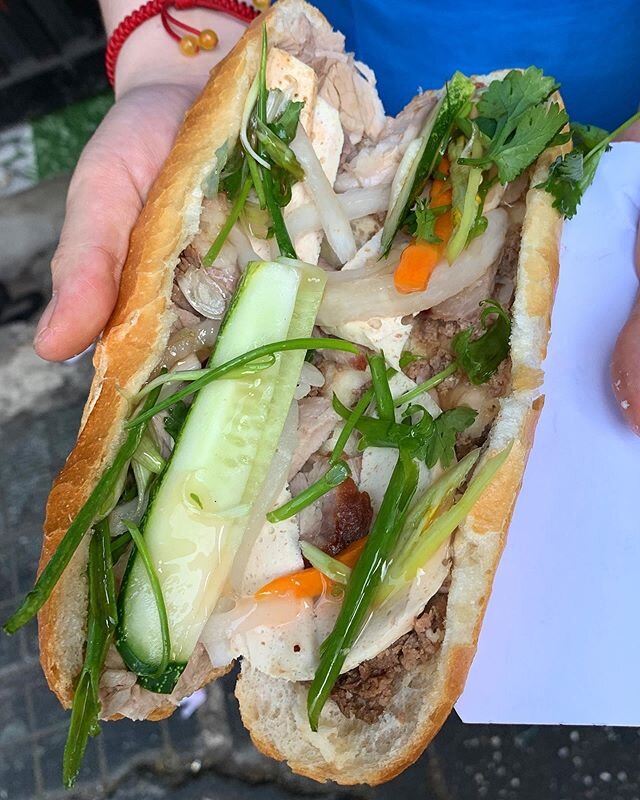
Crystal Jade La Mian Xiao Long Bao

Along with having one of the longest restaurant names in Bangkok, Crystal Jade La Mian Xiao Long Bao must also serve some of the city's best Chinese food. The restaurant is one of a Singapore-based franchise that has branches all over Asia. Bangkok's branch opened about a year ago, and always seems to be packed during lunch time. It was my turn to impress Aong with my restaurant choice prowess, and I thought this place, with its excellent and authentic Chinese noodles, would do the trick.

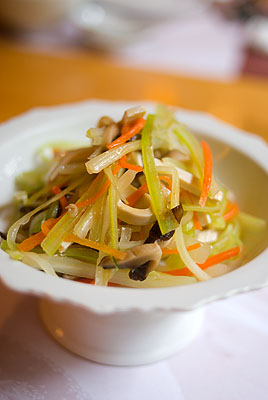
We began with Shredded celery with dried beancurd and sesame oil:
_DSC0929.jpg

The dish was served chilled, and was flavoured with little more than sesame oil and perhaps a drop or two of soy sauce. The celery and carrot carried this subtle flavour, and also provided the dish with a deliciously crunchy element.

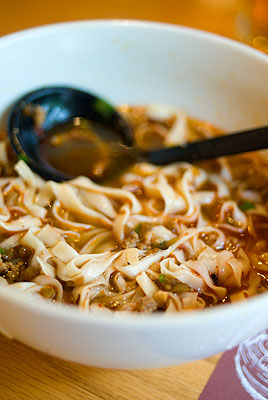
But this was just a starter, and the real reason people come here is for la mian, fresh, hand-pulled noodles:
_DSC0935.jpg

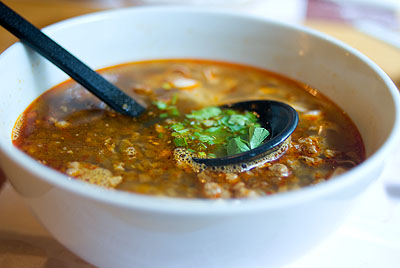
We split a huge bowl of Hot and spicy 'La Mian' with Sichuan preserved vegetable and minced pork. The noodles come to the table coated with a layer of oily broth redolent of Szechuan pepper and cumin:
_DSC0933.jpg

Immediately after receiving your bowl, you'll be approached by an employee wielding a pair of kitchen shears who will ask if you want your noodles cut. I would recommend this, as the noodles are very long, and otherwise you'll end up getting most of the oily broth on your shirt. The noodles, no doubt made minutes earlier (you can see the noodle pullers at work behind the counter) taste fresh and soft, and are surprisingly light. The broth is spicy, sour (from the pickled veggies) and salty.

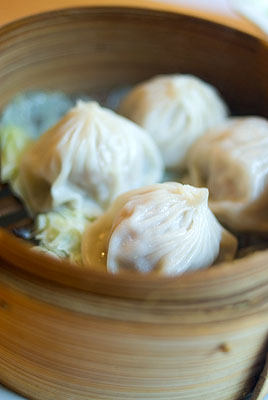
These were followed by the restaurant's other namesake, Xiao long bao, steamed, broth-filled pork dumplings:
_DSC0936.jpg

which Aong and I agreed were average at best. The wrappers were thin and tore easily, making it a messy and difficult dish to eat, and the pork filling seemed disproportionately large.

The only possible complaint I have would be that much of this is cold weather food, and this being Bangkok, it wouldn't hurt the restaurant to turn up the air conditioning a few notches just for atmosphere!

Crystal Jade La Mian Xiao Long Bao
Urban Kitchen (located in the basement of the Erawan Bangkok)
494 Thanon Phloen Chit (Phloen Chit BTS station)
02 250 7990
Kuaytiao Naam Ngiao

_DSC0927.jpg

There are many dishes of Chinese origin in Thailand, as well as a great deal of food using Chinese ingredients, but Chinese food as the Chinese eat it in China is quite rare. Thus my ears perked up when my trusty partner in food, Aong, mentioned that she knew a good Yunanaese restaurant.

In reality, Kuaytiao Naam Ngiaow is something of a hodge-podge of Chinese cuisines, ranging from Taiwanese to Szechuanese, but the most interesting dishes are those of Yunanese origin. The owner comes from the Yunanese community of Doi Mae Salong in remote Chiang Rai Province, a town known for the noodle dish that serves as the restaurant's namesake. Like the food, the restaurant's clientèle was authentically Chinese, and the menu items were written on the wall in Chinese characters.

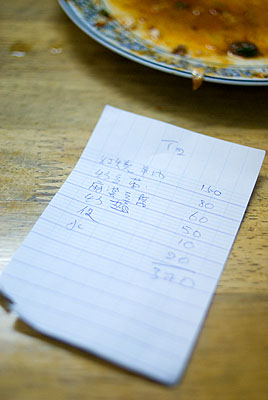
Before we even had a chance to sit Aong had already ordered mii phat, fried noodles:

_DSC0912.jpg

This was the first dish that arrived, and upon tasting it, I knew that this restaurant was going to be special. The noodles had a deliciously smoky wok hei and lacked the oiliness of lesser fried noodle dishes.

I like green things that are fried with salty things so I ordered a dish of yot thua lantao, pea greens, fried with oyster sauce:

_DSC0916.jpg

The greens were fried the way the Chinese do so well; cooked but not soggy or wilted. Tons of garlic and dried chilies didn't hurt either. At this point, things were going very well.

Things got even better when we received my favourite dish of the meal: Szechuan-style tofu:

_DSC0919.jpg

A variant of this dish, tao huu son khrueng, is quite popular in Thailand, but doesn't come close to this version, which was strong with the numbing/hot flavour of Szechuan pepper.

And last but not least, we ordered nuea phae naam daeng, goat in red sauce:

_DSC0924.jpg

A stew-like concoction served over a layer of steamed bok choy. I liked this one a lot as it reminded me of a very similar oxtail dish I had once eaten in Macau. The broth was thick and tasty, and loaded with red wolfberries, which a Chinese chemist once told me are good for the eyes.

Well done, Aong.

Kuaytiao Naam Ngiao
466 Soi 20 Mithuna, Thanon Pracharatbamphen
(The easiest way to reach the restaurant is, beginning from Huay Khwang MRT station, take exit #1 for Pracharatbamphen Road. Get in a taxi and immediately turn left into the aforementioned street. Continue until you reach an intersection where you're forced to turn right or left; turn left and the restaurant, identified by Chinese letters, is about 500 m up on your left side.)
02 690 3174
Mae Sot

_DSC0683.jpg

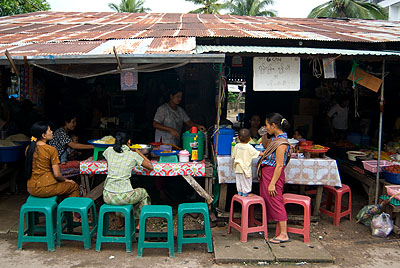
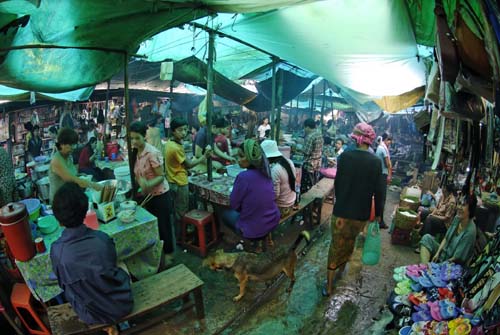
On the surface, Mae Sot is one of the least likely food destinations in Thailand. However those in search of something unusual will certainly be rewarded, as because of its location near the border with Myanmar (Burma), Mae Sot is in many ways more Burmese than Thai. This has led to a variety of dishes and ingredients that are rarely seen elsewhere in Thailand. This is especially evident in the town's morning market (pictured above), where I began my day with a breakfast of mohinga:

_DSC0645.jpg

the famous Burmese noodle soup, which in Mae Sot is sold from several basic restaurants near the market:

_DSC0679.jpg

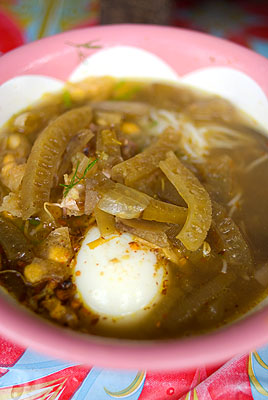
The mohinga was OK, not nearly as good as some I've had in Yangon, but considering this is one of the few places in Thailand where one can get the dish, I was happy. The strips you see in the top of the soup are yuak kluay, the inner pity stem of the banana tree, an essential ingredient in mohinga. Upon ordering the dish, the vendor also crumbles a deep-fried lentil cracker into the soup.

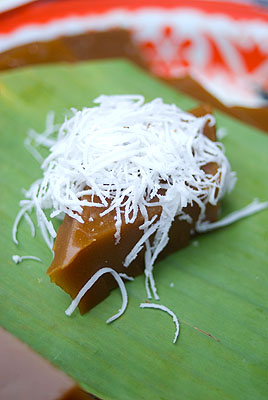
Other interesting things to eat at the morning market included this delicious Burmese sugar cane sweet:

_DSC0633.jpg

another rarity in Thailand, samosas:

_DSC0653.jpg

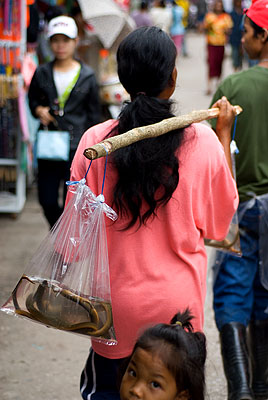
and fresh eels:

_DSC0686.jpg

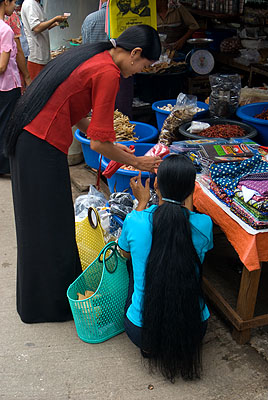
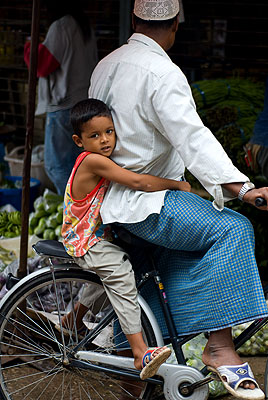
There were also some interesting things to see, such as the Burmese shoppers and shopkeepers themselves:

_DSC0676.jpg

_DSC0685.jpg

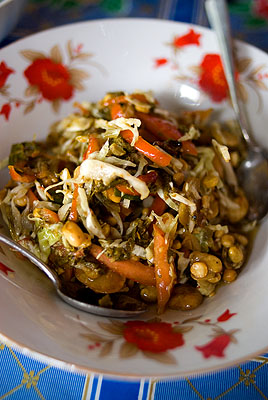
After exploring the market, we stopped by Wat Chumphon Khiri where we had a snack of lephet thoke:

_DSC0694.jpg

the Burmese dish of pickled tea leaves mixed with deep-fried nuts, tomatoes, shredded cabbage, lime juice, sesame oil and garlic. There were lots of other Burmese dishes for sale at the grounds of this temple.

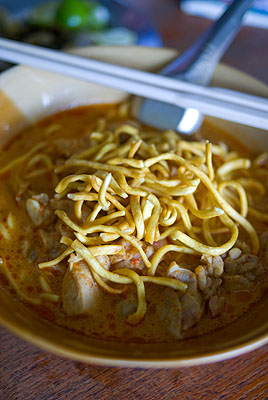
Lunch was another dish of probable Burmese origin, khao soi:

_DSC0688.jpg

Made here by Muslims, an ethnic group that is quite evident in Mae Sot. The khao soi was average; undoubtedly better is hkauk hswe, the Burmese predecessor to khao soi that is sold at the same shops that sell mohinga.

So if you're looking for an exotic market and even more exotic food, I'd highly recommend Mae Sot.

Foon Talop

_DSC0515.jpg

Ahaan isaan, northeastern Thai-style food, is available virtually everywhere in Bangkok. In fact, I'll bet there's more isaan food in Bangkok than in isaan! The vast majority of this food is cheap and informal, and is sold primarily to homesick working class immigrants. However, there is also a great deal of isaan food that is directed towards middle class Bangkok diners. Although this kind of food may not always be as "authentic," it's often much cleaner and more accessible.

Foon Talop, a wildly popular restaurant located in the Chatuchak Weekend Market is an example of the latter. The restaurant is as interesting in terms of its atmosphere as its food, with diners seemingly stuffed into every tight corner and waiters and som tam pounders screaming orders at each other:

_DSC0510.jpg

Since it is isaan, of course you've got to order som tam:

_DSC0522.jpg

which, although it's made en masse in two gigantic mortar and pestles, is quite decent. We ordered som tam thai, som tam with bottled fish sauce, peanuts and dried shrimp. As with every restaurant serving this dish, it is made to order, and I ordered mine "phet priaow," spicy and sour.

Another isaan standby is nam tok muu:

_DSC0531.jpg

This is strips of grilled pork made into a "salad" along with roasted sticky rice, lime, fish sauce, mint leaves and shallots. Nam tok literally means "waterfall," and refers to the fact that traditionally the drippings of the grilled meat are collected and added to the dish. I'm not sure if that's the case here though.

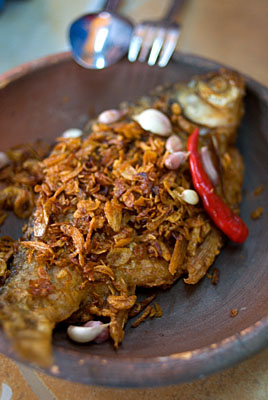
These dishes are good, but I like Foon Talop for its slightly more unusual items, such as plaa som (pictured at the top of this post), a freshwater fish that has been stuffed with sticky rice and allowed to sour. The fish is then battered and deep-fried and served with heaps of crispy fried garlic. Absolutely delicious, except for the tiny bones that are almost impossible to avoid.

Another interesting dish is kuay jap yuan, literally, "Vietnamese noodle soup":

_DSC0526.jpg

A delicious pork broth containing thick round rice noodles, chunks of the Vietnamese sausage known in Thai as muu yor, strips of chicken, and topped with crispy fried shallots. Simple but good.

Foon Talop
Chatuchak Weekend Market (the restaurant is located along the outside edge of Section 24, on the Kamphaeng Phet II Road side.)

Maan Mueng

_DSC8029.jpg

Much like Mexican, authentic northern-style Thai food can be very, very hard to find in Bangkok. A few mediocre dishes are sold at my neighborhood's Tuesday market, and good khao soi is available if you're willing to make the trek out to Viphavadee in northern Bangkok, but in general you're hard pressed to find a tasty kaeng hangle or a pleasant kaeng ho. This is a pity, as when done well, northern Thai food can be among the best in the country. It is markedly more seasonal than other Thai cuisines, featuring the odd mushroom, green or fruit that is only available at certain times of the year, makes great use of a wide variety of indigenous veggies, and is porky, porky and porky. Which, I am told, is a good thing.

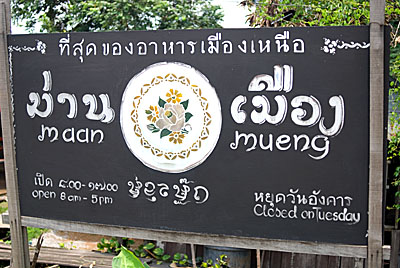
So thanks to the keen nose of my food friend Aong, I was recently directed towards Maan Mueng, a restaurant in Bangkok specializing in the dishes of the north. Maan Mueng features a huge array of authenticly prepared dishes:

_DSC8031.jpg

so even those who can't speak Thai or aren't familiar with northern Thai food can simply point to whatever looks good. And damn, does it look good. Witness:

Nam phrik khaa:

_DSC0482.jpg

A nam phrik or "dip" of chilies and galangal that is typically served with steamed mushrooms (now is mushroom season up north) and beef that is boiled before being steamed over fresh herbs. Thanks to the copious galangal, known in Thai as khaa, this nam phrik has a truly unique flavour, and the beef was, unlike most Thai beef, tender and very edible.

Tam khanun:

_DSC0485.jpg

This is a thick "mash" of young jackfruit and a chili paste topped with crispy fried garlic. Simple but delicious.

Sai ua:

_DSC0493.jpg

The famous northern-style sausage that is loaded with heaps of fresh herbs (lime leaf, lemongrass, garlic, etc.) and grilled. Spot on.

Nam phrik num:

_DSC0488.jpg

Another "dip", this time of grilled chilies mashed up with grilled garlic, shallots and fish sauce, and served with pork rinds and fresh and par-boiled veggies for dipping.

Laap khua:

_DSC0487.jpg

This is laap that has been fried with a chili paste mixture that includes the herb makhwaen, which provides the dish a distinct bitter/hot flavour. The meat includes lots of offal (the heart fans out there will love laap khua), and includes the ubiquitous but delicious crispy garlic topping.

Naem:

_DSC0496.jpg

Raw pork that has been buried for three days until sour. Much better than it sounds.

Here's the spread:

_DSC0499.jpg

Note the pile of greens on the left-hand side; Maan Mueng features an entire table stacked with fresh herbs and greens for its customers. And dishes are accompanied by perfectly-steamed red sticky rice.

Our meal ended with coconut ice cream:

_DSC0500.jpg

a dish available just about anywhere in Thailand, but I'm sure this is among the best I've ever had the pleasure to enjoy. The ice cream was incredibly creamy and light in texture, and was suggestive of the soft meat of young coconuts rather than the cloying coconut milk that is typically used.

Maan Mueng is located quite far from the center of Bangkok, but is in all regards considerably easier than going to Chiang Mai or Mae Hong Son.

Maan Mueng
Located between Ramkhamhaeng 152-154
8am-5pm (closed Tuesday)
02 728 0945

DxO Optics Pro

I've been having heaps of fun with my new toy, Nikon's AF Fisheye Nikkor 10.5mm f/2.8G ED-IF DX. I was even more excited when I came across this article at Ken Rockwell's site about DxO Optics Pro, a program that allows you to correct the distortion associated with such wide lenses. I downloaded the free sample and have been playing around with some of the images I took in Cambodia.

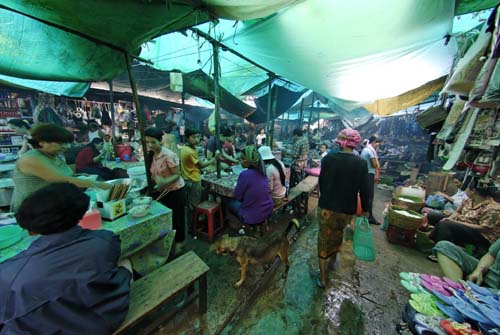
Here's an pic from a market in Kampot, southern Cambodia, without any distortion correction:

before.jpg

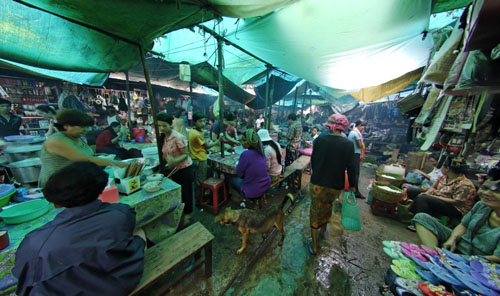
Here's the same image after DxO Optics Pro's one button distortion correction:

wide.jpg

And even cooler, if in Expert settings mode, you click on Max image, you get an even wider image:

ultra wide.jpg

I'm pretty sure I'll end up buying this, especially if they add settings for my 18-35 f/3.5-4.5 D.

Rice and pork

_DSC9442.jpg

After all these years in Thailand I've still never really taken to the Thai breakfast. Jok, pureed rice soup, is about as delicious as the description sounds. Paa thong ko, deep-fried bits of dough typically dipped into crap coffee is a nightmare waiting to happen. And at home Thais generally tend to eat the previous night's leftovers with rice. So when traveling to other countries in SE Asia I always keep an eye open for interesting breakfasts, and invariably I'm impressed: crispy roti and sweet teh tarik in Malaysia and Singapore; a steaming bowl of mohinga (a fish-based noodle soup) in Myanmar; and in Cambodia, rice and pork.

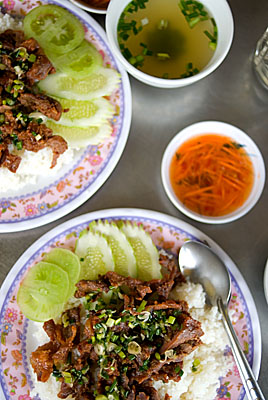
Known in Khmer as bai sach chrouk (literally "rice pork"), this dish is more or less as simple as the name sounds, but is much more delicious. There are two divergent schools of bai sach chrouk. Proper restaurants, invariably Chinese in origin, tend to deep fry their pork and serve it with sides of a porky broth and a sauce similar to a sweet Vietnamese dipping sauce (illustrated above). Preferable, in my opinion at least, are the more "Cambodian" places where after being marinated in soy sauce and palm sugar (and apparently sometimes garlic and coconut milk), the thin slices of pork are grilled over coals:

_DSC8565.jpg

The result is sweeter and smokier than the deep-fried version. This kind of bai sach chrouk tends also to be served with a small dish of lightly pickled veggies, and is generally served outdoors, at makeshift stalls.

Regardless of the ethnicity of the vendor, all bai sach chrouk is served topped with heaps of chopped green onion, and is served over broken rice that, if you're lucky, has been cooked in broth, as shown in this pic:

_DSC0181.jpg

For a more detailed take on the dish, proceed to Phnomenon.

Iea Sae

_DSC0358.jpg

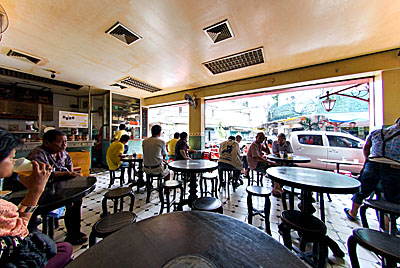
Iea Sae is the unpronounceable name of an old-skool Chinese-style coffee shop in Bangkok's Chinatown. There are quite a few cafes like this in southern Thailand, and heaps in Malaysia, but very, very few in Bangkok, which makes this place somewhat special.

_DSC0369.jpg

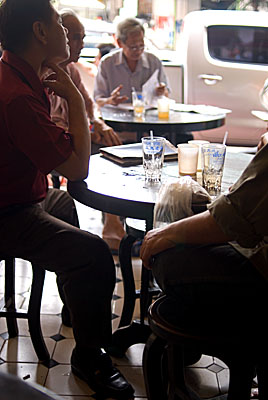
If you're coming here for good coffee, you're going to be sorely disappointed, but if you get a buzz from atmosphere, it can be a fun place. The shop is 60 years old (a fact written on nearly every dish and cup in the restaurant) and is outfitted with antique tables, an old tile floor, and some interesting murals on the walls. These furnishings could be purchased just about anywhere, but the thing that makes Iea Sae interesting is its patrons. The old Chinese-Thai men who frequent the cafe order a single cup of coffee and spend the next three hours doing their best to drink it as slowly as possible while arguing about politics, discussing food, smoking, and in the true Chinese tradition, carrying on with lots of hawking and spitting.
_DSC0361.jpg

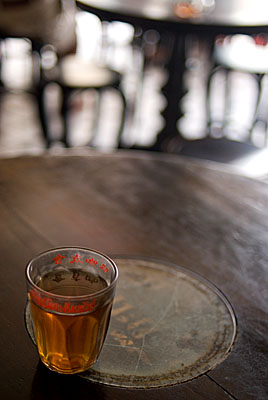
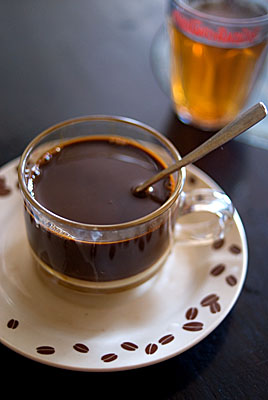
As far as I can see, they just serve coffee (some food items are written on a chalkboard, but they never seem available), and in the Chinese-Thai style, a cup or glass is always followed by a chaser of weak Chinese tea:

_DSC0359.jpg

Iea Sae
Thanon Phat Sai (This street runs parallel to Thanon Yaowarat, Chinatown's main road, and is most easily reached via Thanon Phadung Dao. Iea Sae is located smack in the middle of the short street; simply look for lots of old men drinking coffee.)
02 221 0549

Sunrise Tacos

_DSC0327.jpg

Mexican is a cuisine that one is pretty hard-pressed to find in Bangkok. Thus there was something of a buzz in Bangkok (OK, essentially an email from a friend) when a new taco shop opened off of Sukhumvit.

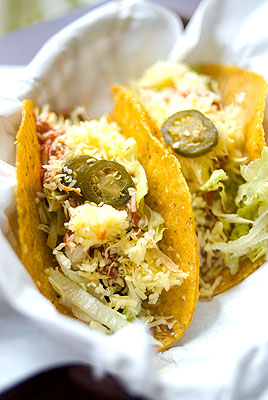
Compelled to investigate, I ordered three soft tacos (pictured above), which in the Mexican style, are served open-faced and topped with your choice of meat: chicken, seasoned ground beef, carnitas, carne asada and barbacoa beef. I went with carnitas and carne asada and found them both to be pretty good. The corn tortillas weren't bad either, but the entire taco package was brought down by shoddy toppings (shredded iceberg lettuce, tinned jalapeños and "cheese") and a sweet, slightly artificial tasting salsa ("John's Red Hot Salsa"). Inexcusable really, considering that most the requisite taco ingredients, including some of those lacking at Sunshine (cilantro, lime, onions) are available fresh here in Bangkok.

Burritos and chips and salsa/guacamole are also available, as well as a couple plate dishes. Sunrise Tacos is a located a short walk from Asoke BTS station and is open 24 hours.

For obsessively in-depth insight into the Los Angeles taco scene, including images of real tacos, visit The Great Taco Hunt.

Sunrise Tacos
No. 236/3-4 Sukhumvit
02 229 4851

Let's get this party started.

_DSC0006.jpg

I've returned from Cambodia and will soon be posting some bits and pieces from my adventures there, as well as finally getting back to some good old fashioned Thai food blogging.

Tuesday market

_DSC8036.jpg

Every Saturday my neighborhood plays host to a gigantic talaat nat, or weekend market. I love this market and always look forward to it. Ironically, I always tend to forget that we also have a much smaller market every Tuesday afternoon. It's probably only 1/4 the size of the Saturday market, but there's still some interesting stuff, including fruit:

_DSC8046.jpg

deep-fried fish:

_DSC8048.jpg

and Thai sweets:

_DSC8042.jpg

This girl was helping her dad sell crabs:

_DSC8040.jpg

This stall sells northern Thai dishes:

_DSC8053.jpg

Not the best, but good when you need a northern Thai fix. Much better were the southern Thai hor mok yaang, grilled curries:

_DSC8055.jpg

They're sold topped with crab meat, shrimp, fish or horseshoe crab eggs. A crab and a shrimp and a plate of rice formed my dinner.

I'm off to Cambodia tomorrow for a week where I'll be working with Phil of Phenomenon on some articles. I won't be posting, but you can expect some follow up posts here after I get back.

A work in progress

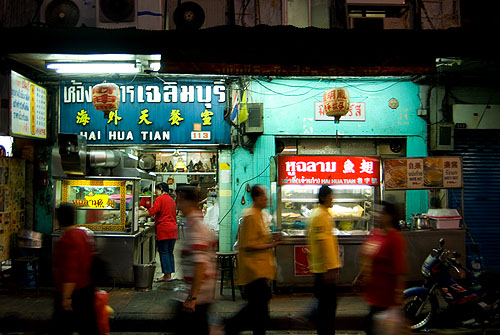
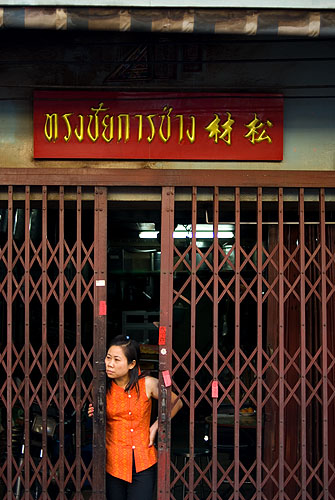
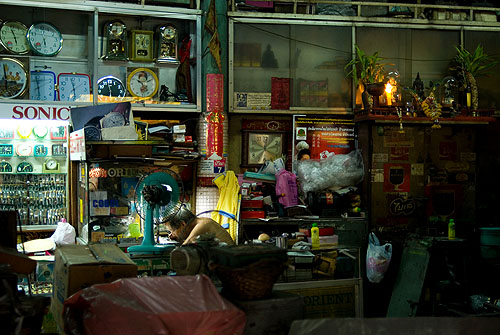
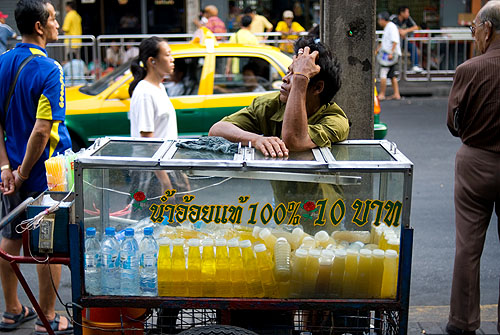
I have plans to do an exhibition at Kathmandu, the photography gallery of famed Thai photographer, Manit Sriwanichpoom. I've been photographing Chinatown a lot lately and took some of my images to Manit before I went abroad. He saw some potential in the pics I brought by, and in particular liked the following shots:

_DSC8844.jpg

_DSC8740.jpg

_DSC1355.jpg

_DSC1351.jpg

_DSC0629.jpg

2006-08-07_BKK_Th041.jpg

I also like these shots, so it's good to know Manit and I are on the same page. My only problem is that I don't really have a "concept" yet. I've just been walking around shooting whatever looks interesting. Also, I've been traveling so much lately that I haven't had time to go back and take more shots. Fortunately I have time--Kathmandu is booked up until the end of the year. So I get back from Cambodia, where I'm going tomorrow, I'm going make a point of going back to Chinatown on a regular basis and will to sure to share my progress here.

Dinner at the market

_DSC6980.jpg

Kota Kinabulu's evening market, besides having some great raw ingredients, also had some wonderful prepared food. In particular there was an entire section dedicated to grilled seafood. Choosing from shrimp, lobster, several kinds of fish and crabs, I had a grilled mackerel/tuna tail and a grilled squid:

_DSC7285.jpg

These were accompanied by a spicy sambal, rice and various sides that were already laid out on the table:

_DSC7279.jpg

The sides included hinava, a local raw fish dish, shredded green mangoes, and a couple seaweed 'salads,' which is what I chose:

_DSC7281.jpg

The seaweed was naturally salty and crunchy in texture, and was great with a squeeze of lime. An excellent meal, and best of all, the whole thing cost me about $3.

Kota Kinabalu's evening market

_DSC7263.jpg

Finally back to Asia...

I recently found myself in Kota Kinabalu, the capital of Sabah, Malaysian Borneo. It's a small town with not a great deal to offer, but fortunately has what must be one of the most colorful and interesting fresh markets I've ever visited. The market is located right on the waterfront, and gets started just before sunset:

_DSC7029.jpg

The emphasis here is seafood, and the market had the biggest variety of fresh fish I've ever seen anywhere:

_DSC7002.jpg

In particular, there were several vendors selling a tuna-like fish that I've never come across in mainland SE Asia:

_DSC7305.jpg

as well as every other kind of fish you could imagine:

_DSC7209.jpg

_DSC6993.jpg

and the people who prepare them:

_DSC7259.jpg

There were also several kids walking around clutching plastic bags, begging for fish scraps. This girl, one of them, was very interested in my camera:

_DSC7243.jpg

Other interesting sea-related eats were several varieties of edible seaweed:

_DSC7299.jpg

_DSC6988.jpg

and conch shells with their meat sold separately in plastic bags:

_DSC7156.jpg

There's also plenty of land-based food:

_DSC6987.jpg

_DSC7161.jpg

and a great deal of prepared food, including curry shops selling stuff such as these deep-fried soft shell crabs:

_DSC7297.jpg

and drinks sold by flirtatious vendors:

_DSC7290.jpg

I'll detail the interesting meal I had here in my next post.

Portland Farmers' Market

_DSC5816.jpg

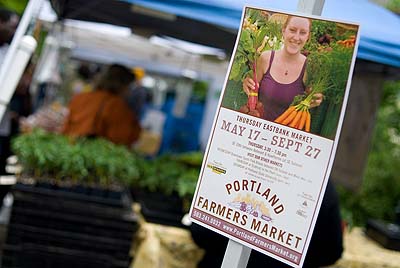
One of the highlights of my visit to Oregon was the chance to finally visit the Portland Farmers' Market. It is considered one of the premier farmers' markets in the US, and features all the stuff I dream about while in Thailand: cheese, fresh herbs, wild mushrooms, wine, oysters and depending on the season, a huge variety of other produce.

_DSC5896.jpg

I was there in May, very early summer, so understandably there wasn't a huge amount of stuff available. There were lots of cold-weather veggies, including carrots:

_DSC5776.jpg

chard:

_DSC5777.jpg

and some early strawberries:

_DSC5813.jpg

And perhaps more unusually, fern shoots:

_DSC5903.jpg

Mushrooms from the forests of Oregon looked particularly interesting:

_DSC5845.jpg

There is also heaps of delicious-looking prepared food, including these pizzas:

_DSC5900.jpg

baked in this mobile wood-burning oven:

_DSC5898.jpg

Another stall tossed its pizza dough on site:

_DSC5886.jpg

This stall selling Italian sausage sandwiches was particularly popular:

_DSC5831.jpg

I was particularly interested in the breads and baked goods, including these amazing looking loaves from Ken's, currently considered one of Portland's best bakeries:

_DSC5847.jpg

Italian-style loaves from a German bakery:

_DSC5866.jpg

and baked sweets, such as tiny lemon tart:

_DSC5869.jpg

There were also lots of happy customers:

_DSC5815.jpg

_DSC5879.jpg

Including me.

Fish and chips in Astoria

_DSC5271.jpg

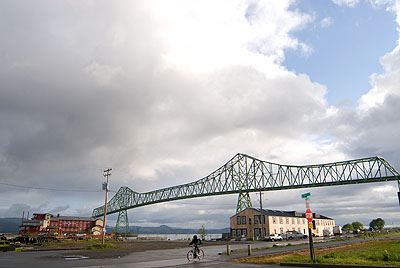
My brother Garett lives outside Astoria, Oregon, a city located at the mouth of the Columbia River in the far northwest corner of the state. Astoria is an incredibly hilly town with lots of old buildings, and has served as the setting of such influential and groundbreaking films as The Goonies and Kindergarten Cop. Film history is not, however, one of my interests, and luckily Astoria also has some interesting restaurants.

In town for lunch one day we stopped by Clemente's, a seafood market and restaurant known for its fish and chips. Rather than plain old fish and chips, I went with the more exotic oyster and chips:

_DSC5284.jpg

The coast of Washington, directly north of Astoria, is known for producing some of the finest oysters in the world, and I wanted to take advantage of this. Thankfully the restaurant treated them well, barely coating them in batter and deep-frying them so that the batter was crispy, but the oysters inside were more or less still raw, just like they should be.

Garett ordered albacore tuna with his chips, a fish that previously formed the basis of Astoria's fishing industry.

_DSC5286.jpg

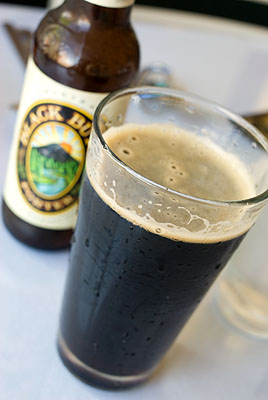
This being Oregon, the fish and chips were accompanied by a bottle of simply amazing beer, in this case the Dechutes Brewery's Black Butte Porter:

_DSC5282.jpg

I chose this bottle because Deschutes makes what must be my favorite beer of all, the Mirror Pond Pale Ale. The porter, although not my favorite style of beer, was excellent, and went very well with oily deep-fried seafood.

And in case you've already forgotten, there's some pretty good f & c available in Bangkok here. My writeup can be found here.

Clemente's
1335 Marine Drive
Astoria, OR
(503) 325 1067

Joe's Donuts

_DSC5248.jpg

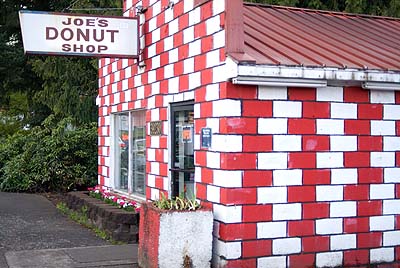
Joe's Donuts is a donut shop in my hometown of Sandy, Oregon. Apparently the place has quite a reputation, and has a keen a following among locals, foodies in the Portland area, as well as skiers on their way up to Mt Hood:

_DSC5244.jpg

Ironically, despite having more or less grown up in Sandy, I had never been to Joe's Donuts. So one morning, with nothing to do and a hunger for American food, I decided to make the 10 minute walk over to the place. I ordered a double espresso, a blueberry fritter (I think that's what it was called) and my favorite, an old fashioned:
_DSC5240.jpg

The donuts were pretty good, but I've been out of the deep-fried dough loop so long I wouldn't know an exceptional one if it hit me on the head. I've never even been to Krispy Kreme. And setting me even further apart from most Americans, I wasn't even able to finish my donuts, and ended up taking half home in a bag.

Regarding the coffee, I find a perverse pleasure in ordering espresso in the US; because most Americans drink incredibly complicated coffee creations that involve multiple-digit ingredients, my order of a simple espresso almost always elicits a bewildered response. Several times while in Oregon I was only charged for what is known as an "extra shot" and got a decent espresso for 50 cents!

Joe's Donuts
39230 Pioneer Blvd
Sandy, OR
(503) 668-7215

A bit of Swedish sausage

I'm still on the road and won't be posting for a few days, but a piece I did on Swedish sausage culture can currently be seen here at the Lonely Planet website. Enjoy!

After I get back, I'd still like to blog on a couple things I saw in Oregon before getting back to Thai and other Asian food, which judging by the emails I've been receiving, has sorely been missed here!

The EEgos

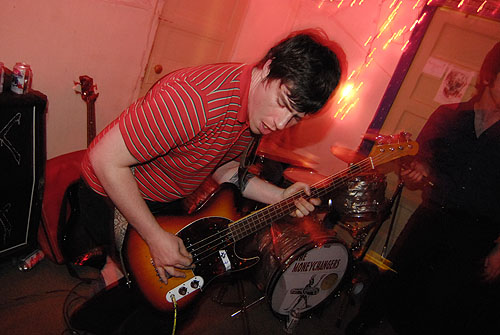
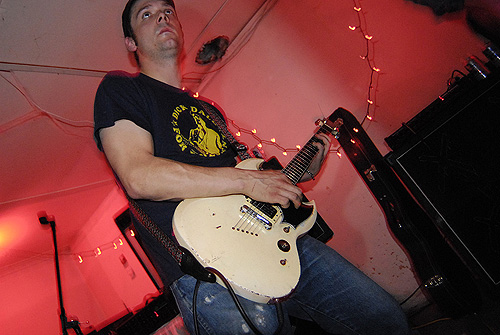
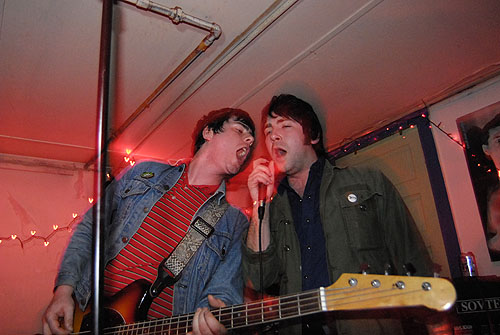
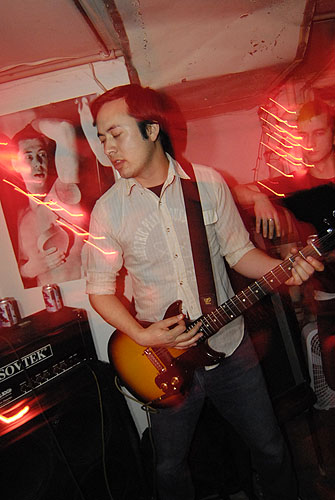
The EEgos are the hottest new band of the moment in Portland, Oregon. Due to the fact that their guitarist, Dave:

_DSC5732.jpg

is one of my oldest friends, I was granted unprecedented access to photograph an invite-only show a few weeks ago.

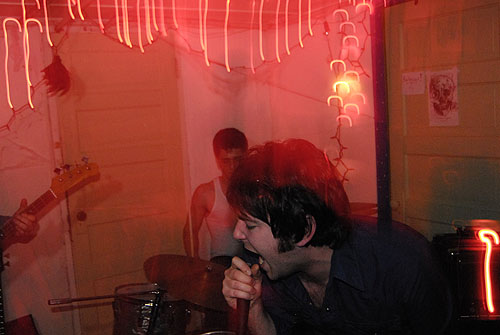
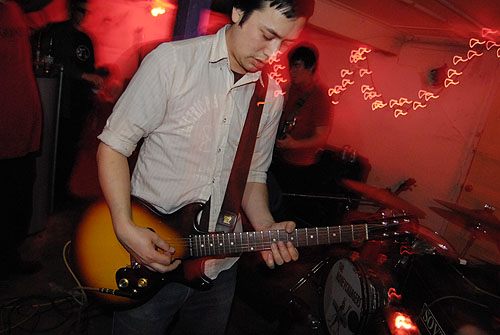
It was extremely dark where they were playing, so I was forced to shoot at ISO 1600 and I illuminated the shots with my SB-800 held in my left hand. If you're not already aware, the D200's built-in flash can control the SB-800 wirelessly and without the use of an extra slave. I simply changed a few settings on the flash and camera, set the strobe to slow-sync (dialing it down one stop, if I remember correctly) and fired away. I really like this effect, which freezes certain elements of the frame, but also suggests motion and action. And the fact that the light is coming from an angle makes the lighting that much more attractive.

_DSC5754.jpg

_DSC5729 copy.jpg

_DSC5745.jpg

_DSC5769.jpg

_DSC5741.jpg

The backstage party, as you can imagine, was totally insane, and I had to use my connections to bail Dave and five underage groupies out from a local jail.