How To Make: Nam Phrik Kapi

Nam phrik are a virtually endless varity of Thai spicy "salsas". They are typically eaten with rice and raw or par-boiled vegetables, and tend to be based around chillies. Nam phrik kapi, a "dip" based on shrimp paste is one of the easiest Thai recipes of all to make. These are old pics I've dug up to contribute to this thread at eGullet, so I don't have the step-by-step pics you would normally expect to see here.

Nam Phrik Kapi with Fresh and Fried Vegetables
Nam Phrik Kapi is probably the most well known nam phrik in Thailand. As the name suggests, it is made with kapi, a salted and fermented paste of fine shrimp known as khoei, and is always served with fresh and/or parboiled vegetables, as well as egg-battered deep-fried vegetables, as described below. The amount of ingredients listed below for the nam phrik are largely for reference; a Thai chef would virtually never use measuring instruments to cook, and a dish is usually made to taste, keeping in mind a desired balance of the four tastes: sour, spicy, salty and sweet.

3+ phrik khii nuu (very small Thai chillies)
1 tablespoon garlic
1 tablespoon sugar
1 squeezed lime (about 1 tablespoon of juice)
1/4 cup Kapi (Thai shrimp paste)
1 tablespoon water
2 tablespoons makheua phuang (pea-sized Thai eggplant)

4 eggs
1 Chinese or Japanese eggplant, sliced into 1 cm thick rounds and put in a bowl of water mixed with 1 tablespoon of vinegar to prevent browning
1/2 cup vegetable oil
1 bunch of cha om (a pungent vegetable sometimes available frozen in Thai grocery stores)

An assortment of fresh Thai vegetables, such as eggplant, cabbage, carrot, wing bean, long bean, all cut into long bite-size pieces

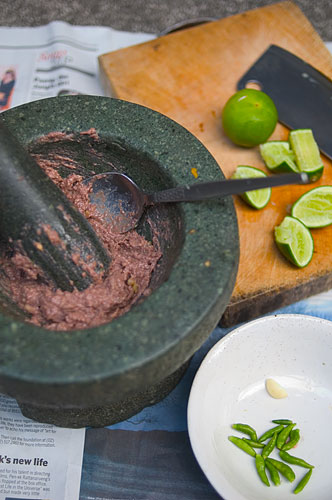
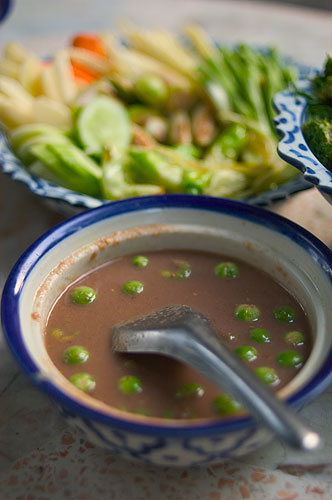
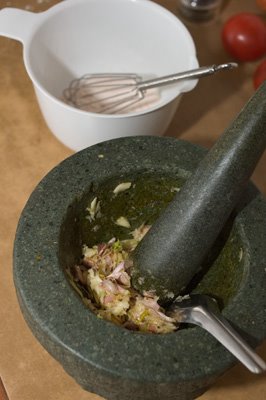
Using a mortar and pestle, grind the phrik khii nuu with the garlic until a rough paste is formed. Add the sugar and the lime juice and grind together. Add the shrimp paste and continue grinding until a paste forms. Add water. If the mixture is still too thick, add additional water, a teaspoonful at a time (nam phrik kapi should have the consistency of a slightly watery paste). Taste and add more chilies, lime or sugar, to taste. Add the makheua phuang, breaking slightly, but not grinding, with the pestle. Put nam phrik kapi in a serving bowl.

Beat eggs with a few drops of fish sauce or a pinch of salt, divide into two bowls and set aside. Drain eggplant and mix thoroughly with one of the bowls of egg. Heat cooking oil in a wok and taking two or three slices at a time, fry the eggplant in oil on both sides until crispy. Set on paper towels to drain. Remove the tender cha om leaves and blend with the eggs. Fry mixture in hot oil as a thick omelet or frittata, turning over to cook on both sides. Drain on a paper towel until cool then slice into bite-sized squares.

Arrange the fresh and fried vegetables on a plate and serve with rice and bowl of nam phrik kapi.

Talaat Aw Taw Kaw

This is the odd name of Bangkok's highest end market. Many claim that it is overpriced and overrated, but if you want to find the best fruit and seafood in town, there's really no other choice. The market is located across the street from the famous Chatujak Weekend Market, and steps away from the Kampheng Phet MRT station.

Aw Taw Kaw (an abbreviation that stands for the Farmer's Marketing Organization) is especially known for its fruit. This includes young tamarind:

a variety of bananas from southern Thailand known as kluay lep mue naang, literally "lady finger bananas":

and guavas:

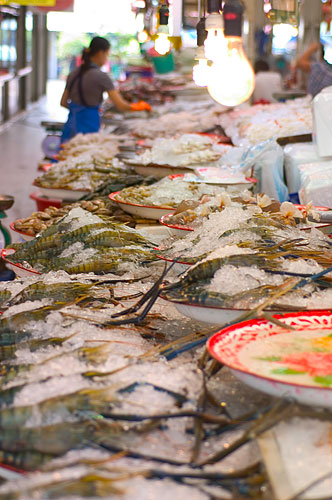
The seafood at Aw Taw Kaw is very expensive, but looks (and tastes) great:

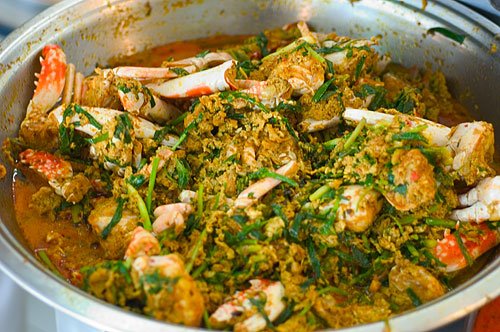
The dish below, poo phat phong karii, combines crab, egg, green onions and curry powder.

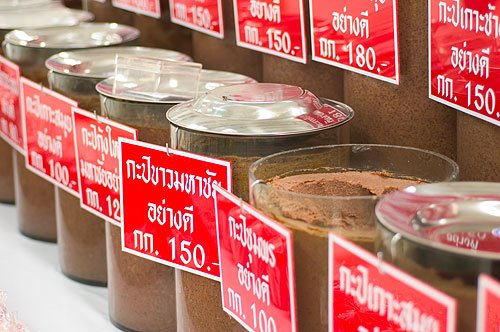
Kapi, shrimp paste, is another form of seafood available at the market.

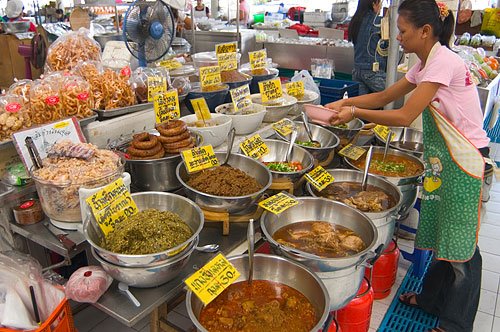
Aw Taw Kaw is a great place to buy regional Thai ingredients and prepared foods. This stall sells northern Thai food:

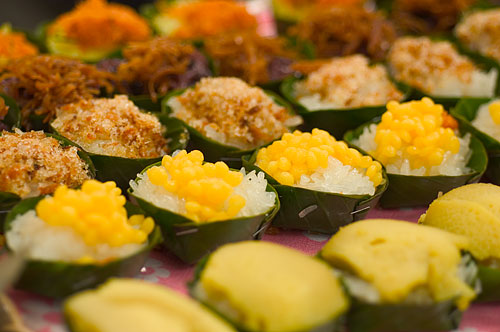
And of course, there's dessert. Below are a variety of sticky rice-based sweets:

These below are called khanom taan, and are a combination of flour and palm sugar steamed in a banana leaf cup and topped with salty/sweet shredded coconut:

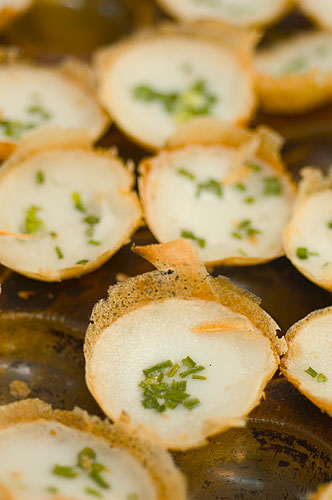
Khanom khrok are tiny crispy "pancakes" of coconut milk. Like many Thai desserts, they have a slightly salty/savory flavor.

ThaiDay: Guardians of art

Guardians of art (ThaiDay, 11/03/06)

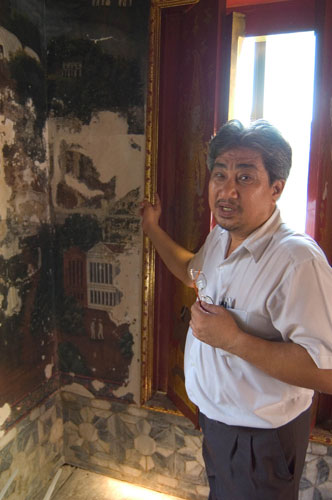
Veeraphong Suwannasin is clearly a man excited about his work. As I wander around Phra Thi Nang Song Phanuat, a graceful century-old structure on the grounds of Wat Benchamabophit, he is more than happy to describe the stories depicted in the structure’s vast murals, and is

eager to provide information about the building. However, Suwannasin’s job, and the structure we are in are anything but typical. Suwannasin is a member of the Department of Fine Arts’ mural restoration team, and Phra Thi Nang Song Phanuat is the former ordination hall of King Chulalongkorn, Rama V.

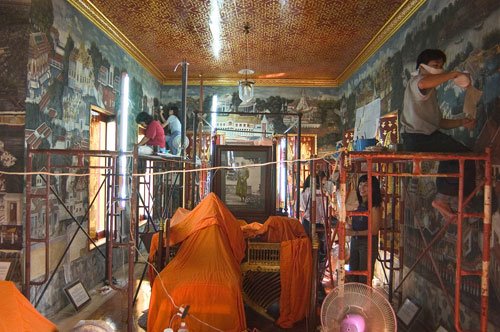
Established 30 years ago, the Department of Fine Arts’ mural restoration team has been responsible for the restoration, upkeep and renovation of an estimated 1,000 sites in Thailand. These restorations can range in subject from Buddha statues to stucco wall designs, but the team is particularly experienced at restoring and protecting the painted murals that often line the inside walls of Buddhist temples in Thailand. They are the only team of its kind in the

country, and are thus responsible for the restoration and upkeep of some of the most important Buddhist art in Thailand. The team’s current restoration efforts at Phra Thi Nang Song Phanuat involves murals, and is, in the words of Suwannasin, a particularly “special” job. “It will take us longer than usual, and many influential people expect to see good work,” he explains.

Phra Thi Nang Song Phanuat is one of four structures that were originally located in the Grand Palace as part of the Temple of the Emerald Buddha. The buildings served as the ordination hall of Prince Chulalongkorn during his time as a monk, and when he later became king, he

ordered the structures to be relocated to the grounds of his newly commissioned temple, Wat Benjamabophit. After being moved, they were joined together and served as the residence of the temple’s first abbot. Not much later, a series of 20 murals depicting the life and reign of King Rama V were painted on the inside walls of one of the structures.

As with most murals in Thailand, the murals at Phra Thi Nang Song Phanuat have suffered a great deal of wear and tear over the years. This includes water damage that erased an entire wall of paintings, and cracks that were the result of previous structural repairs. Large chunks

of the murals have come loose, and a number of hollow spots in the plaster have formed. The structure was previously renovated by the team in 1985, but ongoing water damage at the base of the paintings, a common problem with temple murals, necessitated a new renovation.

Despite the difficulties involved and the high profile of the structure, this type of job is nothing new to the team, explains Somsak Taengphan, administrative head of the group. “We have to train our workers and teach them the rules [of restoration],” explains Taengphan. “All members of the team have art backgrounds, but painting and restoration are not the same.”

The team has 14 permanent members, but also employs the help of other artists for particularly big jobs. Taengphan explains how restoration work on Wat Suthat, a well-known Ratanakosin-era temple in Bangkok, required the help of more than100 artists, and took more than three years.

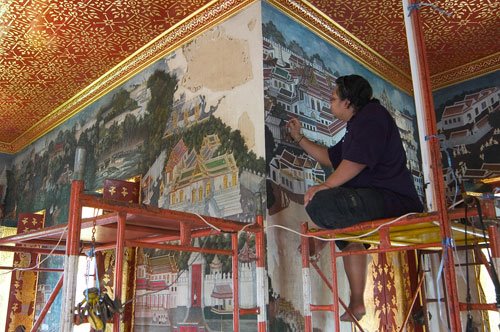
The ongoing work at Phra Thi Nang Song Phanuat involves six full-time workers, and while there, I am given a crash course in mural restoration by Taengphan and other members of the team. They explain that the first step in restoring murals involves removing the surface dust and grime that has accumulated over the years. This is typically done by applying a sheet of mulberry paper to the surface of paintings and painting over this with a wet brush. “The paper absorbs the dirt and can be removed without damaging the murals,” explains Suwannasin. The

use of mulberry paper may seem like a quaint throwback, but according to Virachai Suksawadi, a veteran member of the team, “The most important thing is to use the original materials.” Despite the advances of modern technology, the team strives to use the original methods and materials whenever possible. This leads them to employing such obscure products as buffalo skin, sugarcane juice and tamarind seeds, typically gathering and preparing these materials themselves.

After removing dust and grime, the second step involves securing the plaster base that supports the murals. Over the years, cracks have developed, pockets of air have formed, and water has caused the plaster to separate from the foundation. Virasuksawadi demonstrates how pockets of air are found simply by knocking on the plaster and listening for a hollow

sound, and describes how holes and cracks are filled with epoxy using a large syringe. After injecting the epoxy, loose pieces of plaster are then gently pushed back against the foundation using a cloth-coated pad held over a layer of mulberry paper. For larger structural cracks, occasionally holes are drilled to the foundation, which are then filled with a mixture of glue, plaster and fine sand.

The final step involves painting. This normally involves touching up faded drawings rather than repainting missing or damaged art, which is, for the most part, frowned upon. “We want to make our work look as authentic as possible, but if we have to repaint something, then we have to make it clear that that our work isn’t the original,” explains Virasuksawadi. This is done by discretely outlining or bordering the areas that have been restored or redrawn.

In certain situations where large portions of work are missing, repainting can be an option. “It depends on the work,” replies Virasuksawadi. “If too much is missing, we don’t know what used to be there and we can’t paint.” In the case of Phra Thi Nang Song Phanuat the team was asked by Wat Benjamabophit to repaint an entire section of murals that was previously destroyed by water. There were no photographs of the paintings that used to exist, and the team was left to rely on no more than a few written descriptions, the stylistic precedence of

remaining paintings and other similar murals as a model. “Normally this is not done,” explains Suwanasin, “But this is a special job, lots of important people will see it, and the temple asked us to do it.” For large areas that need to be repainted, a base made partially from a gum that comes from tamarind seeds is applied to the wall. Then the drawings are then outlined in pencil and painted in using tempera, as opposed to modern watercolors.

The work on Phra Thi Nang Song Phanuat, which began in late November is expected to continue until May, and is, in the words of Taengphan, “a perfect job”. “It’s a good size, it’s fun work, and our results will be here a long time.” Without the efforts of Somsak Taengphan and his team, it is almost certain that the murals at Phra Thi Nang Song Phanuat, as well as other precious elements of Thailand’s artistic heritage, would undoubtedly fall into obscurity.

Halls of History (Boxed text)
The murals of Phra Thi Nang Song Phanut are unusual in that, rather than illustrate the various life stories of the Buddha as with most temple paintings, they depict events during the life of King Rama V. Painted by unknown artists during the reign of King Rama V, the 20 panels depict the life of the King in chronological order, beginning with his top knot cutting

ceremony at the age of 13, and continuing with his ordination, coronation, and travels within Thailand and to foreign countries. One panel in particular describes the story of a man-eating crocodile in Chachoengsao that King Chulalongkorn was involved in exterminating. Yet another panel even depicts the relocation of Phra Thi Nang Song Phanuat from the Grand Palace to its current location at Wat Benjamabophit. The murals are valued for their accurate
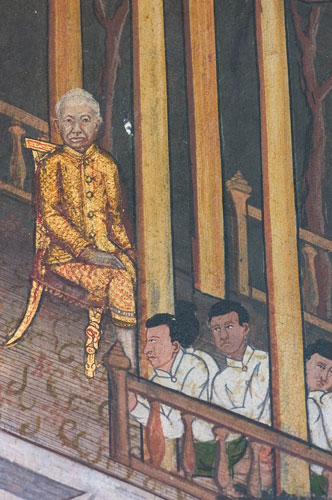
depictions of real people, including depictions of King Rama V’s father, King Mongkut, Rama IV, and for the insight they provide into various aspects of royal life in Ratanakosin during the reigns of Rama IV and Rama V, including King Rama IV’s interest in astronomy, and details of his funeral ceremony.

Thai Day: Oh boy, oh boy

Oh boy, oh boy (ThaiDay, 09/03/06)
The most interesting aspect of my experience at Rotiboy didn’t actually involve eating, but rather, waiting in line. For those of you who don’t know, Rotiboy is a Malaysian bread chain that recently opened two outlets in Bangkok to enormous acclaim. I’m not sure how word spreads here, and didn’t realize that bread was so popular among Thais, but Rotiboy somehow became an instant hit, and initially, waits of 1-2 hours for the chain’s famous coffee-flavored buns were not uncommon.

Rotiboy (“one is never enough… buns to die for!”) began in 1998 as a neighborhood bakery in Penang, Malaysia. Sales of it’s curiously named Mexican bun (now even more curiously branded as the Rotiboy) quickly soared, and after opening its first domestic outlet in 2002, Rotiboy can now be found Singapore, Hong Kong, Indonesia, and as of December 2005, Bangkok. The Bangkok branch sells exactly one product, the aforementioned Rotiboy (25 baht), a largish, rather unattractive, coffee flavored bun, and sells it very well (a recent call to Rotiboy

Bangkok to inquire about many buns were sold each day elicited a cold “I’m sorry we cannot reveal this information” from the store’s manager). With excellent international chains such as Le Notre, and up-and-coming domestic bakers such as Visage now making pastries of a very high level available in Bangkok, I find it strange that a largely obscure establishment selling a single product at a relatively high price could generate so much attention. And so, in the interests of investigative journalism, I decided to brave the buzz (and the lines) and taste the bun.

To truly take part in the Rotiboy experience, I decided that I needed to visit the Silom branch of the franchise during its busiest peak, the afternoon rush hour, and do what everybody else buying Rotiboy buns must do: wait. Arriving at 4:38 on a Monday afternoon I was disappointed to learn that things have apparently slowed down a bit in recent weeks. Although an hour’s wait is still the norm, and supplies are still being rationed (a sign behind the counter
reads: “Each customer may purchase no more than 10 buns. We apologize for any inconvenience.”), the only indication that things might possibly get out of control were a few traffic cones to direct the crowds. I stepped into the tail end of a very long and civil line (why can’t people queue like this at ATMs or hospitals?) and began my wait.

After several minutes of waiting, I turned to the woman behind me and asked, “Is the line like this every day?”
“Wow, you can speak Thai,” was her reply, ignoring my question.
“So, don’t you think this is a rather long line?” I attempted again.
“Where did you learn Thai?” she replied. Apparently waiting an hour in line to buy buns was not a particularly unusual experience for this woman, and there were more interesting things to talk about. We continued to inch forward at a tedious rate, which was made somewhat more pleasant (or unbearable?) by the rich scent of coffee wafting out of the bakery. Although I was

initially skeptical about Rotiboy, waiting in line for 20 minutes had actually sharpened my desire to get that bun, and I was already reconsidering how many I wanted to buy. Making customers wait suddenly seemed like a extremely shrewd marketing technique.

Upon finally reaching the counter (time: 5:18) I purchased my solitary Rotiboy (employee: “Only one?”), ran under the BTS escalator, and immediately tore into it. The verdict? Well, it was quite good, actually. Despite my normally high journalistic morals, I was prepared to dislike Rotiboy from the start, seeing it as yet another hyped-up product, but was pleasantly surprised. Less bun-like than it appears, the Rotiboy is actually very similar in taste and texture to an American-style buttermilk pancake. The shell was satisfyingly crispy, and the soft interior was laced with a generous aroma (rather than taste) of coffee and a layer of melted butter. I wolfed down my prize, looked back on the line that had now grown even longer, and reflected on my Rotiboy experience. Was it really worth the wait? Honestly, I would love to write more on this, but unfortunately I need to get in line for my next bun. Sorry.

Rotiboy Bakeshoppe
189 Silom Road
02 632 0897
www.rotiboy.com

For those interested in trying the bun, but not willing to brave the lines, there are now several Rotiboy alternatives available in Bangkok. Most of these revolve around Siam Square, home to a popular branch of Rotiboy, and a virtual epicenter of Bangkok's coffee-flavored bun craze.

Crystal Jade My Bread
(Basement, Siam Paragon, 02 610 7581)
My Bread's Mexico Coffee Bun (25 baht) is the least coffee-like but the most buttery of its genre. I bought a bun to go, and the staff recommended that I heat it up before eating. In retrospect this was good advice, as the generous butter filling was solid and overwhelmingly rich.
BreadTalk
(Basement, Siam Paragon, 02 610 7588-9)
The Coffi-0 (22 baht) is this Singaporean bread chain's answer to the Rotiboy. Featuring a sweet, green pandanus-flavored filling, in terms of taste, concept, and name, it doesn't get much weirder than this.
Papa Roti
(Siam Square, next to Dr. Maarten's, near the stage)
Papa Roti resembles its popular predecessor in every way, even down to the shop's yellow decor and nearly identical smiling chef logo. The buns (25 baht) are served hot ("always fresh always tasty") and have the proper balance of coffee and butter that one would expect from such an eerily "similar" competitor.

Kwaytiao Khae (again)

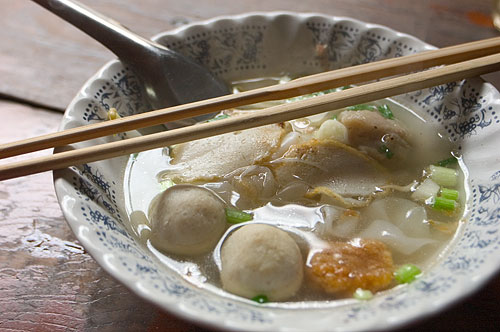
I 've previously mentioned this somewhat difficult-to-find Chinese noodle dish, and was delighted to find it again today:

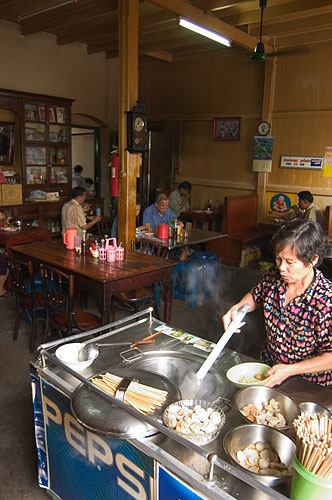
Again, the dish consists of mostly fish-related balls served with noodles in a clear broth. This particular example was not amazing, but rather the restaurant's setting in a really cool old shophouse was what drew me in:

It's hard to see in this pic, but the shop has the old wooden booths that can be found in many of Bangkok's older restaurants. The place is located steps away from Chang Pier, near Wat Phra Kaew and all the other touristy stuff. A cool glimpse of Olde Bangkok, and fun place to eat, but in terms of noodles I think I prefer my local joint.

ThaiDay: Vive le Soi!

As I mentioned previously, I'll be contributing food-related features and restaurant reviews to ThaiDay, the paper bundled with the International Herald Tribune. I'm going to be posting those articles here, and I'll begin with a feature/restaurant review that ran on page 5 of today's ThaiDay (Thursday is food day at ThaiDay!). I'd like to thank Features Editor, Nick Grossman, for letting me do this. (And for those of you who may have already seen the print version, the version below is the original, and will vary slightly from the editor's take, but I will include the same pics as in the article.)

Vive le Soi! (ThaiDay, 02/03/06)
Live the vie en rose in Bangkok's French Quarter.

For authentic regional food, Bangkok’s ethnic enclaves are an obvious destination. What better place to go for hummus and tabouli than the Nana area? Thinking of dhal and chapatti? Think of Phahurat, Bangkok’s Little India. And Yaowarat, Bangkok’s Chinatown, is the obvious choice for all foods Chinese. These neighborhoods and their cuisines are well established, however in recent years a new ethnic district has begun to emerge in Bangkok. Home to a bakery, an ambitious butcher shop, a restaurant popular among French expats, a wine shop, and numerous cafés, Soi Convent, “Bangkok’s Champs Elysées”, has all the attributes of a Parisian arrondisement. The following is a rundown of the French food establishments found in Bangkok’s newest ethnic enclave.

La Boulange
2-2/1 Convent Road
02 631 0355

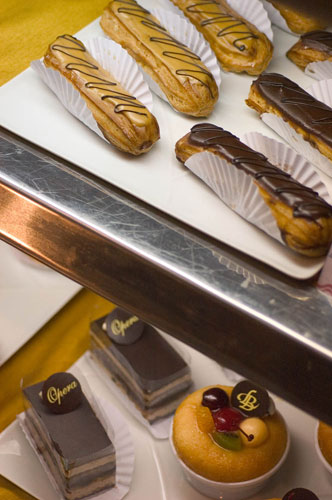
For many, the first image that comes to mind when most people think of French food is bread, and it is thus fitting that the first French business to become established on Soi Convent was a bakery. La Boulange was started up seven years ago, and was probably Bangkok’s first high-quality independent bakery. In the beginning the small café/bakery sold a small selection of high-quality pastries and sourdough breads baked on the premises in an imposing wood-burning oven. However, other than a cup of coffee or a simple sandwich, La Boulange was largely a take-home affair, and never progressed past this.
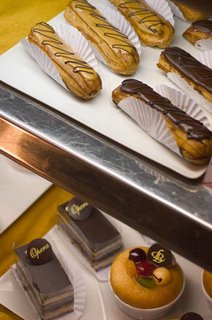

Tempting pastries at La Boulange.

After less than a year in business, La Boulange was taken over by Bangkok-based French hotelier, Robert Molinary. The wood-burning oven was removed, and under the guidance of an experienced French chef, a greater emphasis was put on bistro-type meals and wines. “This business is more competitive now,” explains acting GM and self-proclaimed “food engineer” Patrick Parthonnaud, about the decision to revamp the restaurant. Today, La Boulange’s breads are baked in factories in Bangkok and Pattaya, however, for those concerned, Parthonnaud assures me that “The bread is still exactly the same.” There are now as many as 20 varieties of pain sold at La Boulange, including the hearty country-style loaf, pain de campagne, a sourdough-rye bread, and such Parisian staples as baguette and batard. The bakery is still producing pastries, and La Boulange’s marble-topped street front tables are probably the most pleasant place in Bangkok to take a café au lait.

Gargantua
10/2 Soi 6 Convent Road
02 630 4577

Tucked into the end of an unremarkable side street, Gargantua is the unusual name behind a recently opened French-style butcher shop. Part owner, Arnaud Carré, is a fifth-generation butcher from Brittany who has been involved with meat since childhood. “I used to work in my
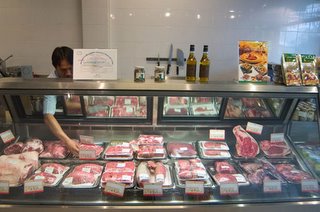

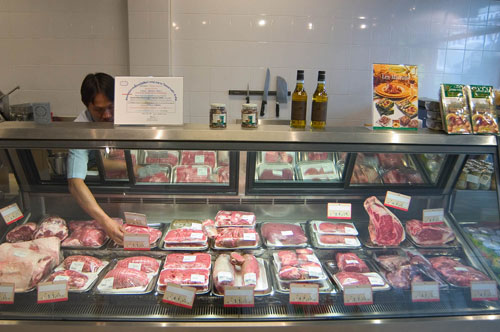
Gargantua, a French butcher's shop on Soi Convent, offers hard-to-find cuts of meat and exotic sausages.

father’s butcher shop as a child,” explains Carré between endless cigarettes and coffee. After running his father’s business for several years, Carré spent 10 years in the US working for a chain of steakhouses, and eventually opened a French-style boucherie in Manhattan. When asked why he decided to relocate to Bangkok, he replies confidently, “I am a man of challenge.”

Challenges aside, Gargantua is one of the few domestic producers of elusive French products such as terrine de lapin, rabbit terrine; merguez, Algerian-style spicy lamb sausages; and saucisse aux herbes, fresh herb sausages; as well as choice cuts of beef and veal. All of the meat products, except for lamb, are Thai, and when asked about the quality of Thai beef, Carré is quick to reply, “The quality of meat here is fantastic. High quality Thai beef is close to
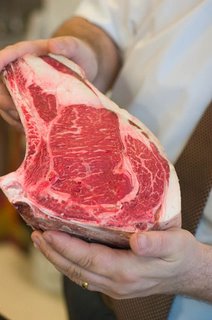
American beef, if prepared right.” After less than a year in business, Carré already has plans to open another branch of Gargantua “somewhere in Bangkok”, and will soon be expanding his range of merchandise to include a greater variety of fresh sausages and other products.

Wine Connection
Unit 5 Ground Floor, Sivadon Building
1 Convent Road
02 234 0388
www.wineconnection.co.th

You’ve bought yourself a baguette and a few slices of pâté, now what do you drink? The obvious choice would be wine, and since 2002, Wine Connection on Soi Convent has proven itself to be one of the best places in the city to buy a bottle. Wine Connection’s CEO and founder, Michael Trocherie, hails from the south of France and previously worked in Vietnam
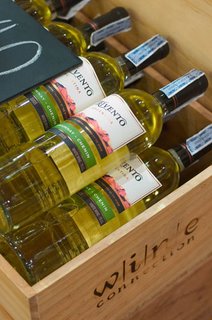
exporting French wine to other parts of Asia. After seven years of this, he decided to move to Bangkok and import instead. “I wanted to be on the other side of the business,” explains Trocherie. Wine Connection began as an online business, and opened its first shop on Sukhumvit 32 in 2000. Since then the store has expanded to various locations in Bangkok and Thailand, as well as Singapore.
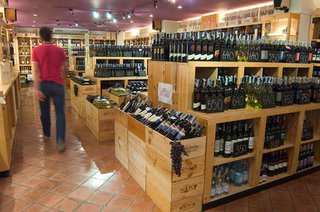

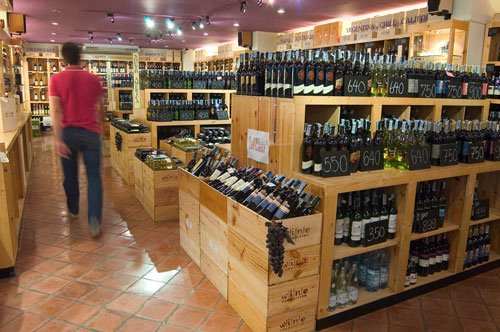
The search for that perfect bottle is not difficult at Wine Connection.

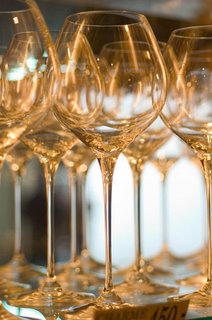
Part of the reason for Wine Connection’s success is its shops; they are attractively designed and well organized, just like a good wine shop in Europe or the US. And there is also volume; the Soi Convent branch of Wine Connection alone sells more than 250 kinds of wine, with a large proportion of these being, not surprisingly, French. Thankfully for the consumer, Wine Connection emphasizes mid-range wines, and several excellent bottles can be found for 600 baht or less. I ask Michael for a recommendation and he suggests a Domaine de la Begou, a red from southern France. “It won a gold medal in France, but it’s not a famous name,” he explains. “It’s a very good wine, but not expensive, exactly the kind of thing we like to sell.”
Cafés
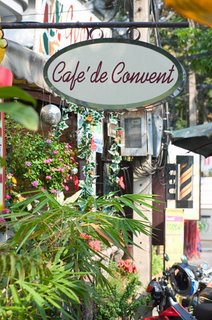
Any self-respecting French street wouldn’t be caught dead without its cafés, and Soi Convent is no exception. Starting at the Silom end of Soi Convent is a branch of the ubiquitous Starbucks (1/3 Convent Road), equipped with Wi-Fi for those who prefer to read Le Monde online with their coffee. On the same side of the street is the Café Swiss (3 Convent Road, www.swisslodge.com). More a restaurant than a café, the location offers a pleasant outdoor dining area and a European-style breakfast buffet. The Tung Who Coffee Shop (13/1 Convent) across the street serves “Original Thai Coffee” and a number of Chinese/Thai dishes. Goûte House is a small bakery (French only in name) selling a variety of pastries including palmiers, a sweet of French origin. And finally, near Sathorn, are the Café de Convent, a small café-cum-florist, and Goodwill, an attractive café with a Thai menu
(Boxed restaurant review)
Indigo
6 Convent Road
02 235 3268
indigobangkok@yahoo.com

Located in an attractive former schoolhouse and boasting one of the loveliest outdoor dining areas in town, Indigo has been a popular meeting place for French expats since opening five years ago. I had never visited the restaurant until a friend of mine, a French cookbook author, urged me to go, expressing repeatedly that it was “very French”. I wasn’t sure what she meant by this, and not once did she mention the restaurant’s food, but I trust her judgment and decided to drop by.

Arriving at 4:45 to an empty restaurant and a confused waitress, my companion and I were seated and promptly given lunch menus. We requested the dinner menu, and I began with one of the specials, rocket salad (190 baht) and my companion with warm goat cheese salad (320 baht). The rocket salad reminded me of rocket salads I’ve made at home (which is a good thing,
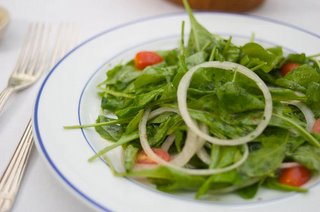
but not particularly exciting when eating out), but the warm goat cheese salad was more interesting; a bed of mixed greens supporting two toasts topped with fresh thyme and melted rounds of local goat cheese. My salad was followed by blanquette de veau à l’ancienne (390), a notoriously difficult to make “stew” of veal. I should by know not to order any dish employing the word “traditional”, and the blanquette was flat, the cream and egg yolk-based sauce heavy and lacking the zest and spice that more current interpretations of the dish often allow. And as if to rub my nose in my lackluster choice, my companion purred over her bar à la provençale (390 baht), fillets of sea bass pan-fried with olives capers, tomatoes, lemon and basil. We’ve all seen this dish (and this fish) before, but again, she had made the wiser selection, and the result was satisfyingly crispy, savory and tart. Our food was taken with the house white wine (120 baht), a predictable Chardonnay, and we ended our meal by sharing a tarte fine aux pommes et glace vanille (170 baht), a freshly-baked apple tart with vanilla ice cream. Tasty, but I always get a little sad when the warm tart melts all of my ice cream.
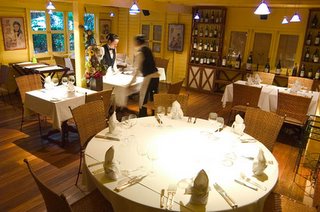

The old world charm of Indigo's whitewashed interior.

Up to this point our food had been underwhelming and overpriced, and the setting perfect, and I was wondering if this was what my friend meant by “very French”. However, my understanding came later, when the owner of Indigo, initially wary of my picture snapping and wandering around his restaurant, caught on that I was a food critic, invited himself to sit down at our table and began to gush about his restaurant, bringing us wheels of French cheese and frightfully large loaves of bread to look at. Cynics would say he was doing this to promote his restaurant, and they would undoubtedly be correct, but I found this unabashed love of food touching and very French. If only this affection would carry over to the restaurant’s kitchen.
Eating Penang

Spent the last few days in Penang, Malaysia. An interesting place, if it's your first time, but I've been there three times already, and wasn't exactly looking forward to it. Luckily though, there's the food. Georgetown (Penang is actually the name of the entire island) is essentially a Chinese town, but there are lots of Indians, and some malaysians, which makes for an interesting culinary mix. Although I've been before, most of my culinary experiences were quite random, and I owe a lot to Robyn of EatingAsia for her helpful information. All in all, I'd have to say that Georgetown is probably the single best city for eating authentic asian food anywhere in Asia--at least of all the places I've been.
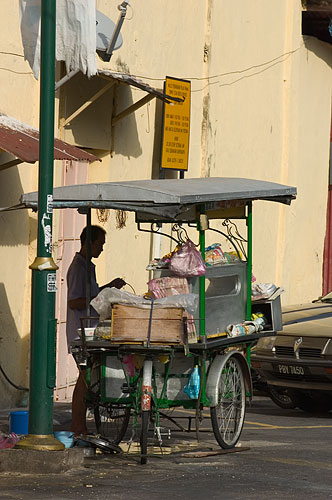
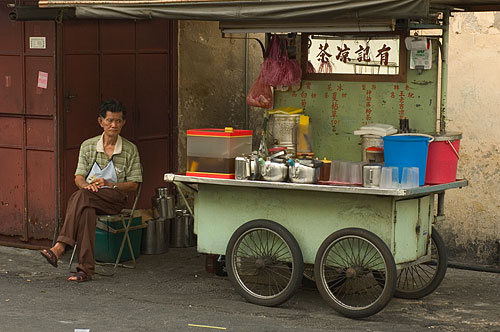
Georgetown is especially known for its hawker food, which means there are lots of people selling food from carts like this:

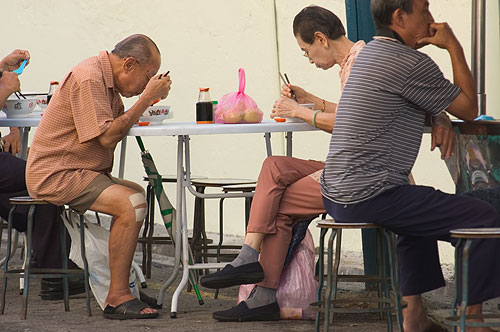
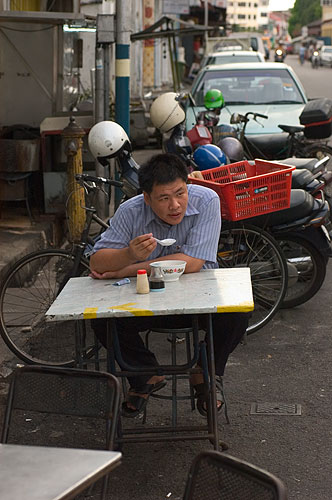
And since the food is on the street, you also eat on the street, like this:

or this:

Here's a guy selling Chinese-style herbal drinks on the street:

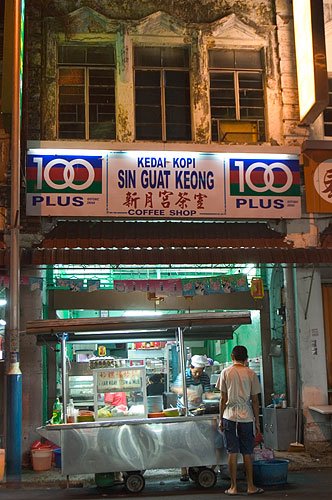
And the street-food mirth doesn't stop at night:

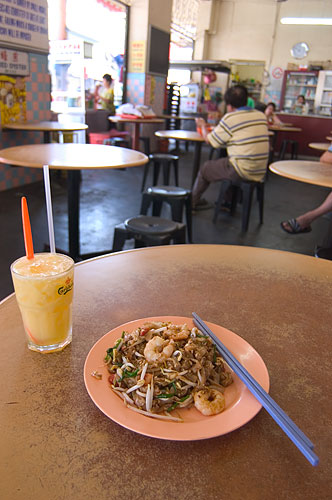
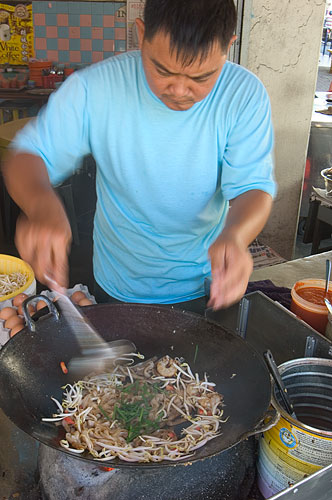
But actually, the thing I liked the most are the numerous old-school cafes, where several different vendors congregate and a variety of food and drink is available. Most of these are Chinese, and serve a variety of largely noodle-based dishes. Here's an example:

That handsome looking dish in the foreground was char kway teow. Here it is being made:

In all honesty, virtually everything Chinese in Georgetown seemed to revolve around noodles. They were good, but dishes often seemed quite similar to each other and usually made every effort to distance themselves from vegetables.

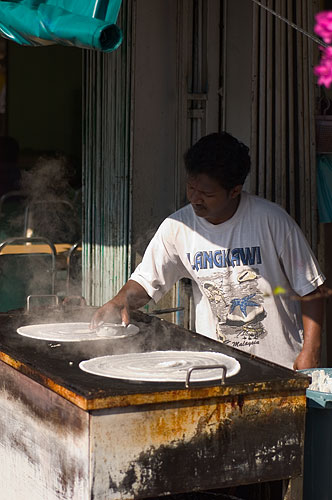
My personal favorite was the Indian places. They are almost exclusively southern Indian in origin, which means you're getting great banana-leaf veggie meals and treats such as thosai and idli. This stuff is somewhat expensive and hard to find here in Bangkok, so I had about four thosai every day to make up for lost time! Here are some thosai ("pancakes" of fermented rice flour) being made:

These deliciously sour and cripy treats are fried on one side (as shown) and served up on a banana leaf with dal (lentil curry) and a coconut-garlic and a tomato-based sauce.

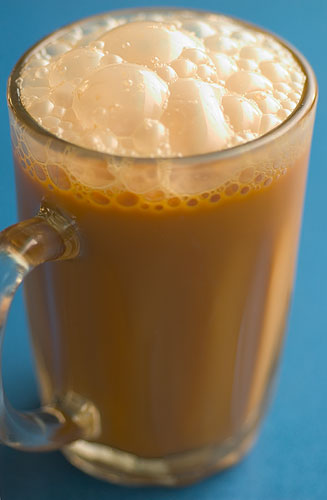
Virtually all eats in Penang, regardless of origin, are washed down with a sweet teh tarik (literally, "pulled tea", so named to describe how the tea is poured from a great distance to create a frothy head):

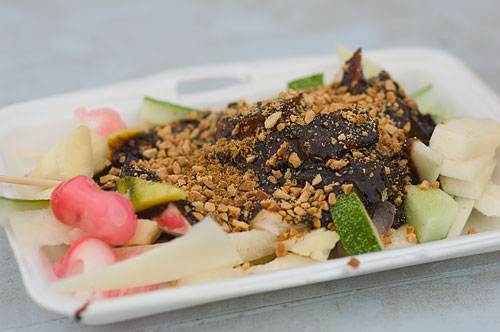
On my last night I visited an outdoor hawker center at the end of Gurney Drive and experienced my best meal (thanks Robyn!). I started with rojak, a "salad" of assorted fruit with a shrimp paste/sugar/tamarind dressing:

This is a dish of Indonesian/Malay origin, and can also be found in Singapore.

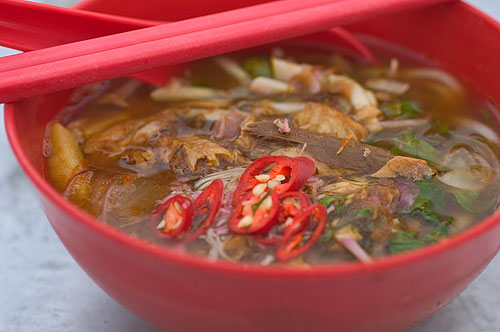
I followed this assam laksa (also known as Penang laksa), a noodle dish (of course) with a slightly sour fish-based broth:

This was good, a lot like Thai khanom jeen except with udon noodles! The broth had some fresh herbs and pineapple, which I thought was nice.

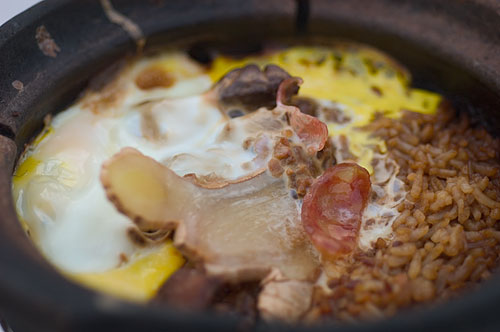
But the best I had that night was chicken claypot, a ceramic urn holding rice cooked in chicken broth, a few pieces of chicken, a huge slabba ginger, chinese sausage and topped with an egg (why don't people combine chicken and egg more often?):

Damn, this was good. The rice was crispy and fragrant, and the claypot was served with a black pepper-inudated broth that could (I imagine) be poured over the rice, or taken seperately.

Bamii Blow Out

Continuing on the bamii theme, today I went to the local bamii pet, duck with egg noodles, shop. This kind of bamii is a bit more hard to find than the usual that has pork or crab, but is quite good, if not better.

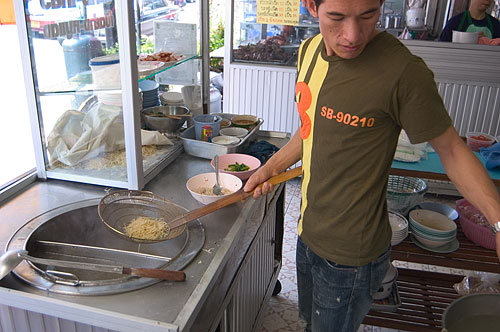
The noodles they use here are really good, similar in quality to egg noodles I've had in China. Here is the guy parboiling the noodles before adding them to the bowl:

If you're not into noodles, you can also order something called kao lao, which is basically the dish without the addition of noodles, and which includes a ladlefull of "gravy" made from fermented soybeans and duck broth, giving the dish a deep, savory flavor.

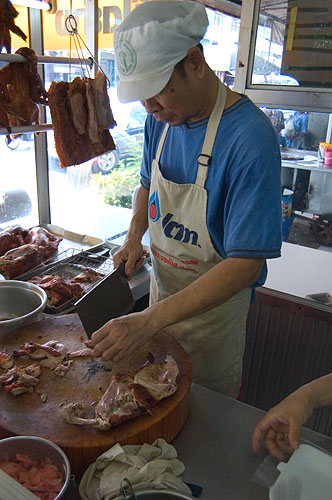
The shop uses entire Chinese-style roasted ducks. Here's the guy who chops them up:

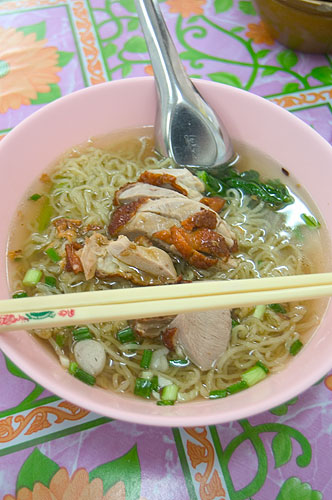
And here's my bowl:

I ordered bamii pet naam, egg noodles with duck and broth. There's also some phak kwaang tung, a green leafy vegetable hiding under there.

The Magical World of Thai Baked Goods

Today's lesson in bizarre Thai pastries is an extra super double blowout edition, featuring two very unusual baked treats from the local Yamazaki, a Japanese bakery.

First we begin with a pastry called, and I'm not joking here, the Weiner Kids Donut:

Yes, Kids, it's the snack you've been waiting for: part savory, part cripy sweet, this is essentially a hot dog (the aforementioned "Weiner") encased in dough, rolled in bread crumbs, deep-fried, and generously topped with a dollop of sweet ketchup. The thing was so oily that if you stuck a wick in it you could probably use it to read by for a couple weeks.

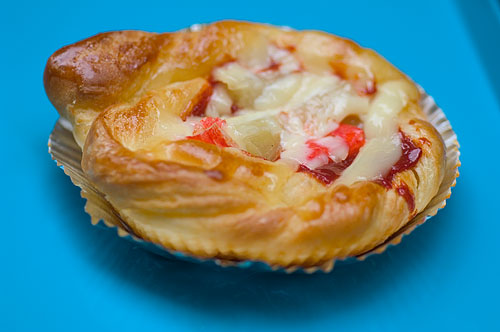
The next example is the ambitiously-titled Crab Pizza Danish:

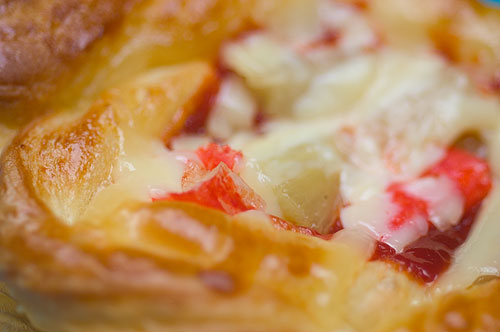
OK, there are obviously a lot of faults with this one, but my main objection to the Crab Pizza Danish is why try to do so much with one pastry? I can (sort of) conceive of a Crab Danish, or even a Pizza Danish, or even more so a Crab Pizza, but why on earth would somebody try to combine all there of these disparate elements? And what's with those toppings:

It's a bit hard to see here, but you've got imitation crab, pineapple, "cheese" and ketchup, all mingling on the same platform. I almost chose its neighbor, the Corn Pizza Danish, but felt that imitation crab was something I couldn't pass up.

Phat Sii Ew

This fried noodle dish is something I enjoyed when I first moved to Thailand, and I even made it at home a couple times. For some reason though I somehow lost track of phat sii ew and hadn't eaten it for about four years.

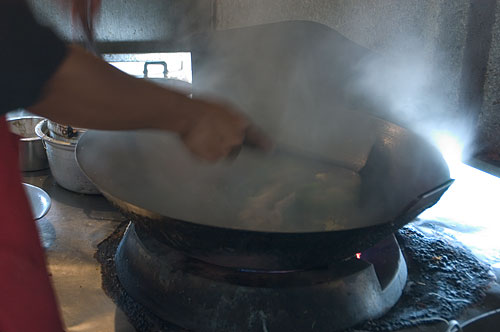
Just recently I was stranded on a street near my house and "discovered" an excellent phat sii ew shop. The name of the shop is Laad Naa Yod Phak Nay Lao, ("Mr Yao's Laad Naa with Tender Vegetables", laad naa is another dish made there), a well-known shop downtown that has a branch near my neighborhood. Eating here made me realize what I had been missing all these years. For those who don't know, phat see ew is made by frying wide rice noodles with eggs, pork, and phak khanaa (Chinese broccoli), with a soy sauce-based sauce. This place makes truly amazing phat sii ew. It's done in a huge freaking wok over a very strong flame:

First the eggs are fried, then the noodles and veggies are added. The noodles are pre-soaked in the sauce, which the cook (below) told me is a mixture of soy sauce (sii ew) and oyster sauce.

And the best thing is that from order to eat takes honestly no more than two minutes!

Here's my dish:

Because of the way they're flash-fried, the whole dish has a wonderfully smoky taste. I'm not a big meat eater, so I always order mine minus pork and extra veggies, that's why it looks particularly green.
Here's an action shot of the eating process:

Bamii Blow Out

Due to the request of one of the many millions of RealThai readers, today's reportage will be the first in a series to focus on bamii, Chinese-egg noodles that are very popular in Thailand. Normally served with barbecued pork or crab meat, these noodles can also be had with kiaow, wontons, and are a favorite late-night snack.
I'm going to start with something close to home, my neighborhood's mobile kiaow vendor. This guy cycles around my neighborhood during lunchtime selling bamii and kiaow. We know he's coming because he strikes a hollow piece of wook making a tok-tok-tok sound.

I was at the computer working, heard the sound, ran downstairs, and saw him just down the street:

I called him over (isn't mobile food wonderful?):

And orderd a fat bowl of kiaow naam, wonton with broth (many people like to order bamii and kiaow haeng, meaning, without broth). This is him at work:

(I supplied my own bowl.)

His stuff is pretty MOR, nothing that's going to make the front cover of Bamee Magazine, but good in a pinch. Here's the result:

I do like the fact that he puts bits of khaeb moo, deep-fried pork crackling (pork rinds for all you Americans) in with it. Other than this though, I find his bamii/kiaow too meaty for me. I prefer the kind with crab meat and lots of phak kwaang tung, a green leafy vegetable that is hiding somewhere under all that flesh in this picture. There is also a place near my house that serves bamii pet, bamii with duck. More on that soon.
I got a real job

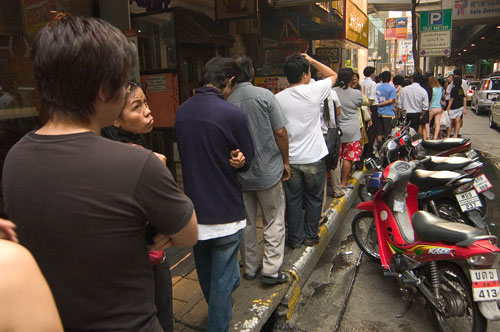
Haha.. Just kidding. You don't think I'd go and do that, do you? However, if things go well I'm going to be regularly contributing food features and restaurant reviews to the Thursday food section of ThaiDay, the paper bundled with the International Herald Tribune. My first assignment looks to be a hard-hitting, no-holds-barred expose of Rotiboy, Bangkok's latest and strangest food craze. For the two or three of you who don't know, Rotiboy is a Malaysian chain that sells nondescript coffee-flavored buns. Actually I shouldn't say buns, as the Bangkok Rotiboy sells exactly ONE kind of bun. And against all logic this bun has become madly popular here. There are two hour waits. There are limits on the number of buns you can buy. It's total freaking madness over a simple pastry. Here's a line people waiting to buy Rotiboy buns on Silom:
Anyway, hopefully more on Rotiboy later, because as most of my reviews and articles for ThaiDay will concern food in Thailand, I'm thinking of asking the editor if it would be OK to cross-post them all here.

Talaat Nat Mania

Talaat nat were defined by my university Thai textbook as "occasional markets". This doesn't help much, so let me explain: Every Saturday afternoon in my neighborhood, a market springs up out of nowhere. There are prepared foods and ingredients, as well as lesser-important non food related frivolities. It's a big deal and EVERYBODY comes out, the old, the young, beggars, construction workers from the nearby housing project... It's a lot of fun, and virtually only a few steps from my door.


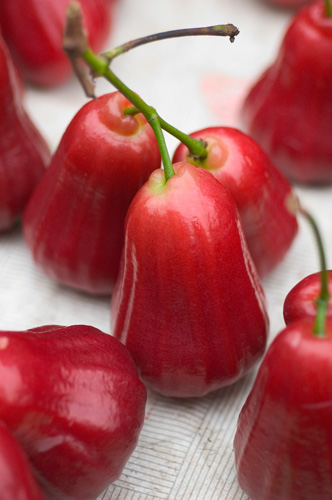
These beautiful rose apples are for sale every week.


Stopping by to pick up the essentials; limes and dried fish (?).


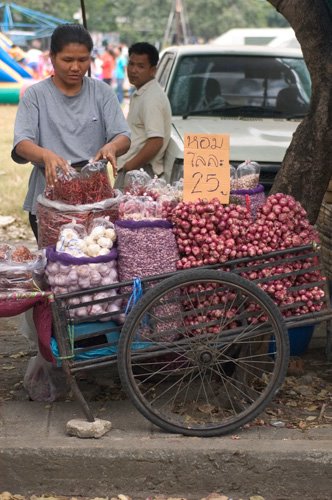
This is where to get your garlic and shallot fix. She's mobile.


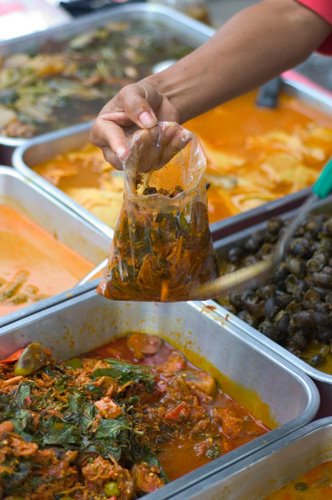
Southern Thai-style curries. I think there must be several people of southern Thai origin in my neighborhood, as there are about three or four stalls selling this type of food.


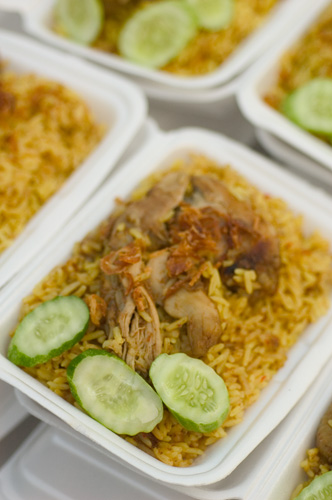
This khao mok kai is sold by a Muslim family.


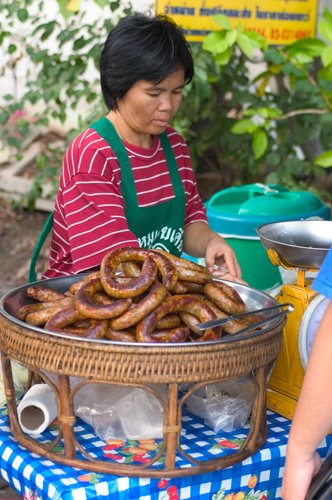
In addition to southern food, there are also a couple people selling northern Thai food. The sausages above are a northern speciality called sai ua and consist of fatty pork and fresh herbs such as lemongrass, lime leaf and galangale. Very, very good.


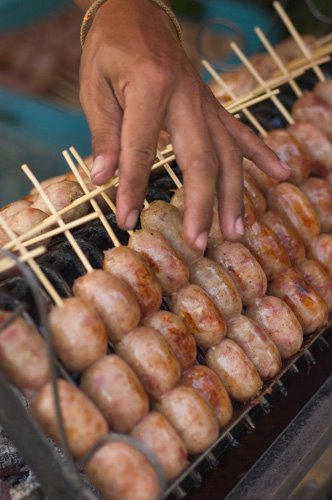
Continuing on the sausage theme, these northeastern-style sausages are filled with rice, glass noodles, and a kind of sour, fermented pork, and are also grilled.


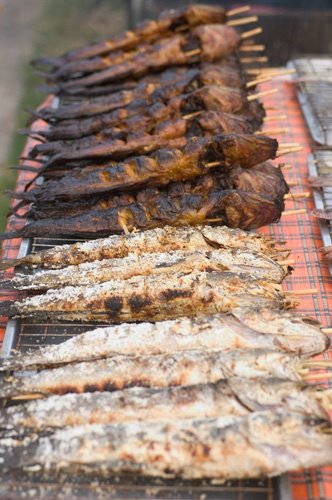
Another popular northeastern dish is grilled freshwater fish, especially catfish, as seen at the top of the pic. The other fish are coated in salt before being grilled.


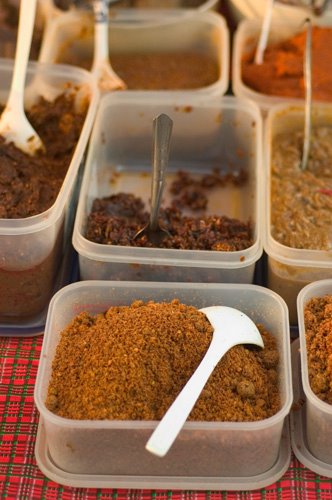
These are nam phrik, various "salsas" or dips that you have over rice or with vegetables.


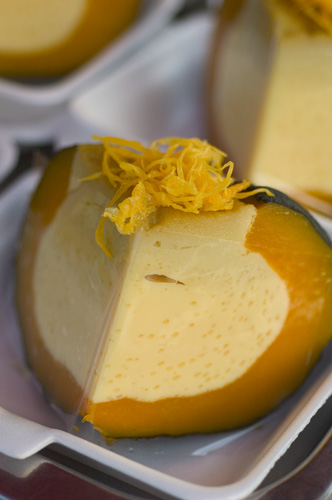
And for dessert, try a pumpkin filled with custard and steamed, or


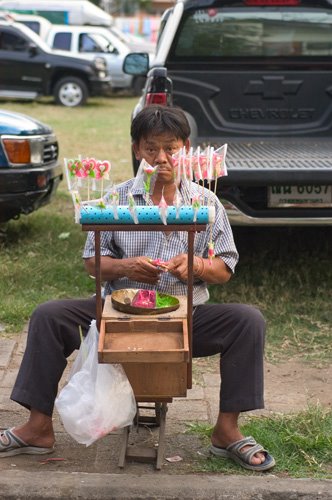
colored sugar twisted into birds and other shapes.

How To Make: Plaa Thot Khamin and Plaa Krabok Tom Khamin

Today's lesson revolves around two southern Thai dishes, specifically those using khamin, turmeric. This bright orange root, as I've said about 64 times already, is an incredibly popular ingredient in southern Thai cooking, and it is what tends to give these dishes orange/yellow hue. Today's recipes use the stuff both in dried form and fresh; essentially two completely different ingredients. The first, plaa thot khamin, fish fried with tumeric, uses powdered turmeric largely to counter any unpleasant "fishy" smells, and to give the dish an attractive yellow/orange color. The second recipe, plaa krabok tom khamin, mullet in a turmeric broth, uses a generous amount of the fresh stuff to provide a wonderfully acidic/fragrant/sweet flavor to the broth.

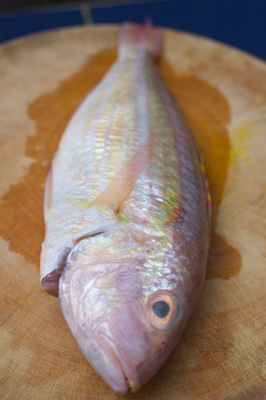
For the turmeric fried fish I'm using plaa saay daeng, this fish:

but plaa insee, Spanish mackerel fillets are also common, and very good.

Take about 1/4 cup of garlic (preferably small cloves with a thin peel--don't worry about removing every last bit of peel--you'll soon see why) and smash it up real violent like using a mortar and pestle:

Next, take about an 1/8 cup of rice flour, an 1/8 cup of all-purpose flour, a teaspoon of turmeric power and a teaspoon of salt and mix this up with the garlic in a bowl.

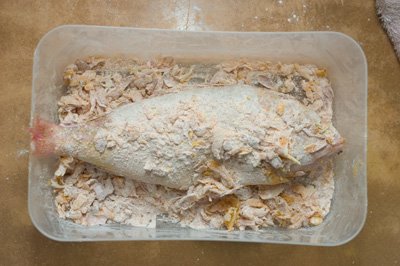
Coat the scaled and gutted fish with this mixture and set aside for 10 minutes:

After the 10 minutes, shake off the excess garlic/flour mixture, reserving all of it (there should be a lot), and fry the fish on both sides in plenty of oil over a medium-high flame:

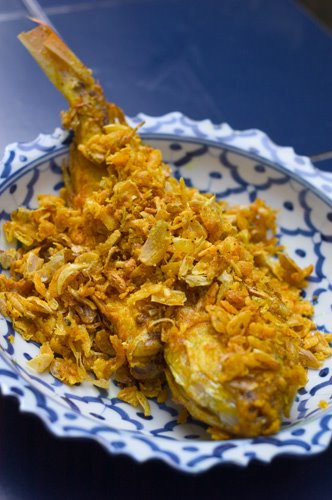
When the fish is cooked, crispy and yellow, remove and allow to drain. Now put all of the reserved garlic/flour mixture in the same oil and cook until crispy. Ladle this cripy gold over the fish, and serve:

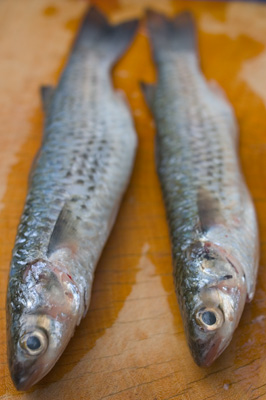
Now, for the mullet (heheh...) in turmeric broth, take a couple small cleaned and gutted mullets:

and chop their heads off. You could even chop the bodies into long-ish bits (as I did) if you prefer.

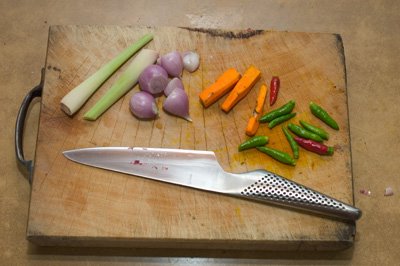
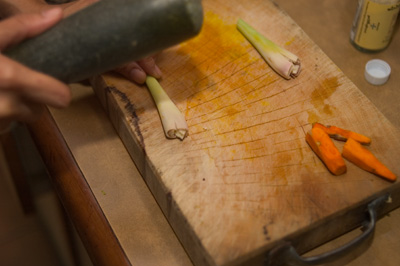
Bring about three cups of water to a boil. In meantime prepare your broth flavoring ingredients, a couple stalks of lemongrass, some peeled shallots, peeled turmeric and chilies:

Using a pestle or the head of a your nearest loved one, generously bruise two stalks of lemongrass

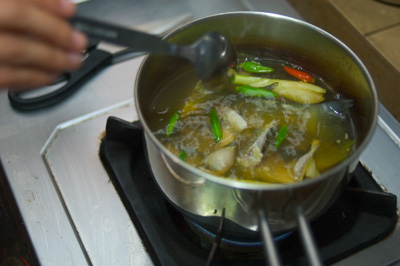
the shallots and chilies (this helps the flavors to release more easily), and throw all of this into the broth and simmer until the broth is yellow and fragrant, about 2-3 minutes:

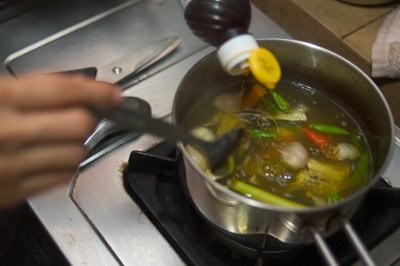
Add your mullet (hehehe...) and bring to a gentle boil. Add a few torn kaffir lime leaves. Flavor to taste with fish sauce and lime:

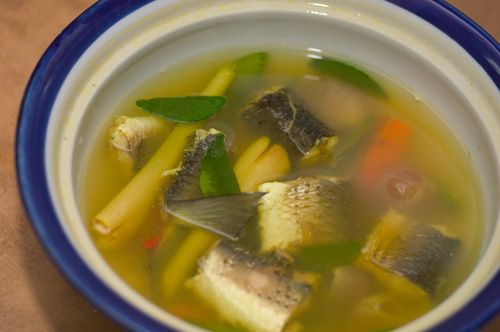
You is done:

(My apologies for the less-than-stellar last pic, it was getting dark and I was hungry!)

Bangkok with Pim

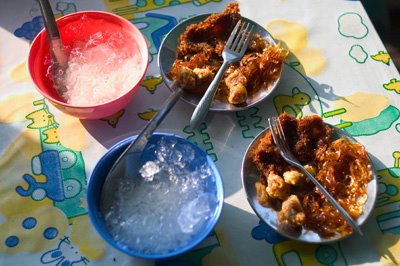
Spent a pleasant couple hours yesterday with Pim, of chez pim fame. She took me to the Tha Phra Chan area, a wonderfully congested part of Old Bangkok that is positively reeking of good eats. Among the things we feasted on were khao chae, a bizarre combination of jasmine-scented rice in ice water and savory tidbits:

Here's another vendor just up the road selling the same thing:

Khao chae is something I didn't care for too much the first time I tried it, but the mixture of sweet and savory is actually quite good, and you can expect to hear more from me about this unique dish in the near future.

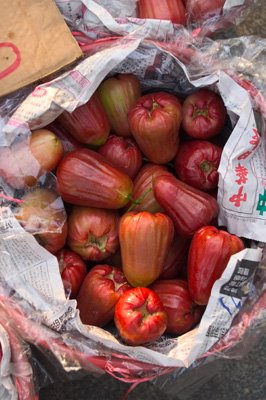
Also espied were a right handsome basket of Chinese rose apples:

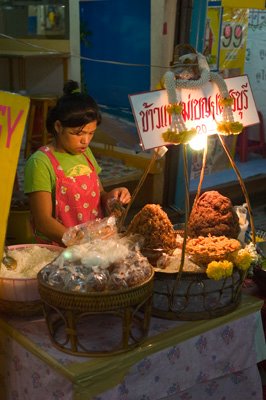
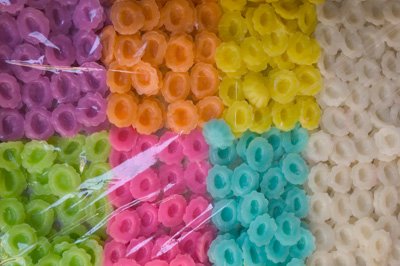
Some technicolor Thai treats:

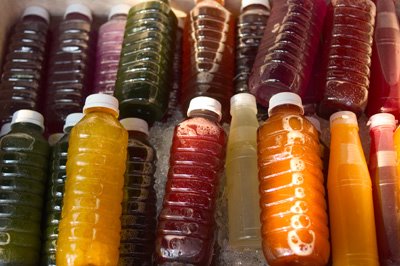
And some equally colorful juices:

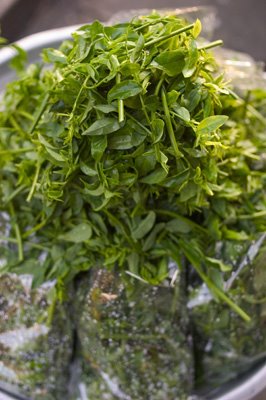
And this veg, called phak waan:

The fact that I knew the Thai name for this semi-obscure vegetable really freaked the vendor out, and I think she thought I was Thai and Pim was a foreigner!

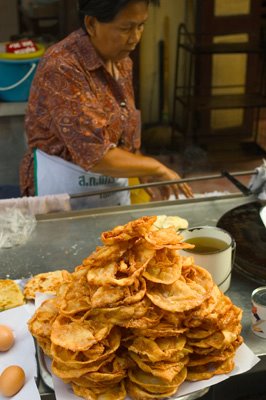
Came across these:

A kind of crispy roti, a snack I'd never seen before.

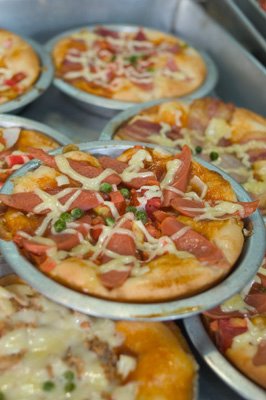
And finally, keeping with my Thai Baked Goods theme, an appallingly disgusting-looking baked treat labelled simply as "Thai Pizza":

Don't you always ask for lengthwise-sliced hotdogs, mayonaise, and peas on your Thai pizza?

And for those of you who are wondering what the real Pim looks like (she chooses to hide behind the false safety of a gigantic tea cup at her blog) I'm offering images of Pim in in her home environment for $20 a pop. Contact me for delivery details.

How To Make: (Southern Style) Kaeng Som

Kaeng som is probably the most well known southern dish within Thailand. Kaeng som is actually the name of a similar central Thai dish, so central Thais tend to refer to the southern version as kaeng lueang, or “yellow curry”, because of its color. This is not to be confused with the yellow curry that most foreigners are familiar with, which is a coconut-milk based curry of Indian origin called kaeng karii “curry curry” by Thais. Confused? Good, now we can begin.

Kaeng som (which I will continue to call it here) actually translates as “sour curry”, but the predominate taste is usually that of spicy. Very spicy. I consider this to be probably the spiciest curry in the country (which says a lot in a country of spicy curries!). The curry paste consists of a few simple ingredients, and the soup consists of fish (or other seafood) and typically one kind of vegetable (or fruit). That’s it.

Here are the curry paste ingredients:

Small fresh “bird shit” chilies 25
Small dried chilies 15
Garlic, chopped 6-8 cloves
Fresh turmeric, chopped 1 Tbsp
Salt 1 tsp
Shrimp paste 1 Tbsp

Using a mortar and pestle, smash all of these together very, very finely (it is important to do this well so you won’t happen upon any large bits of chili in your soup!).

The finished curry paste.

Put the curry paste aside and prepare the soup ingredients. Thinly slice sour, slightly unripe pineapple, about 1 cup. Clean and cut some fish into bite-size pieces until you have about 1-1 1/2 cups. I’m using a kind of fish known as plaa kraphong (sorry, can’t recall English name), which is the most common fish used in this dish. I reckon any white-fleshed sea fish will do. Set both of these aside. For your mise en place you’ll need a bottle of fish sauce, 3-4 sliced limes ready for squeezing, and some sugar.

Bring about 3-4 cups of water to the boil, add about half of the curry paste and stir and simmer until the broth is fragrant. Add more curry paste if necessary, but don't add it all at once as it may be too much!

Add the pineapple.

Simmer until it begins to soften, 3-4 minutes, and taste the curry. The pineapple should add a slightly sweet flavor to the broth. If you prefer more of this, add a bit of sugar.

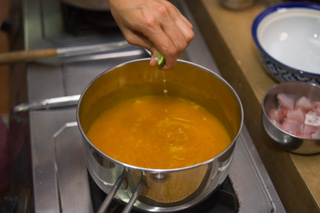
Squeeze a few limes’ worth of lime juice into the broth until you reach a tolerable state of sourness.

Remember, it is called “sour” curry, so there should be a definite sour taste, followed by spicy, salty and sweet. Add some fish sauce if it isn’t salty enough.

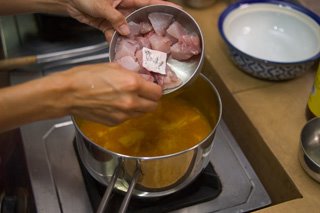
Now add your fish.

Simmer until the fish is just done, 2-3 minutes, remove from heat, and you’re done!

Serve with rice.

I like using pineapple in this dish as it adds a wonderful sweet flavor, but a variety of other veggies can be used, including pickled bamboo (very common and extremely sour) or slices of unripe papaya.

The Battle Is Over

Battle of the Khao Soi was a certified success, grossing me hundreds of thousands of dollars in endorsements, critical acclaim in a number of multi-national glossy magazines, and generating literally millions of hits to RealThai. There is talk of a made-for-TV movie, and this morning I was identified in the street four times. However most important is the fact that I continue to maintain my place as the King of Khao Soi. Onigiri and I have reached a truce of sorts and hope to conduct another competition in the near future.

I'll be heading down to southern Thailand, then on to Laos, and will probably not be blogging too much this month as a result. When I do get back however I'll post some juicy pics of southern Thai food.