How To Make: Phat Phrik Khing

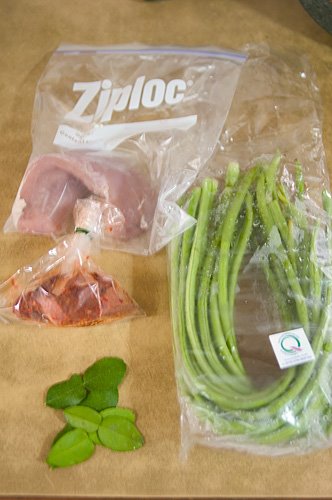
Today was a clean out the fridge kinda dinner, and here's some of what I came across:

Long beans, pork, curry paste... I know what you're thinking: You can make phat phrik khing! Well, that's what I thought, and here's how to go about it.

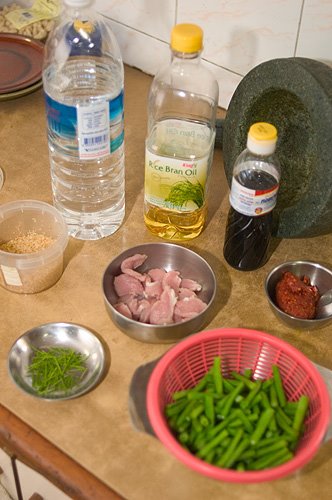
Phat phrik khing is a very easy dish to make, and is probably one of the first Thai dishes I ever learned to make. I think most of the ingredients, including the curry paste, are generally available in the West nowadays, so go ahead and give this one a try if you're new to Thai food. Going from my mise en place, here's exactly what you'll need:

Starting at 6 o'clock you have some parboiled long beans. These are made by taking long beans, chopping them into 1-inch lengths, and boiling them in salty water, immediately plunging them into cool water to stop the cooking process. Actually you don't have to parboil the beans first--you can just fry them in the curry, but I think this is easier. Continuing clockwise we have three or four kaffir lime leaves sliced as finely as possible, sugar, water, cooking oil and fish sauce. At 3 o'clock we have some phat phrik khing curry paste that I bought pre-made a few days ago. And in the middle is pork cut into bite-sized pieces.

First, using a generous amount of oil, fry the curry paste over med-high heat in a wok until it is fragrant and a layer of red oil has begun to emerge:

Then add your pork, coating it with the curry paste:

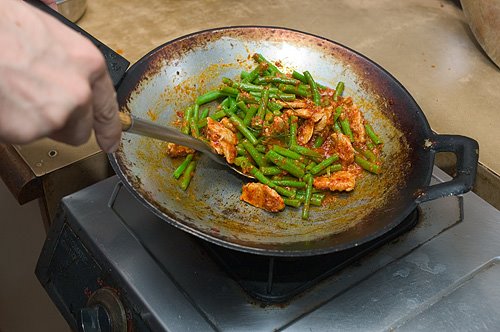
Continue frying and stirring until the pork is fully cooked, at which point the mixture should be quite dry. Add about a 1/2 cup or so of water, turning up the heat, and fry, stirring constantly, until the mixture is reduced and curry-like:

At this point season the mixture to taste with fish sauce and sugar (Thais like this dish sweet--I don't), and add your long beans and kaffir lime leaf slivers. As the long beans are already cooked, you really just want to heat them through here:

And you're done:

You could make with any meat you like--my particular favorite is big chunks of a particular kind of crispy dried fish--but pork is the most common. I had mine with hot rice and a fried egg.

Help!

Can anybody recommend a site that offers a good tutorial on how to change my template using HTML? I'd like to do some very basic things to this blog (make a lefthand sidebar, pull the right sidebar over where it should be) but can't figure out how. I've been looking at the source code of other blogs, but haven't been able to apply them to mine without messing everything up! Any help/advice would be appreciated greatly...

Smooth as ice

ThaiDay, 18/05/06
Gelato so remarkable you'll think you're in Italy

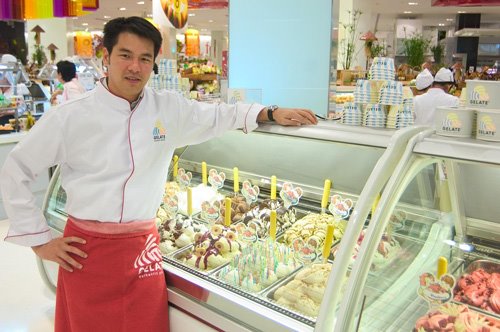
I’m a bit ashamed to admit that the first time I ever tried gelato was only last year, and in Macau of all places. I had heard about this famous Italian-style ice cream many times over the years, but nothing prepared me for my first taste: creamy, smooth and totally refreshing; thoroughly unlike any ice cream I’d ever tried. I’m still looking forward to trying the real stuff in Italy someday, but thanks to Ittiake Kittiungool, an enterprising 33-year-old Thai, tasting authentic Italian-style gelato now requires only a trip to Siam Paragon.

Kittiungool, who first discovered quality ice cream while a university student in San Francisco, took his newfound interest to lengths not many would be willing to follow. After returning home to Thailand, he arranged to take courses in ice cream making at the Frozen Dessert University in Bologna, Italy. At this institution, the only of its kind in the world, Kittiungool studied under Luciano Ferrari, a well-respected figure in the world of Italian-style ice creams. Upon returning to Thailand, he opened up Gelate, a shop selling gelato, milk-based ice creams, and sorbetto, fruit-based sorbets, at Central World Plaza.


Gelate owner Ittiake Kittiungool studied at Italy's Frozen Dessert University, where he learned the art of creating flavorful gelate and sorbettos.

I meet with Kittiungool, who has no previous experience in cooking or the food industry, at his shop in the basement of Siam Paragon. I ask him to describe the differences between North American-style ice creams, which comprise the majority of ice cream sold in Bangkok, and gelato. “Gelato has a dense texture, but is light and smooth, and it has less fat,” explains Kittiungool. “Also, all of the ingredients are fresh, which gives us the opportunity to create unlimited flavours.” He pauses and points at some freshly cut pineapples at a nearby stall. “For example, if we wanted to make pineapple sorbetto, we could just take that and use it right now. It all depends on whatever raw ingredients are available.”

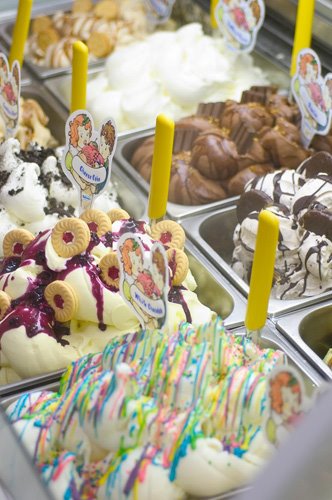
As we are talking two girls walk by and I overhear them remarking how delicious Gelate’s ice cream looks. This prompts Kittiungool to mention what is perhaps the single most recognizable aspect of gelato: its appearance. “How it looks is the most important thing,” he explains. “That’s what catches people’s attention.” At Gelate this involves whipping the ice cream into tall peaks, and decorating these with generous chunks of the various ingredients. Kittiungool even goes as far as to serve the gelato with the traditional flat metal spatulas rather than the ubiquitous ice cream scoop. This emphasis on authenticity has led to Kittiungool importing ingredients, machinery, and even display cases directly from Italy. “Our concept is to make everything as real as possible,” he explains.


A few of the gelate available at Gelato, a recently opened ice cream shop at Siam Paragon.

I ask Kittiungool if he has made any allowances for Thai tastes, and he explains that Thais aren’t as fond of sweet tastes as the Italians are, so his gelato is significantly less sugary. So far people in Bangkok seem to favour his milk-based gelate, and hazlenut and cheesecake are currently the shop’s best sellers. He offers me a bowl of three gelate: pistachio, double chocolate and bacio (Italian for “kiss”), a mixture of chocolate and hazelnut. Both of the nut-flavored gelate resonate with the flavour of real nuts, as opposed to powders or syrups, and the texture is smooth and almost fluffy. The pistachio gelato in particular is deliciously fruity and savory, with its green color an indicator of the generous amount of pistachios it includes. Gelate’s sorbettos consist of just fruit and syrup, and are thus fat-free, and the most popular flavour is fruitti di bosco, mixed fruit.

Right now Gelate can only be found at Siam Paragon, but Kittiungool plans to open outlets in Central World Plaza and The Mall Ngam Wong Wan in the coming months. “I’d love to have an shop with fresh ice cream made on-site, and a Lambretta hanging from the ceiling!” the young entrepreneur tells me while I try finish every last drop of my ice cream. Gauging by the product he’s created, it seems like it’s only a matter of time.

Gelate is located inside Gourmet Market, basement floor, Siam Paragon.

The Food of Luang Prabang

The following is a piece that I wrote several months ago about the food of Luang Prabang, Laos. Unfortunately the article was never printed, but to put it to some use I've decided to post it here. Incidentally, I do have photos to accompany the text, but they will be used to illustrate a similar piece currently being written by Bangkok-based writer which will run in an undisclosed magazine. So it's probably best not to post them here just yet. Enjoy!

I first visited Luang Prabang in 1998, when the most common way to visit the former royal capital was an arduous two-day boat trip from Chiang Khong, Thailand. Grimy backpackers mingled with homebound locals on the noisy ferry, and through the windows, Laos seemed very much like unexplored territory. Arriving in Luang Prabang, I was amazed to have found such a delightful place that had seemingly not yet been exploited by modern tourism. Accommodation was abundant and more than adequate, but the town’s food, typically quasi-Thai cuisine in overpriced restaurants, or the ubiquitous Vietnamese noodle soup, pho, left a great deal to be desired. The local cuisine was said to be interesting, but was really only available in take-home form from the evening market.

Fast forward nearly eight years and Luang Prabang is clearly on the beaten track. Tourists can now fly directly from Bangkok, and spas, boutique hotels, and high-end shopping are all firmly established. And as a result of all this activity, food, the one area that traditionally lagged behind for so long, is finally starting to catch up. The cuisine of Luang Prabang, for years a concept virtually unknown to the outside world, is by no means generating a buzz, but is grabbing attention, and is finally there for those who are willing to try it.

What have we been missing out on then? To get an idea of the food of Luang Prabang, the best place to go is the town’s daily evening market. It is here where vendors line the streets peddling the flavours of Luang Prabang: bright-red pork curries, grilled Mekong River fish, “salads” of local vegetables, homemade pork and herb sausages, and steaming baskets of sticky rice. The food of Luang Prabang is simple, honest and earthy, relying much on the use of vegetables, herbs, often those having a bitter-spicy flavour, ahaan paa, game from the jungle, and fish from the Mekong River. Unfortunately, the food at the evening market is sold to be eaten at home, and there are no tables or chairs.

However, if you like what you have seen, and you’re ready to taste Luang Prabang, a good starting point is the delightfully unpretentious, third-generation restaurant, Maly Lao Food. “We’re the only restaurant in Luang Prabang that serves authentic local food,” explains Yinthorn Dalachit, son of the restaurant’s namesake. He describes how his mother, Thai by birth, married a high-ranking resident of Luang Prabang and learned the local recipes well enough to become a chef in the former royal palace. The monarchy was abolished along with the advent of communism in 1975, but many of the recipes still survive and are now served in the restaurant.

The restaurant’s optimistic but barely-legible English-language menu doesn’t help much, but simply opening the first page (“Luang Prabang Specialties”) and pointing to a dish at random will virtually guarantee a good choice. With the benefit of experience, I order yam salat, a salad made from a variety of local watercress known as phak naam. The dish resembles a western salad, but the dressing, a tart mixture of lime juice, egg and ground peanuts, is unmistakably Asian. “This dish is very local,” explains Dalachit. “It is always served at any sort of festival or celebration in Luang Prabang.” Other specialties of the restaurant include or laam phak, a thick, savory stew of vegetables and local herbs, and laab paa, a “salad” of minced Mekong River fish with a spicy-tart dressing.

For a more upmarket take on the local cuisine, the Restaurant Les 3 Nagas is easily Luang Prabang’s most ambitious restaurant. An anomaly of sorts, Les 3 Nagas is a fine dining restaurant serving humble Luang Prabang dishes to a mostly foreign clientele. The owner, Yannick Upravan, describes the menu as “real Lao”, but admits that to suit foreign palates, he has compromised on the level of spiciness. “In the beginning I invited my family [to eat at the restaurant], and they said the food was good, but not spicy enough,” he relates, laughing. Ranging from local takes on well-known Lao dishes such as laab, to obscure specialties such as khai phaen, crispy sheets of Mekong river weed, the restaurant’s menu is a virtual encyclopedia of traditional Luang Prabang cuisine.

Ironically, Upravan’s first contact with the food of Luang Prabang came while he was living with relatives as a cooking school student in France. “My aunt’s husband was from Luang Prabang, and in France I ate Luang Prabang food every day,” he recounts. “When I came Luang Prabang I knew the flavours and tastes of the foods, but didn’t know the names. Everybody asked me, ‘How did you learn these recipes living in France?’”

In 2000 Upravan noticed the lack of fine dining in Luang Prabang, and he and a partner opened L’Elephant, a French bistro-style restaurant. An interest in the local cuisine of Luang Prabang’s continued to haunt him though. “Next door to L’Elephant was an aunt of mine,” explains Upravan. “She spent all day in the kitchen making Luang Prabang food, and I could smell this from L’Elephant. We began to exchange food, croissants for Luang Prabang dishes, and when she cooked something I asked her for the recipes.” This growing interest in the local food inspired Yannick to open a restaurant wholly dedicated to the food of Luang Prabang.

I ask Yannick to describe the flavours of Luang Prabang cuisine, and he replies “rustique”. “For instance, or laam,” explains Upravan, describing the thick herb-laden stew—a staple of Luang Prabang cuisine, “has meat, vegetables and paa daek [Lao-style fish sauce]. In the beginning you smell the paa daek, then you taste the flavour of the meat, and then finally the spiciness of the herbs. In this dish there are many tastes,” he explains.

And this complexity is certainly the case with the food at Les 3 Nagas. The food of Luang Prabang is subtle and earthy, slowly approaching you rather than hitting you in the face like Thai food often does. I order jaew bong, a paste of crushed dried chilies, garlic, shallots and buffalo skin that is probably Luang Prabang’s most famous dish. Eaten with sticky rice, the jaew bong is savory and heady—not as spicy as the amount of chilies would suggest, and it takes a few bites before I can really get a grasp on the wide variety of flavours at work.

Another highlight in Luang Prabang’s emerging culinary scene is the Maison Souvannaphoum’s restaurant, L’Elephant Blanc. The hotel and restaurant are located in the home of a former member of Luang Prabang’s royal family, Souvanna Phouma, and L’Elephant Blanc’s executive chef, Vanhsay Picknock, has created a menu that includes Lao and French cuisine, as well as dishes that were once favored by the prince, such as kaeng som kalampi, a sour soup of pork, white cabbage, and herbs such as lemongrass.

The restaurant’s menu also includes a few Luang Prabang specialties. “We have three old local ladies working in the kitchen,” explains Picknock. “We keep them around because they know the local recipes,” laughs the Vientiane-born chef. Local dishes at L’Elephant Blanc include sai ua, a sausage of pork and fresh herbs, and ua nor mai, a tender bamboo shoot stuffed with savory pork and deep-fried. “I was surprised,” replies Chef Vanhsay, when asked how foreign diners respond to local cuisine. “Foreigners who come here can eat Lao food, but if Lao people go to Europe, they probably won’t be able to eat the food,” explains the chef.

Luang Prabang, as well as the rest of Laos, was a French colony for more than 50 years, and the French left a significant culinary legacy, including baguettes, called khao jii by the Lao, and the ubiquitous coffee. This legacy is also evident in Luang Prabang’s numerous French restaurants. The best of these is L’Elephant, also co-owned by Yannick Upravan and his business partner, Gilles Vautrin. The restaurant, opened in 2000, serves, in the words of Mr. Vautrin, “simple, honest French bistro-style food”.

The menu at L’Elephant ranges from French staples using imported ingredients, such as escargots de Bourgogne, to more innovative dishes combining ingredients unique to Luang Prabang with French cooking styles, such as Bouquet de Cresson a la Vinaigrette, a salad using the local watercress. A particular highlight is the use of wild game such as boar and venison, manifest in the restaurant’s Terrine de Sanglier au Poivre Vert et au Cognac, Wildboar Terrine with Green Pepper and Cognac. L’Elephant also has its own organic farm with herbs such as basil and parsley, and salad vegetables such as rocket and frisee. “Sometimes during the high season we couldn’t get all the produce we needed, so we started up our own garden,” explains Gilles. “The produce is better quality and cleaner, and we even sell produce to other restaurants in Vientiane.”

Upscale local cuisine. Imported snails from France. Frisee in Laos. As I exit L’Elephant on my last night in Luang Prabang, reflecting on these culinary anomalies, my eye catches a snapshot of one of L’Elephant’s former customers: Mick Jagger. In this instant I’m convinced that yes, the food in Luang Prabang finally has caught up.

Hold the pretension

ThaiDay, 11/05/06
What's the quickest way to South India? Families converge on a fast-food favorite.

I had been eating at Komala’s, a Singapore-based Indian restaurant on Sukhumvit Soi 20, since it opened in 2002, and always harbored suspicions that the food was good. My hunch was confirmed when the food and beverage manager of a five-star Bangkok hotel—himself a native Indian and former chef—mentioned to me that Kormala’s was his favorite Indian restaurant in town. This is all it took for me to go back to the restaurant with an even more critical view.

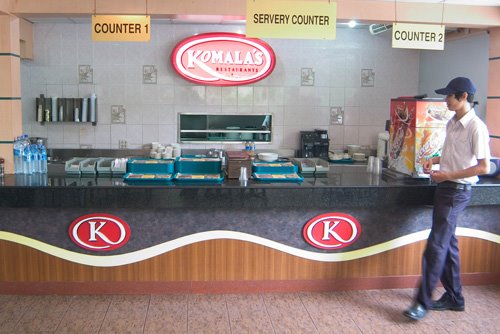
Do keep in mind that in the case of Komala’s, restaurant is a loose term. Specializing in southern Indian style vegetarian cuisine, Komala’s is a self-confessed peddler of fast food. But, please don’t run away just yet. As one would expect from a fast food joint, the emphasis on value (is this necessarily a bad thing?), and few of the restaurant’s dishes cost more than 100 baht. Unfortunately, this frugality is also manifest in the restaurant’s interior, which seems to share the same design sensibilities as McDonald’s (plastic molded chairs, an overabundance of counters, reckless use of teal), but luckily not in the food, which despite the setting, is as vibrant and delicious as any Indian restaurant in Bangkok.


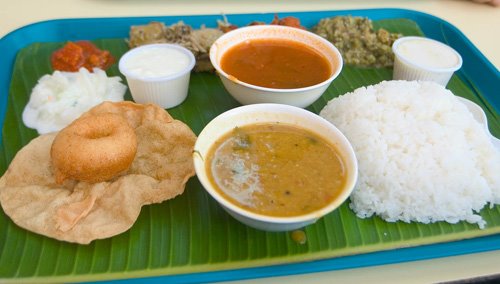
Komala's South Indian Meal.

Visiting Komala’s with a companion one recent Sunday, I strode into a restaurant packed to the gills with Indian families on their day out. Indeed, virtually every time I’ve been to Komala’s, I’m generally the only White Guy, which is generally a good sign. Ordering food here involves a confusing process of placing an order at the counter in the front of the restaurant (“Ordering Counter”) and taking the receipt to a counter in the back of the restaurant (“Servery Counter”), whereupon the food will be probably brought to your table by the wait staff. Despite the obvious setbacks, this system can sometimes work in the diner’s favor, such as when my companion was given a delicious dish (onion uttappham, ? baht) he hadn’t actually ordered.

I chose the South Indian Meal, a vast banana leaf topped with a manly mound of rice and no less than 12 different items including rasam, a sour broth; sambar, a hearty soup of pureed lentils and spices; and several delicious sides of steamed raw banana and curried vegetables, among others. Being a fan of sour tastes, I thoroughly relished the tart rasam and the mouth-puckering achar, and even liked the dessert—a tiny cup containing sweetened warm milk with vermicelli. I washed this down with the traditional can of Elephant Ginger Beer (“Using real ginger”), a tasty beverage of Sri Lankan origin.


Ordering at Komala's might be a confusing ordeal, but the food compares favorably to that found in any other Indian restaurant in Bangkok, especially given the prices. Just ignore the unfortunate color scheme and the plastic chairs.

My companion ordered the Mysore masala (95 baht), a large triangle of thin crispy dough filled with a spicy pulse and vegetable mixture, which he found agreeable. Indeed, the various breads associated with southern Indian cooking (dosai, rawa, parrotta, poori) are the restaurant’s specialty, and all are served with sides of coconut chutney, onion chutney, and the aforementioned sambar. Many of the breads are intimidating in their girth, but are generally quite light, and I never find one to be enough. However I still recall the shock on the faces of a Thai couple when served a dosai the length of a baseball bat.

Desiring more, my companion ordered a plate of samosa (? baht), which was the biggest disappointment of the meal. As if punishing us for ordering such a banal Indian standard, the samosa were doughy and tasteless, and seemed to have forgotten that they were supposed to be crispy. Also a letdown was another Indian cliché, the mango lassi (? baht). The drink appeared to be nothing more than yoghurt laced with a miserly swirl of mango syrup, and tasted correspondingly.


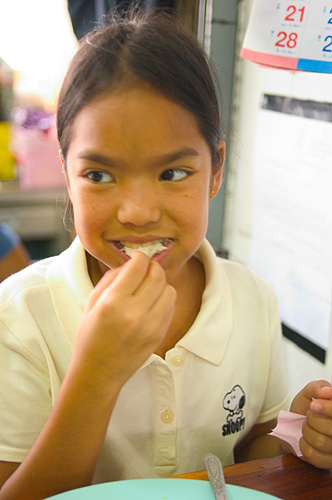
A girl enjoys bhattura, a deep-fried bread of southern Indian origin.

A girl at the table next to ours ordered a deep-fried bread that was puffed up to the size of a small basketball, a bhattura, I later learned. As the girl poked the bread with her finger in an effort to deflate it, her father told us that the food at the Bangkok Komala’s was “different” than that of its Singaporean predecessor, although he wasn’t able to explain exactly how. In general I found the food at Komala’s to be everything good food should be: tasty, a good value, and fun, bringing into question why other restaurants need to go to such pretentious lengths (custom-designed carpets, foie gras) to provide good sustenance. Although honestly, somewhat less teal would be appreciated.

Komala’s
15 Sukhumvit Soi 20
02 663 5971-2

Biryani, Bangkok style

ThaiDay, 11/05/06
Lifting the lid off 'khao mok,' a popular Thai variant of a world-famous dish.

I can still recall a conversation I had with a friend before visiting Thailand for the first time. We were sharing what precious little we knew about the country, and he was enthusiastically going on about how much he loved Thai food, “Especially that peanut sauce,” he said, mentioning the famous accompaniment to sate. As is the case with many Americans, and indeed, many Thais, neither of us was aware that several of the dishes one associates with Thai cooking are actually Muslim in origin.

Although Muslims form less than 5% of Thailand’s population, they have nonetheless had an immense influence on Thai food. Popular dishes such as sate, grilled skewers of meat served with the aforementioned peanut sauce, the fried ‘pancakes’ known as roti, and perhaps the most lauded Thai curry of all, kaeng masaman (literally ‘Muslim curry’) are all Muslim in origin, having been brought to Thailand by Muslim traders several hundred years ago. Thai-Muslim food is generally characterized by the use of dried (as opposed to fresh) spices, and many dishes tend to be quite sweet and savory, rather than spicy. Thai-Muslim food is, like other Muslim cuisines around the world, largely meat-based, and dishes must be halal, meaning that cooks must follow certain religious precepts regarding the slaughter of meat, and the avoidance of pork and alcohol, among other things.

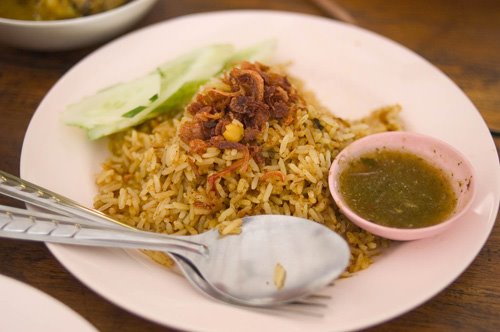
One of the most common Thai dishes of Muslim origin, and a dish that combines nearly all of the elements above, is the spiced rice dish is known in English as biryani. The dish is thought to have its origins in India, and variations can be found around the world, ranging from the Central Asian pilaf and the Indian biryani, to the more distant Spanish paella and the jambalaya of New Orleans. Thai biryani, called khao mok (literally meaning ‘buried rice’) is known for its bright yellow color, a result of the use of turmeric, and is typically served with chicken that has been cooked in the rice, along with sides of sliced cucumbers and a sweet and sour sauce. Formerly a dish associated with Muslims, khao mok is today made by Buddhist Thais as well, and can be found in virtually every part of the country.


A dish of khao mok, a Thai version of the Indian dish, biryani.

Despite its ubiquity, khao mok is a notoriously difficult dish to make, and is almost exclusively eaten in restaurants. I was curious to learn more about the making and the history of this unique dish, and was fortunate enough to share this interest with David Thompson, the Head Chef of London’s Nahm, the Michelin-starred restaurant that is arguably the most acclaimed restaurant in the world serving Thai food. Mr. Thompson is currently in Bangkok working on a Thai cookbook, his second, and was also interested in learning more about khao mok.

We begin our research at Yusup, a popular Muslim restaurant located along the Kaset-Nawamin highway, north of Bangkok. The restaurant’s near-perfect khao mok is its major draw, and includes versions made with beef, goat and the standard chicken, as well a version made with fish. It is this unusual latter take on the dish that interested David and me, and we asked if the shop would be willing to show us how to make khao mok plaa, fish biryani. They agreed, and a couple weeks later, accompanied by David and his partner Thanongsak, I met with the restaurant’s owner and namesake, Yusup at the newest branch of his restaurant in Bang Na.

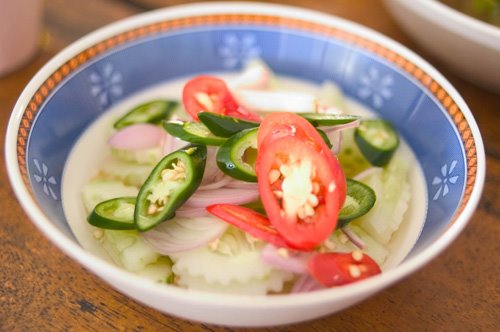
Before going directly into the cooking, we began with a meal of several Thai-Muslim specialties including sup hang wua, a deliciously sour broth of oxtails; kurma kai, a thick curry of chicken that, as Thompson points out, is also Indian in origin; kaeng karii kai, a watery coconut milk and dried spice-based chicken curry; and of course, khao mok plaa. As a side we were also given a small bowl of ajaad, a condiment consisting of sliced cucumbers and chilies in a mixture of syrup and vinegar, that, as Thanongsak suggested, did an excellent job of cutting through the predominately heavy and oily main dishes.


Ajaad is a common condiment in Thai-Muslim cooking.

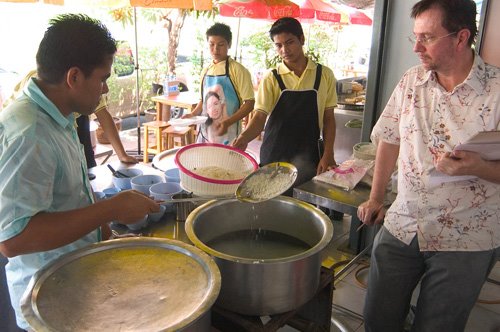
Moving to an improvised kitchen, Yusup began his cooking demonstration by sautéing a thick curry paste in a large pot. “You have to fry it until it is almost burnt,” he explains. “Otherwise it won’t taste good.” When I ask what the ingredients are, he says sheepishly that this is his “secret”, and admits only to the use of milk and dried spices. Thompson, intrigued by this, tastes and smells the mixture, giving me his take on the ingredients (“There’s definitely some cardamom in there, something sour, maybe vinegar…”). Yusup reveals only that most of the ingredients he uses are available in Thailand, and that some have to be ordered from Egypt. He continues by adding chopped tomatoes and coriander, and additional dried spices, stirring the mixture with a giant wooden paddle.

I ask Yusup about his cooking background and he relates simply that he “loves making food.” He confesses to being largely self-taught, having learned mostly from books and trial and error, and claims that it took him more than two years of experimentation to reach a khao mok recipe that he was satisfied with. While he is talking he adds a small amount of chicken broth to the mixture, followed by several hearty steaks of plaa insee, Spanish mackerel. He closes the lid, and moves to another large pot of boiling water. Into this he adds several cups of rice, a handful of lentils and some dried spices. He explains that he is going to par-boil the rice before adding it to the curry paste and fish mixture. “This is my own step,” explains Yusup, “Others don’t do this, and this is part of what makes my khao mok different.” Thompson explains to me that this step leaves the rice half-cooked, with a translucent exterior and solid core—perfect for absorbing more spices, yet able to avoid becoming soggy.

When the rice is ready, Yusup strains it from the water and adds it to the curry paste mixture, which by now how has reduced considerably. “You have to do this step quickly, or else the rice will overcook,” he explains. He drizzles the rice with melted butter and deep-fried shallots and replaces the lid. “When steam starts coming out, that means it’s done,” he explains confidently. After only a few minutes steam does start emerging from the pot, and it is as this point that Yusup removes the lid and declares the khao mok done. I glance into the pot and am surprised to see that the rice hasn’t yet obtained its characteristic yellow color. Yusup carefully removes the fish steaks, and using the paddle, gently stirs the rice, which has the effect of turning the entire mixture yellow. He tastes the khao mok, and his excitement is almost tangible. “Wow!” he exclaims calling his staff over to smell and taste the result, “This is even better than the stuff we usually make!”


Michelin-starred chef David Thompson turns to restauranteur Yusup to learn the secret of his delicious khao mok.

We sit down to eat this still-warm khao mok, and it is indeed sublime; hearty and fragrant enough to be eaten on its own without the traditional sauce. “This is a dish that’s always disappointed me until now,” explains Thompson, going on to describe how khao mok is too often simply rice adulterated with copious turmeric and topped with rubbery fried chicken. Yusup’s khao mok plaa has seemingly inspired Thompson, who is thinking out loud about the possibility of a khao mok with lobster. Perhaps it is only a matter of time until diners at one of London’s finest restaurants are greeted by a dish of Muslim origin with a long history and a particularly yellow hue.

Yusup is located along the Kaset-Nawamin Highway (known to taxi drivers as sen tat mai, the ‘new road’), in Bangkok’s Bang Khen district. The shop is on the left-hand side before the first stop light.

Khanom Jeen!

Today was definately a theme day: khanom jeen. These are noodles made from fermented rice involving a very unique process. I was able to see this firsthand a couple of years ago in Sangkhlaburi, a small town on the Thai-Burmese border. The name khanom jeen includes the Thai word for Chinese, jeen, which causes many people to think the noodles come from China. However khanom jeen are actually Mon in origin, and as Sangkhlaburi is home to many Mon people, this was an excellent place to see the noodles being made.

The first step involves mixing rice with water. When this mixture is sufficiently soft and slightly fermented, it is boiled, blended and poured through a seive into boiling water:

The mixture solidifies in the water resulting in thin, white noodles, which are immediately stacked:

and sold or consumed, as they tend to spoil quickly.

Back to the present--I'm making an effort to try new places, and the restaurant we visited today, despite being very close to my house, is the kind of place one passes by but never stops at. Well, today we stopped, and it was well worth it.

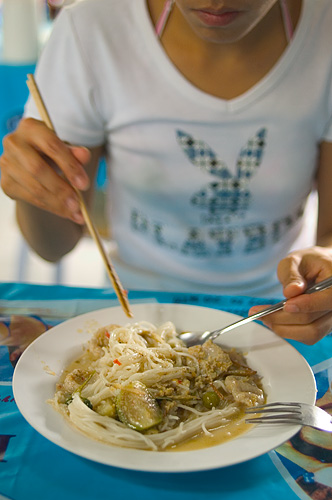
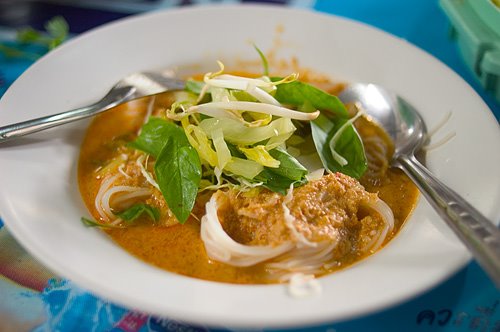
The first dish I ordered was khanom jeen kaeng khiaow waan look chin plaa kraay (whew!), fermented rice noodles topped with green curry and fish balls made from plaa kraay, a type of freshwater fish:

I assume most of you are already familiar with green curry, but this a particular variant that is typically taken with khanom jeen. The green curry is given some life with slivers of kra chaay, an indegenous root herb somewhat similar to ginger. An authentic recipe for this exact curry can be found here at Chez Pim.

The curry was excellent--one of the best green curries I've had in ages--not nearly as watery as most of the "green curry" peddled around Bangkok nowadays. I wasn't so hot about the fish balls (too rubbery), although Khuat liked them:

(Please note that one does not usually employ chopsticks when eating khanom jeen---she had ordered noodles, saw how delicious my dish looked, and changed her order!)

Being thoroughly impressed with the food at this shop, I ventured further into the world of khanom jeen and ordered a dish of naam yaa:

This is a coconut milk-based curry, this time featuring pureed fish, that is only eaten with khanom jeen. This dish was just as good as the first one--especially considering that it is usually to sweet for me. It also included a generous amount of kra chaay, which gives the dish a simultaneous cooling/spicy flavour!

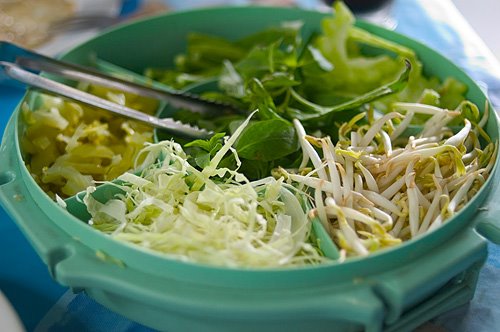
Upon ordering this dish, I was given a dish of raw veggies to eat with the noodles:

Starting from the bottom and moving clockwise we have shredded cabbage, pickled mustard greens, green beans, parboiled bitter gourd, bean sprouts, and in the center, bai menglak, an herb that has the unfortunate English name, hairy basil. You simply take what you like and mix it up with the noodles and curry.

And as if this wasn't enough khanom jeen, I had another plate at home when I took a pic of khanom jeen naam yaa pak tai, khanom jeen with a spicy southern Thai-style curry for my cookbook on southern Thai food:

I made this one myself, and it is topped with some exotic fresh herbs I picked up at the southern Thai place down the street. This particular curry is, like naam yaa, only eaten with khanom jeen, however it is much, much more spicy, requiring something like 50 dried chilies its chili paste!

A Whole Lotta Yen Ta Fo

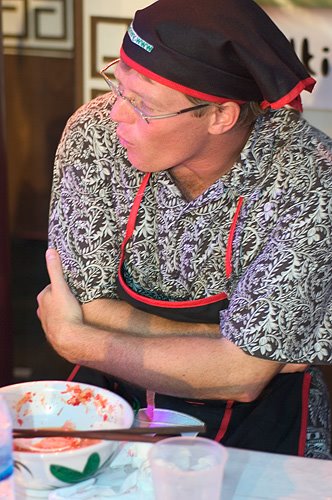
On Saturday I was fortunate enough to take part in ages-old Thai tradition: a yen ta fo eating contest. Yen ta fo, for those of you who have been living under a rock, is a Chinese noodle dish that is probably the most popular of all noodle dishes in Thailand, and has been mentioned previously here. A friend of mine was invited to take part in this contest--not necessarily because of his competitive eating skills--but rather because he was invited by the owner of the chain of yen ta fo restaurants who apparently needed a Token White Guy! The contest was sponsored by the well-known noodle restaurant, Yen Ta Fo Khrueng Song, owned by Ajaan Mallika, who also works at the school my friend works at.

Anyway, this is Kelly being introduced by two extremely perky TV hosts:

And no, he doesn't normally wear the apron and hat.

There were eight contenstants, and they had one hour to eat as many bowls of yen ta fo as possible.

One important ingredient in yen ta fo is a big fat cube of coagulated pork blood:

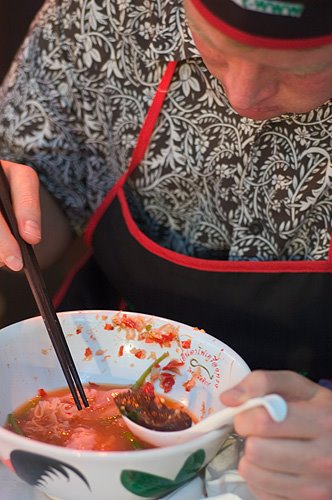
And lest you think eating a bunch of noodles looks easy, I should mention that the contestants had to eat the rot jep, "searing taste" noodles, with an almost obscene amount of chilis, as illustrated below:

This young man hiding behind a stack of consumed bowls is the eventual winner:

Here's last year's winner, who this year came in nearly last:

However it was Kelly who eventually did come in last... He was able to eat only six bowls, whereas the winner, a skinny university student, ate 12 bowls!

After the contest, everybody was given a popsicle, which I thought was a bit odd. When Kelly emerged several minutes later he said that the reason for this was so that everybody could use it to facilitate vomiting! He said backstage was a mess--not something I want to reflect on...

Silom Soi 20

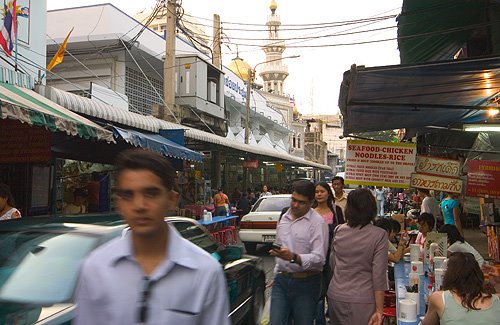
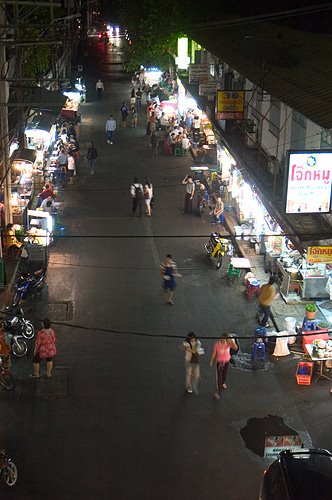
Was downtown yesterday and decided to stop by another well known food street, Silom Soi 20. Although not as well known or expansive as Sukhumvit Soi 38, this street also seems to get its fair share of both hungry Thais and sunburnt whiteys. The street is in what must be one of Bangkok's most multi-cultural areas, with a great deal of people of Chinese origin, a popular mosque, a very large Hindu temple across the street and even a sizeable Burmese population.

Here's a view of the street:

You can see the spire of the mosque in the background, and some Muslim dishes are sold there, and keeping with the multi-culturality of it all, a Chinese guy selling pork just accross the street!

The majority of the food on Soi 20 is Chinese-style, which means lotsa frying:

So with this in mind I started out with a dish of phat see ew:

It was too dark inside the shop to photograph the dish, but it was nothing special. Hardly a tick on the bum of this phat see ew near my home, and I needed to add about six tablespoons of fish sauce to make it taste like anything.

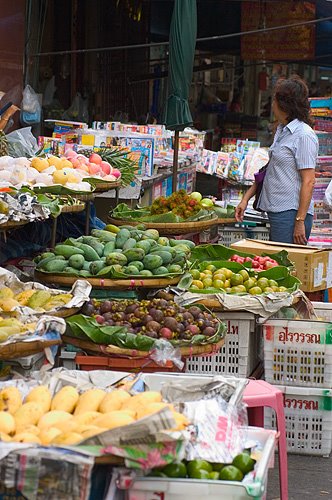
In general the street seems to sell more fruit than cooked food, as can be seen here:

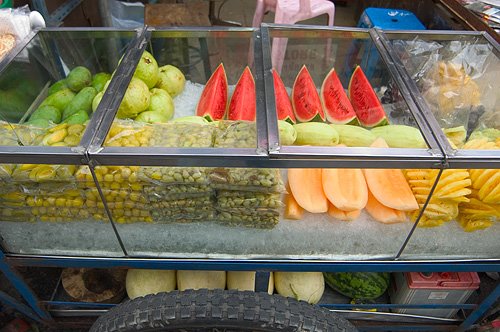
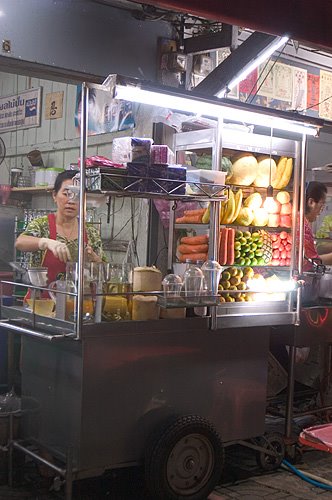
For those too lazy to peel their own, here's a close of up a fruit cart that can be found in virtually every corner of Bangkok:

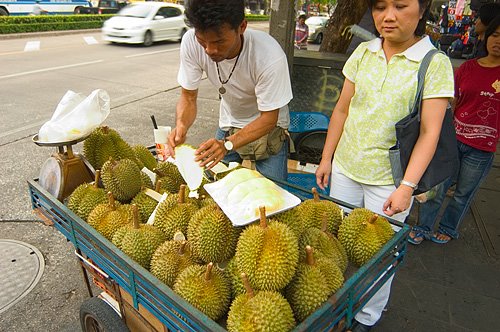
And some fresh durian sold near the Silom end:

On my way out I noticed a new restaurant across the way on Silom. The restaurant was called Roti Yummy and specializes, as the name suggests, in roti, a kind of fried "pancake", normally associated with Thai-Muslim food. I was excited about this, as roti with curry is one of my favorite dishes. I stopped by and ordered plain roti and a bowl of kaeng karii kai, Muslim-style chicken curry...

...and was rapidly disappointed. The roti was OK; hot and crispy in the right places, but the curry was bland and stodgy; a big fat brown bowl of mush. With a corny name like Roti Yummy I should have known better.

Culinary castaways

ThaiDay, 04/05/06
Koh Kret - a time capsule for long lost treats.

In recent years Western fast food has had an immense impact on the eating habits of the people of Thailand. Rarely do Thais crave such traditional snacks such as miang kham, wild tea leaf ‘packages’ filled with fresh herbs, or kai sarong, savory balls of chicken wrapped in noodles and deep-fried. Today, most Thais would probably rather buy a bag of chips at one of countless 7-11’s, or fried chicken at a nearby KFC. This drastic change in diet and the resulting homogenization of a once diverse cuisine means that many traditional recipes stand the risk of being lost forever.


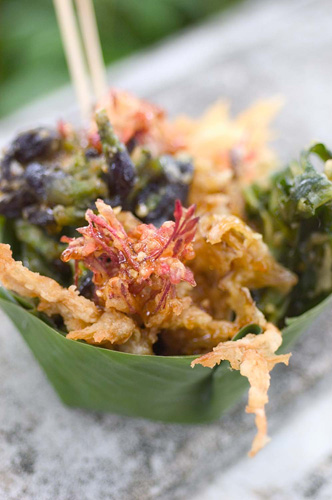
Thod man nor ka laa, deep-fried battered herbs and flowers that are a speciality of Koh Kret.

Thankfully there are a few places in Thailand that have chosen to preserve this rich culinary heritage. Once such place is the island of Koh Kret in Nonthaburi province, north of Bangkok. This ‘island’ is actually the result of a canal dredged to shorten an oxbow bend in the Chao Phraya River nearly 300 years ago. The area is also home to a community of Mon people that have lived in the area since the capital of Thailand was moved to Thonburi from Ayuthaya, and today Koh Kret is a stronghold of Mon culture in Thailand. This, coupled with the island’s relative isolation, have made it an excellent place to sample the obscure but delicious food of the Mon people, as well as a variety of old fashioned central Thai fare.


Koh Kret is known for its pottery, which is often used to serve coffee and other drinks.

To experience these diverse tastes, I paid a visit to the island on a recent Sunday. Koh Kret is an extremely popular destination on weekends, when urban Thais come in droves to eat and shop, and the day I visited was no exception. I boarded a very crowded boat at Wat Sanaam Nuea for the brief ride across the Chao Phraya River and set off to explore the culinary possibilities of this tiny man-made island.

Virtually the first thing one encounters after disembarking from the boat, and probably the commonest dish on Koh Kret, is a snack of Mon origin known as thod man nor ka laa. Thot man usually refers to a dish of deep-fried patties of ground fish, however this particular version consists of various fresh herbs, colorful flowers, mushrooms and nor kalaa, an aquatic vegetable, battered, deep-fried until crispy, and served with a sweet and sour sauce. The result is both delicious and attractive, particularly considering the rare pleasure of eating such colorful flowers. The thot man nor ka laa are, like many other dishes on Koh Kret, served in traditional banana-leaf cups called krathong, although nowadays the krathong are held together by a staple, rather than the bamboo toothpick of the past.


Khanom bueang, an old-fashioned Thai sweet.

A variety of Mon dishes are can be found on Koh Kret, including khanom jeen, fermented rice noodles eaten with a variety of different curries, and the rice dish known as khao chae. The latter is an improbable but delicious combination of camphor-scented rice in chilled water with savory tidbits, and is particularly popular during the Thai summer, as it is considered to have cooling properties. I stop by Khao Chae Khun Daeng, probably the most popular of the numerous khao chae restaurants on the island, and am given the requisite rice along with a dish of candied strips of daikon coupled with savory dried pork. The odd combination of sweet and savory somehow works, and the coolness of the rice leaves me feeling refreshed and ready to continue my culinary tour.

Other than Mon food, Ko Kret is also known for its khanom, sweets, and khong waang, savory/sweet snacks, and most visitors to the island leave clutching bagfuls of both. This wealth of sweet food is due to the fact that sugar palms grow very well in the fertile soil of the riverbank, thus supplying the people in the area with ample raw materials. Many of the sweets sold on Koh Kret are of high quality, but are generally easy to find on the mainland, and much more interesting are the khong waang, many of which are rarely made or eaten nowadays. These include miang kham, wild tea leaves topped with a do-it-yourself mixture of fresh herbs and a thick, savory/sweet sauce, and pan sip, tiny deep-fried “turnovers” filled with a mixture of shredded fish, ground peanuts and black pepper. Another delicious snack one rarely sees nowadays is kai sarong, minced chicken wrapped in egg noodles and deep fried, resulting in crispy golden balls.


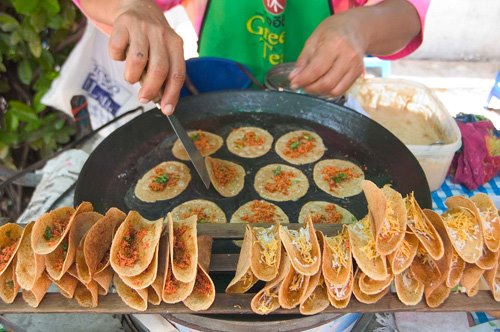
Koh Kret is home to a variety of old-fashioned snacks, such as these griddled quail eggs.

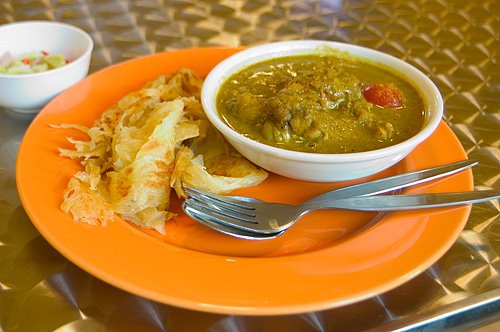
This emphasis on antiquated food extends to meals too, and many of the restaurants on Koh Kret specialize in dishes that have fallen out of favor. Driven by the intense heat of midday, I stop for lunch at a such a curry stall where I order phat phrik khing, long beans fried with pork and a sweetish curry paste, and kaeng phet, a coconut-milk curry, in this case made with pork and hearty chunks of pumpkin. Another old-school Thai dish available on Koh Kret is a soupy curry known as kaeng bon. Similar to the central Thai favorite kaeng som, kaeng bon differs in that it includes kaffir lime zest and krachaay, an indigenous root similar to ginger, added to the curry paste. The curry is thicker than that of kaeng som, the result of the addition of the pounded flesh of grilled fish.

Koh Kret is a fertile island, and during the course of the day I see numerous vendors selling the various agricultural products grown on the island. I was delighted to see that many of these were indigenous Thai fruits and vegetables, such as kaffir limes, buap (a kind of gourd), tam lueng (a leafy vine) and fresh herbs, such as Thai basil, cha om (a pungent leafy herb) and the aforementioned nor ka laa.


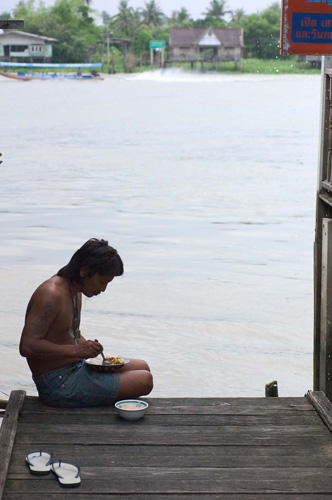
Enjoying lunch near the Chao Phraya River, Koh Kret.

By the time I come to the end of my culinary tour it is late afternoon and the crowds on Koh Kret seem to only be getting larger. I decide to leave, but first I indulge in a particular specialty of Koh Kret: freshly brewed coffee. Countless stalls selling coffee prepared the old-fashioned way dot the island, and as Koh Kret is also known for its pottery, the drinks are served in large clay cups produced on the island. As I sit enjoying an iced coffee among the throngs of visitors, I’m reminded that in many cases, tourism is often a destructive phenomenon. However in the case of Koh Kret, tourism has given the locals incentive to continue culinary traditions that might otherwise have died out, something that left a very good taste in my mouth.

This article is also available at ThaiDay's website here.

Winner House

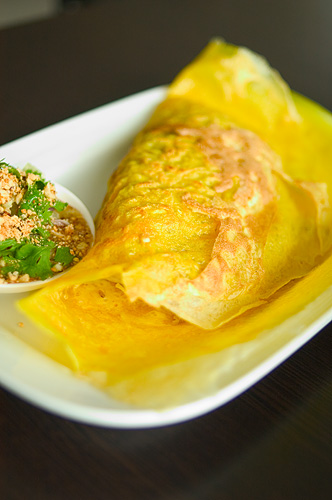
This is the odd name of a Vietnamese restaurant near my house. We've passed by it several times, but never ate there until today. I think it's a chain, and features the kind of uninspiring interior that one would expect from such a place, but the food was actually pretty good, if a bit overpriced. I like Vietnamese food, but in Thailand, it almost always tends to be the same 5-6 staples dishes on offer, usually of virtually the same quality and style. Would be nice to find an authentic, no-frills Vietnamese place in Bangkok with some different dishes.

We started with khanom beuang yuan:

The thin, crispy "pancake" is filled with ground pork, minced shrimp, firm tofu and beansprouts. Most Thai just pour the sauce over it and go at it with a spoon and fork, but I like to eat it Vietnamese style, which means rolling bits of it up with the provided fresh herbs (mind, coriander, etc.) and sauce in lettuce leaves and eating with your hands.

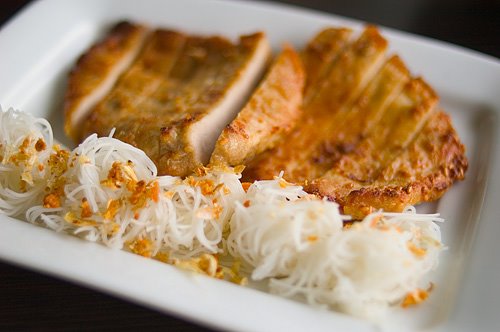
We also had muu yaang, grilled pork with a side of fermented rice noodles and crispy garlic:

Not bad at all--the pork was marinated before being grilled, and despite being quite try, was pretty tasty. A bit too meaty for this wannabe veggie though.

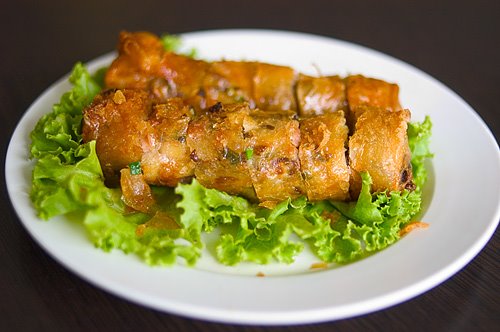
The best dish of the day was poh pia thawt, deep-fried spring rolls:

I almost feel a bit embarrased ordering spring rolls--they're a bit of a foreigner cliche in Thailand, but these were by far the best I've had in a very long time; crispy, hot and made to order, and generously filled with savory/sour fermented ground pork, glass noodles, mushrooms and some crispy vegetable that I forgot to identify. We ordered two plates of this. We also ordered pho, Vietnamese noodle soup, which was very bland and not worth showing here. I've had pho a few times in Thailand and for some reason the Thais cannot do this dish any justice. All in all a nice lunch, but probably not worth the cost (believe it or not, $11 is a substantial amount for lunch for two in Thailand!).

Cornucopia

This week's Cornucopia is about ahaan kin len, Thai snack food, and is, as always, an interesting read. In it Mr Sukphisit mentions several dishes that I've heard of, but haven't had the chance to sample, and he does a great job of tying in culture, langage and food.

Sukhumvit Soi 38

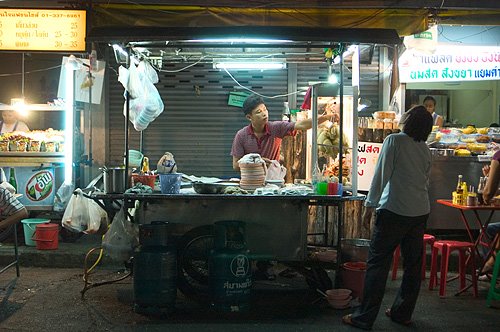
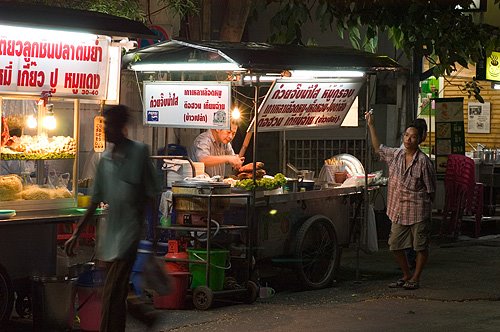
This is a street in Bangkok that is particularly known for its street food. Every night at about 7:00 vendors push their carts out to the intersection with Sukhumvit and the hungry follow them there. The area has been well known for ages, but I get the feeling that it might be in the process of becoming a Tourist Attraction, as there were quite a few lost-looking foreigners clutching guidebooks, and the prices on some dishes were substantially higher than usual. I must admit that I've only recently discovered this area; I live on virtually the opposite end of Bangkok and don't tend to eat Thai food outside of my area too often. However, I'm looking into moving--possibly to this street--and the added benefit of good street food might make it an easy decision!

Here's a view of the street from the Thong Lor BTS station:

This guy is selling khao man kai, Hainanese chicken rice:

The guy on the right is making khaa muu, pork leg stewed in spices:

And to his left is the noodle stand I ate at. I had yen taa fo, a Chinese noodle dish. Here it is being prepared:

He's adding phak bung, a crunchy green vegetable known in English as morning glory. The noodles were excellent--probably one of the best bowls of yen taa fo I've had--but at 50 baht, also one of the most expensive! However I'm always willing to pay a bit more for good food, and ahem, atmosphere (the noodles were consumed while sitting on a plastic stool on the side of the road with me virtually dripping with sweat).

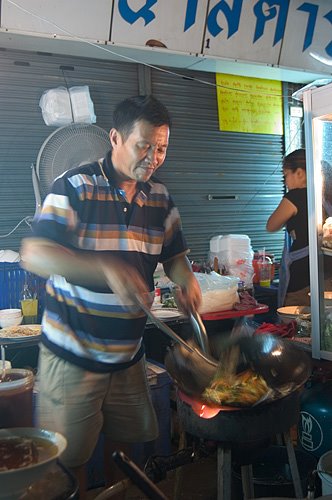
Frying phat thai:

Makin juice:

This lady makes yam, Thai-style spicy/sour 'salads':

Luso-Siamese synergy

ThaiDay, 27/04/06
Tracing the roots of Portugal's influence on Thai cuisine.

I have some news for you: the green curry you ate last night is really a Portuguese dish. And your favorite som tam? Portuguese as well. Fancy a glass of cha dam yen, Thai-style iced tea? You have Vasco da Gama to thank for that. Well, OK, I’m exaggerating a bit, but it is essentially true that none of the above Thai dishes would have been possible without the help of the Portuguese.

This is because many of the ingredients and dishes that we consider Thai are actually fairly recent culinary introductions, a result of the influence of Portuguese traders and missionaries who visited Thailand starting in the 16th century. This 500-year-old exchange of produce and ideas had a profound impact on Thai food, and largely contributed to defining the cuisine we are familiar with today.


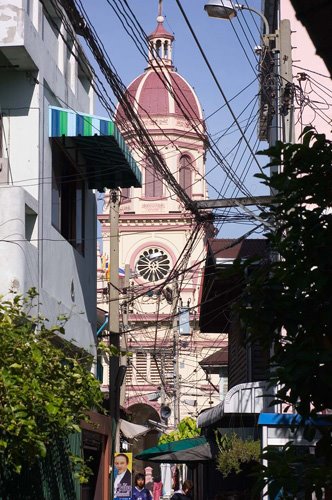
The area surrounding the Santa Cruz Church was once home to a community of Portuguese settlers.

The Portuguese were the first Europeans to visit Thailand, having arrived at the former royal capital of Ayuthaya in 1511. Establishing friendly relations with the court of King Ramathibodi II, the Portuguese were quick to take the exciting new products coming from the Americas and market them in Thailand. Thus saw the introduction of such modern-day Thai staples as tomatoes, potatoes, corn, lettuce, cabbage, chilies, papaya, custard apples, guava, pineapples, pumpkins, sweet potatoes, cashews, peanuts, and tobacco. Today these ingredients have been integrated to such an extent that their origin is largely forgotten, and few Thais are aware that their beloved chilies, for example, are actually a non-native species.

The Portuguese were also responsible for bringing products from other parts of Asia to Thailand, such as cinnamon from Sri Lanka and nutmeg and cloves from Indonesia. Perhaps the most significant example of this inter-Asian commerce was the trade of a simple leaf known in an obscure southern Chinese dialect as te: tea. The Portuguese brought tea from China and introduced it to Thailand and much of the rest of Asia, and were also largely responsible for popularizing the drink in Europe.


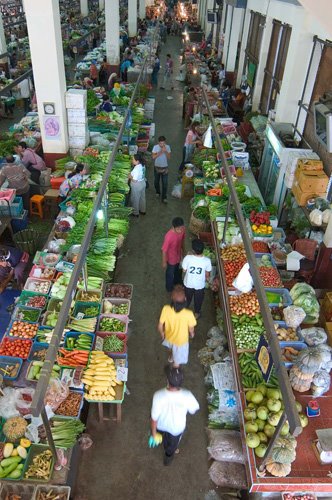
A great deal of the produce that Thais use on a daily basis are actually fairly recent introductions courtesy of Portuguese traders.

Other than introducing a new variety of raw ingredients, the Portuguese also had an impact on the way Thais cooked. This influence is most clearly seen in the area of khanom, sweets. In fact, Thai history claims that much of the Portuguese influence on Thai sweets can be traced back to a single person: Marie Guimar, the mixed-race Portuguese wife of Constantine Phaulkon, Greek explorer and high-ranking minister of King Narai. Guimar had a strong influence on the kitchen of the royal household, and by introducing the concept of baking and the use of ingredients such as egg yolks and flour—methods and elements unknown in Thailand but integral to Portuguese dessert making—she had an impact on Thai desserts that can still be seen today.

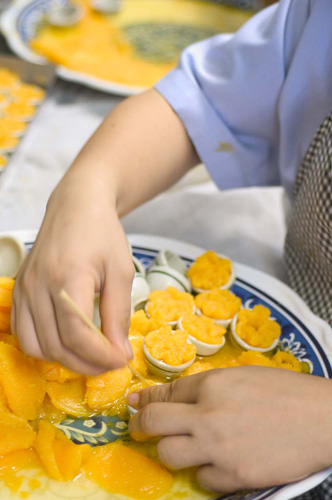
One of the most obvious examples of the Portuguese influence on Thai sweets can be seen in the numerous desserts that share the Thai word for gold, thong, a reference to the yellow/orange color imparted by the liberal use of egg yolks. These desserts include thong ek, thong yawt, thong yip, and foy thong, and are all variants of a family of Portuguese desserts known as ovos moles. Despite the passing of a half-century since their introduction, many of these sweets are still similar in form to desserts that can be found in Portugal to this day. To learn more about the production and origin of these desserts, I paid a visit to the factory of Kanomthai Kao Peenong, the largest producer of Thai sweets in the country.


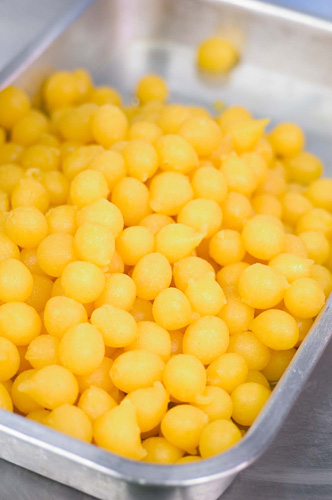
Thong yawt.

I am given a tour of the factory byArin Pipattawatchai, Kao Peenong’s head of quality control, and an expert in the production of Thai sweets. She explains that all of Kao Peenong sweets are made by hand, still employing the same methods that were introduced by the Portuguese nearly 500 years ago. In the case of the Portuguese-influenced thong sweets, this process typically involves immersing duck-egg yolk combined with various other ingredients in simmering syrup. “For Thai people in the past, eggs were dinner food—they weren’t used for sweets,” explains Pipattawatchai. “This concept was introduced by the Portuguese.” We watch the production of thong yawt, made by dropping a thick paste of duck eggs, coconut milk and jasmine-scented flour into boiling syrup, resulting in firm, bright yellow balls that are both sweet and fragrant. The process for thong yip is similar, however the still-warm golden disks are pressed into small ceramic bowls to obtain their flower-like shape. The most interesting process of all is that of foy thong, whereby egg yolks are streamed into simmering syrup through a fine sieve, resulting in delicate, golden ‘noodles’ of egg yolk.


Making thong yip at Kanomthai Kao Peenong.

Another example of the Portuguese influence on Thai sweets can be found alongside the Chao Phraya River in Thonburi, in the neighborhood surrounding the Santa Cruz Church. This area was allocated to Portuguese and French traders when the capital of Thailand was moved from Ayutthaya to Thonburi, and is today known for khanom farang kutii jiin, a cake of Portuguese origin. The cake, a simple mixture of duck eggs, sugar and flour, is prepared by an improvised method of baking, which employs a bottom layer of heated gravel and a top layer of hot coals to simulate the effect of an oven, a kitchen tool not found in Thailand during the Ayuthaya era.


Along with food, the Portuguese also introduced Christianity to Thailand.

To learn more about this unique sweet, I pay a visit to Thanusingh, a family bakery that has been making khanom farang kutii jiin in the shadow of Santa Cruz Church for more than 200 years. Pong, a fifth-generation baker, and Thai of mixed European and Japanese descent, is one of the few people in Thailand still making this dessert, and explains how every effort is made to preserve the original recipe and methods. “The Portuguese tourists who come here recognize the cakes immediately,” explains Khun Pong of the sweet that has changed little in several centuries.


Khanom farang kutii jiin fresh from the oven.

To make khanom farang kutii jiin, duck eggs and sugar are beat at a very high speed until slightly stiff and peaked. Formerly this was done by hand using an improvised pulley system turning a wooden paddle, but today modern electric blenders do the job. Flour is then carefully folded in, and the mixture is poured into small hand-made metal trays. These are then baked in a modern, custom-made oven that recreates the effect of the original method of employing a bed of heated gravel topped with hot coals. When the cakes are done, I try a hot one, and find the cake dry and generally unremarkable, but to Ayuthaya-era Thais not familiar with bread or sweets, it must have been nothing short of a culinary revolution.


Khanom farang kutii jiin, a Thai snack of Portuguese origin, are still made using traditional methods.

Khun Pong goes on to mention that the Santa Cruz Church area is also known for other dishes almost certainly of Portuguese origin, including a dish of a roasted calf’s leg inserted with dried spices, and a hearty vegetable stew probably with origins in the Portuguese cozido, both of which are typically are only made during Catholic festivals nowadays. Portugal’s influence on Thai cooking is a unique culinary heritage, the result of a centuries old cultural exchange, that is both thriving, and in danger of dying out.

A nice view of Bangkok

This week's nice view is from the Dome at State Tower:

This is the Chao Phraya River just before it heads out to sea. Actually, most of Bangkok is behind you; what you see here is actually the province of Thonburi. The Dome is a conglomeration of two restaurants and a bar, and is arguably Bangkok's hottest place to eat right now. Haven't eaten there yet--only been up to take photos for a magazine--but hope to get there soon. Will let you know how it is.

Cornucopia

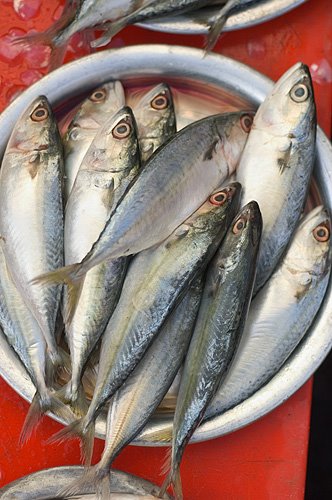
Today's Cornucopia column, written by our favorite Thai food expert, Suthon Sukphisit, concerns the Thai staple fish, plaa thoo, known in English as horse mackerel. Mr Sukphisit discusses the harvesting, history and uses of this fish, and describes some very delicious dishes that can probably be made at home as long as you can get your mits on the fish.


Fresh plaa thoo for sale at Phuket's morning market.

The direct link to the article doesn't seem to be working right now, so if you're interested in reading it, try going to the Outlook section and choosing the article title, "Thailand's favourite fish"--hopefully it will work by the time you get this.

Kai Yaang Sut Jai

Another day, another isaan (NE Thai-style) restaurant. This particular bad boy is located in the Or Tor Kor Market compound and is known for its kai yaang (grilled chicken), as the name suggests. We consumed this dish, but the shop was dark and the pic was crap, so I've decided not to include it here.

Other things we ate were tom saeb:

This is a sour/spicy soup popular in the NE of Thailand. "Saep" means spicy and sour at the same time, and this soup was deliciously tart. This one was based on tender pork joints, and had the unsual addition of lettuce and chinese celery in the broth.

We followed this with tam sua:

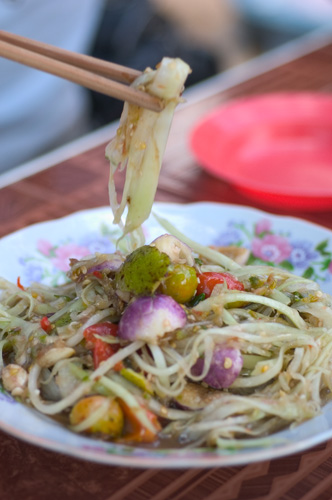
This is an isaan-style som tam, or papaya salad, with the addition of fermented rice noodles. The black bits are pickled field crabs; they are crushed up with the papaya in the mortar and pestle used to make the dish and are a very common ingredient, added more for flavor than anything else.

For the kid we ordered tam poo:

This is a milder, central-style papaya salad with crab and cashews. We told them to make it palatable for a kid, not spicy, and the result was sweet enough to be a dessert. I couldn't eat it but Nong Paeng liked it.

This is her demonstrating the proper way to eat sticky rice, ie., with the fingers:

One more thing worth mentioning about this place it's also probably the loudest restaurant I've ever eaten at. The staff are terribly unorganized and compensate by screaming orders at each other. It's really quite unbelievable, both in terms of volume and also in terms of what people are willing to subject themselves to in order to eat good food!

Real Lao

Just got back from four days in Singapore for the World Gourmet Summit. More on that later... In the meantime, I've been wanting to post an article of mine that ran in Intermezzo magazine. The piece concerns the food of Laos, an interesting cuisine, and a current topic at eGullet. Enjoy!

Spicy, Salty, Sour and Sweet: My Second Taste of Laos (Intermezzo Volume No. 5, Issue 13)

In 1998, as a twenty-year-old junior at the University of Oregon, I received a scholarship to visit Laos with a group of students from various Southeast Asian countries. At that point the country had only recently opened its doors to international tourism, and when I arrived I had the distinct impression that I was somewhere unknown and unvisited by the outside world. Since my college years, I have spent most of my time living and working in Thailand. I have eaten countless amazing Thai dishes, and tasted the foods of nearly every country in Asia. Yet I'm constantly reminded of the food of Laos, and recently decided to revisit the places and tastes that proved to be so eye-opening to me as a student.
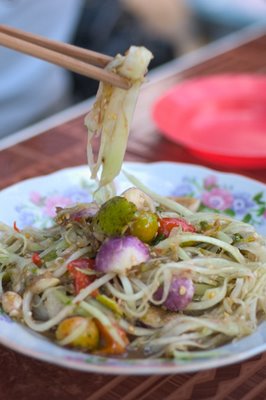

Tam baak hung, a tart salad of unripe papaya, eggplant and tomatoes, is a favorite meal in Laos.

What I ate in Laos eight years ago was so unlike anything that I had ever tasted before that it truly grabbed my attention. Several of my culinary experiences still remain vivid to this day, such as my first time eating sticky rice, being faced with an intimidating dish of raw beef laab, and eating a papaya salad so spicy I nearly fainted. Every meal seemed an adventure, the food being both unusual and exciting, and after all this I was shocked when, after arriving home, I heard Lao food brushed off as “like Thai food but less spicy”.
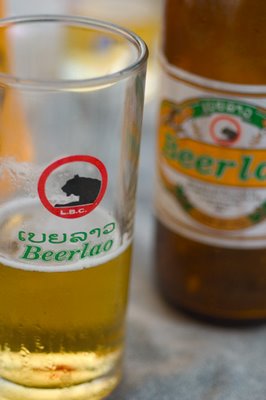

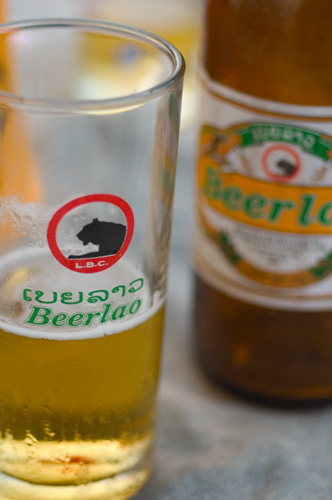
Beer Lao is considered by many to be the best beer in Southeast Asia.

The food of Laos is based on fresh ingredients and boasts assertive flavors. Being a poor, mountainous, landlocked country has had an impact on the cuisine that makes Lao cuisine completely distinct from its big brother to the West. To begin with, that most important of Asian staples, rice, is in Laos, very different than that of Thailand. Rather than fragrant, long-grained rice, the staple carb of Laotians is short-grained “sticky rice” known as khao niaow. And as Laos is fully landlocked, freshwater fish is an immensely important staple, as is game (including deer, wild birds, lizards and other ahaan paa, or "jungle food"). And that symbol of Chinese culinary imperialism, the wok, has made little inroad in Laos, where much of the food is grilled or prepared in soups rather than fried.

I begin my journey in Vientiane (pronounced “wieng jan”), the capital of the Lao People’s Democratic Republic. Although it’s only a short bridge crossing over the Mekong River from Thailand, Vientiane feels a world, and a generation away. Upon arrival in the city, one is greeted by crumbling colonial-era villas and towering shade trees, a palpably different experience from the largely characterless, concrete cities of Thailand. Schoolgirls wearing the Lao national costume, a long embroidered skirt called the phaa sin cycle by on bicycles, and monks wrapped in bright orange sweep leaves in front of Buddhist temples. The capital of Laos is essentially a sleepy, dusty town on the banks of the Mekong, undoubtedly how Thailand was a generation ago, and much of the isolation of the past 30 years has served to preserve a culinary heritage that, even today, is still very much intact.
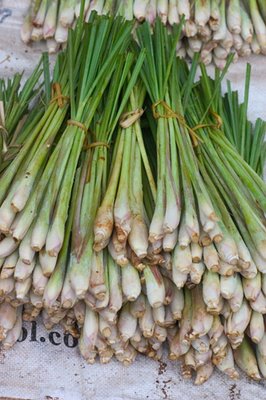

Fresh lemongrass is a common ingredient in Lao cooking.

Upon arrival in Vientiane, I proceeded directly to the banks of the Mekong River to begin my culinary reeducation by sampling what is undoubtedly the most quintessential of Lao dishes, tam baak hung. Consisting of strips of shredded green, unripe papaya, sliced tomatoes, lime, garlic, and fish sauce all ground together with a mortar and pestle, this tart “salad” is a relatively simple but delicious meal. The deep wooden mortar used to make tam baak hung is ubiquitous in every part of Laos, and is almost always wielded by women. Some cooks pound aggressively, as if punishing the papaya, the mortar and the pestle at once, while others use the mortar and pestle more as mixing tools, gently coaxing the ingredients together. Regardless of how it is done, the bell-like hollow thud that resonates when the dish is being prepared is recognizable enough to make one’s mouth water. One particular element that makes a tam baak hung particularly Lao is the use of chilies. Despite what others may say, the majority of Laotians actually do like their food hot, and I still wince when I recall a dish of tam baak hung I had in 1998 that was so spicy, that after the almost intolerable initial heat, I began to feel an intense chili-induced “high”, and stumbled back to my hotel room in a near-stupor.

The spiciness of chilies is, along with sour, sweet and salty, one of the four essential tastes that makes up Lao cuisine. Sour flavors typically come from the use of lime juice or crushed tamarind pulp, and a dish’s sweet taste might be the result of cane or palm sugar. Saltiness is usually obtained through generous use of paa daek, a mud like, unpasteurized fermented fish sauce essential to Lao cooking. The use of paa daek lends Lao food a certain earthy flavour, not to mention the fact that many Lao people still prefer to eat ahaan paa, game taken from the jungle. Lao food is also earthy in its tones, many of the dishes brown from the use of ingredients such as mushrooms or paa daek, or green from the addition of fresh herbs.
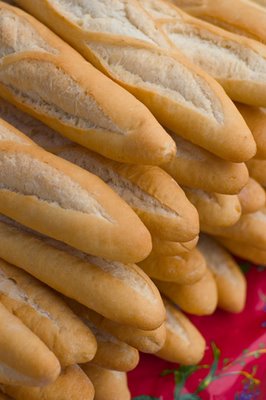

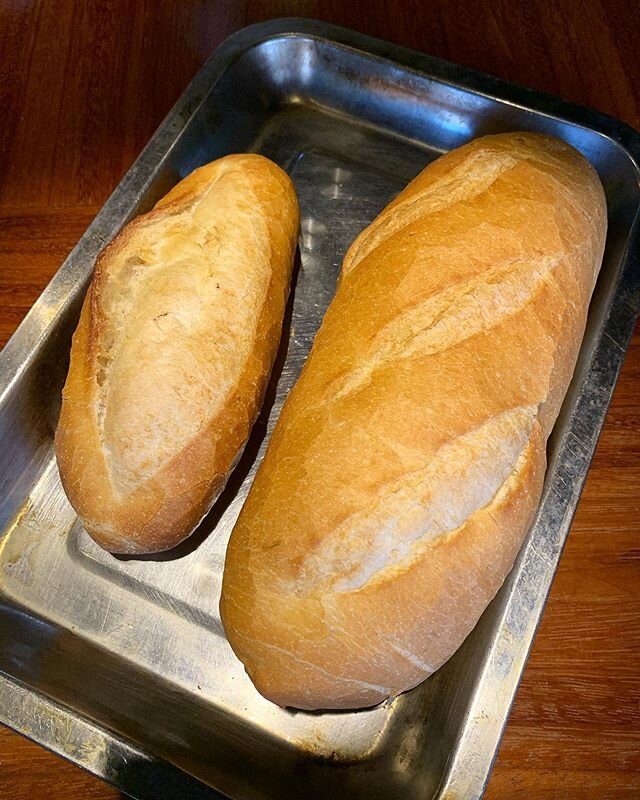
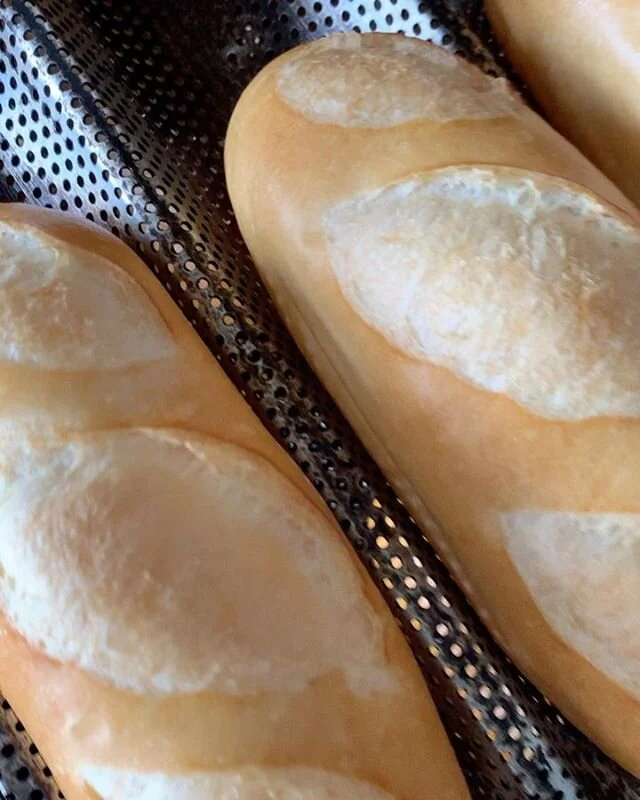
French-style baguettes for sale in Luang Prabang.

As with most countries in Asia, the staple food of the Lao people is rice. Not fluffy steamed rice, as in the vast majority of Asia, but rather, heavy, glutinous “sticky rice”. This form of rice grows well in Laos’s relatively high mountain valleys, and is prepared by being steamed over boiling water in wicker baskets, rather than by being immersed in water. In Lao households, sticky rice is often prepared in the morning then left in a permeable wicker container for the rest of the day, to be consumed with all meals. This container is known as a katip, and individual serving sizes, often used in restaurants, make good souvenirs. Sticky rice is eaten using the hands, and is rolled into a ping-pong sized ball with the right hand, and dipped into soups and dips. Eating sticky rice in Laos was the first time in my adult life that I had ever eaten entire meals with my hands, and I remember finding it a liberating and delicious experience.

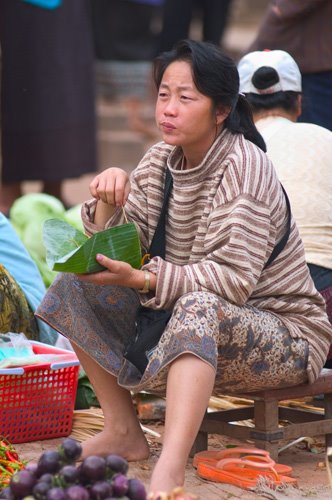
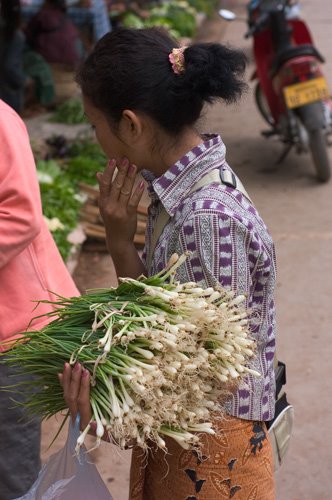
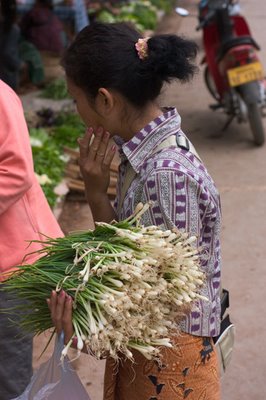
To truly get a feel for Lao food, it helps to see the ingredients in their raw form. This is best done at any of the morning markets that take place every day at nearly every town in Laos. With this in mind, on my second day in Vientiane I wake up early to visit the hectic talaat sao, or morning market. Making my way past piles of lemongrass, pink joints of galingale and neatly bound bunches of dill and coriander, I wander over to the meat section, where entire chickens are on display, and bored-looking vendors shoo flies away from pork meat. Despite being a poor country, the inhabitants of Laos are generally rich with food, and consume meat on a regular basis. Thus, along with tam baak hung and sticky rice, the third essential element of Lao food is ping kai, grilled chicken. Grilled foods rule in Laos, and can range from fish to pork skin, but grilled chicken is the most popular, and arguably the most delicious. Chickens are typically first deboned before being rubbed with a mixture of cilantro root, garlic, turmeric, and salt, and are then splayed on a bamboo rack and grilled over hot coals. The result is smoky and savory, and along with tam baak hung and sticky rice, forms a complete Lao meal.
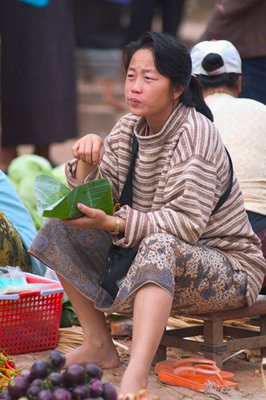
After a few days in Vientiane, I continue my culinary tour by traveling north to the former royal capital of Laos, Luang Prabang. Situated on a finger of land between the Mekong and Khan Rivers, Luang Prabang was declared a UNESCO World Heritage Site because of its pristine colonial-era and traditional Lao architecture. The city is one of the most pleasant and atmospheric places in Asia, if not the world, and is also where I had spent the majority of my time in Laos all those years ago.

I was eager to return to the places I had eaten in Luang Prabang, and made a point of making pho, Vietnamese-style noodle soup, my first meal upon arrival. Surprisingly for a landlocked, isolated country, there is a considerable amount of culinary influence from other countries, and pho is an example of this. However, Lao pho, unlike the beef-based Vietnamese original, is typically served with pork or buffalo meat. The soup is served with side of fresh herbs including Thai basil, sawtooth coriander, and the fragrant young mint leaves particular to Laos, as well as limes, pickled vegetables, chili paste, and deep-fried crispy rice cakes. It is this variety of condiments that makes pho such an individual eating experience. Almost instinctively, I added the herbs, squeezed my limes dry, crumbled the rice cake, mixed the soup, and the tart, herblike scent that resulted took me immediately back to my first time in the country.
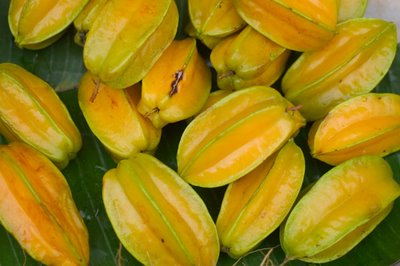

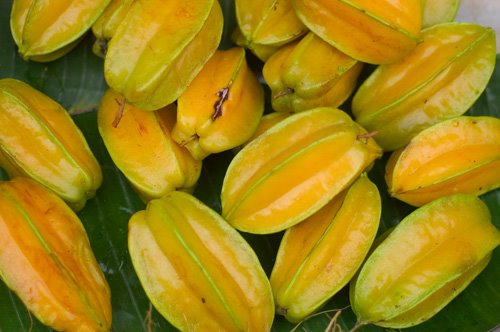
Starfruit for sale in Vientiane.

Laos was part of French Indochina for more than 50 years, and other than Vietnamese food, along with French rule came certain inseparable European culinary traditions, including bread. It was in Luang Prabang where I first came in contact with khao ji, French-style baguette sandwiches that arrived in Laos via the Vietnamese. Using freshly baked bread, khao ji are often consumed at breakfast, the bread somehow always able to stay crisp and flakey despite the humidity, and spread with a variety of ingredients usually revolving around a form of pork-liver pate (no doubt also vestige of French influence) or the ubiquitous Vache Qui Rit cheese spread.

It is a desire for bread and yet another French legacy that impels me to wake up early on my first morning in Luang Prabang. My memory serves as my guide to a ramshackle mélange of benches and chairs known as Pasaneyom Lao Coffee. I am here to sample what must be the most ubiquitous French culinary legacy in Laos, coffee. The Laotians took this unfamiliar product and created their own method of brewing it, pouring hot water through a small baglike filter filled with coffee grinds. The resulting thick liquid is served small tumblers with sweetened condensed milk and followed by a “chaser” of green Chinese tea. The people of Laos also produce coffee, at one point the country’s beans, mostly grown in the southern part of the country, being among the costliest in the world.
Another remnant of foreign influence is the country’s beer. Laos is also home to what is considered by many to be the best beer in South East Asia, Beer Lao. Despite formerly being a monopoly (and thus not necessarily obliged to produce a good product), the state-owned Lao Brewing Company produces a fresh-tasting, hoppy lager-style beer, which when served ice-cold on a hot Lao day, is somehow even more refreshing than water. Beer in Laos is typically served with ice cubes, and sometimes, during the sweltering months of summer, bottles of Beer Lao are served wun, meaning that the beer is so cold it has reached a slushy, near frozen state.

While in Luang Prabang I was eager to sample the town’s unique local food, a cuisine that differs substantially from that of the rest of Laos. As in much of the country, the best and sometimes only place to sample local cuisine is at the evening market. Here freshly made curries, soups and salads are dished up to take home along with steaming hot sticky rice. In Luang Prabang, grilled Mekong River fish and ping kai can also be found, as well as a variety of jaew, a kind of chili-based “dip” eaten with sticky rice and vegetables. A particular specialty of Luang Prabang is jaew bong, roasted dried chilies pounded with garlic, shallots and buffalo skin. Jaew bong is traditionally eaten with sticky rice and paper-thin crispy sheets of dried Mekong river weed called khai phaen. After some deliberation, I buy both of these, as well as a bottle of ice-cold Beer Lao, and return to my hotel for a final celebratory meal. The occasion? I have tasted Laos again.
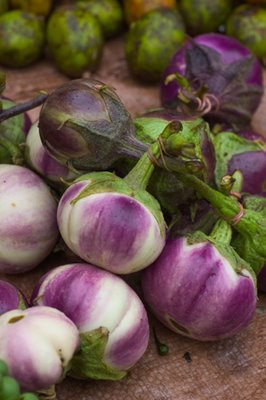

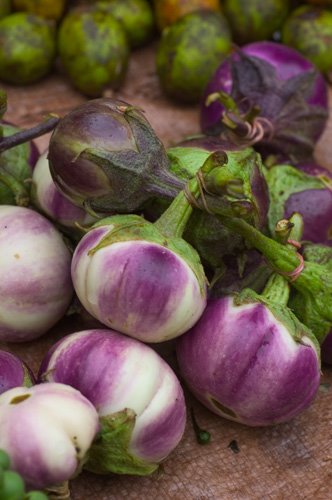
Lao eggplants come in a variety of shapes and colors.

Recipes:

Khao Niaow
Sticky Rice
Serves 4

In Laos, sticky rice is traditionally steamed in a cone-shaped bamboo basket called a huat The rice is placed over an aluminum pot designed to fit snugly with the huat. If you can find these at an Asian market, go ahead and use them, otherwise this recipe is adapted for use with a two-piece pasta pot.

2 cups Thai sticky rice
5 cups water

1. Soak sticky rice in water for four hours. Drain water and set rice aside.
2. Add water to a pasta pot until it is slightly below the bottom of the strainer. Line the removable strainer with cheesecloth, and add the sticky rice.
3. Insert strainer, tightly replace the lid, and bring water to a boil over high heat. Steam rice for 20 minutes, until grains are soft but firm.
4. When rice is done, remove cheesecloth with rice and open on a countertop, using a wooden spatula to spread the rice out flat, and let sit for five minutes.
5. Keep rice in a permeable container, such as a colander covered with cheesecloth, until needed, and serve warm, or at room temperature.

Tam Baak Hung
Papaya Salad
Serves 4

To shred the papaya, peel the papaya first, then use a cheese grater with large holes. Alternatively, for more hearty slices of papaya, use a sharp knife to dash several lengthwise cuts into the green, unripe papaya, then, using a knife or potato peeler, shave off strands of the papaya. The strips of papaya should be roughly cardboard thick and more or less as wide as a finger. In Laos, tam baak hung is made using a mortar and pestle, but as most people in the West don’t use these tools, this recipe is adapted for use with a sturdy bowl. In terms of seasoning the tam baak hung, in Laos this dish is made to taste, so if you prefer spicy, then add a few more chilies. If you dislike sour, then don’t add all of the lime juice and tamarind pulp. To this extent I have suggested adding only half of the seasoning ingredients initially, then adding the remainder to taste.

1 tablespoon tamarind pulp
5+ Thai chilies
2 cloves of garlic
3 cups shredded unripe papaya
5 cherry tomatoes halved
2 golfball-sized green or yellow Thai eggplants
1 tablespoon lime juice
3 tablespoons fish sauce
1 tablespoon of palm sugar (or white sugar)

1. Prepare tamarind by mashing the pulp up with 1/4 cup of warm water. Strain the resulting liquid and set aside.
2. Roughly chop chilies and garlic and smash with the broad side of a knife.
3. In a large bowl insert chili and garlic mixture and the shredded papaya and tomatoes. Slice the Thai eggplant directly into the bowl, and mix and grind all the ingredients using the bottom of a large wooden spoon, for about 20 seconds. The idea here is to gently bruise the papaya so that the other flavors will penetrate.
4. Add half of the tamarind, lime juice, fish sauce and sugar, and grind again. Taste for a balance of spicy, sour, sweet and salt, and add additional lime juice, fish sauce or sugar as needed.
5. Serve immediately with sticky rice.

Ping Kai
Lao-Style Grilled Chicken
Serves 4

In Laos entire chickens are typically deboned and splayed on bamboo racks before being grilled. For simplicity this recipe uses a whole chicken that has been jointed. Another option would be to use six chicken thighs.

1 chicken, jointed and cut into parts
2 tablespoons of salt
3 tablespoons of chopped cilantro roots
1/2 tablespoon peppercorns
4 tablespoons of chopped garlic
1 teaspoon turmeric powder
1 teaspoon fish sauce

1. Rub chicken parts with salt and set aside for 20 minutes to draw out any unpleasant juices.
2. In the meantime, using a mortar and pestle or food processor, finely grind cilantro roots, peppercorn, garlic and turmeric powder until a thick paste results. Stir in fish sauce.
3. Wash chicken pieces, pat dry, and coat with the paste. The previous steps can be done the day before and the chicken left to marinade in the paste overnight. Otherwise allow chicken to marinade in the paste at least 30 minutes before grilling.
4. Grill over a well-oiled grill on medium heat, turning every 10 minutes, until finished.
A good read

For those of you interested in reading more about Thai food, I encourage you to take a look at Suthon Sukphisit's weekly column, Cornucopia, which runs every Saturday in the Outlook section of the Bangkok Post. Suthon is a retired writer with the Post, and now spends most of his time writing about food and travel. The guy is a virtual expert on Thai food, and I look forward to reading his column every Saturday. We haven't yet met, but have exchanged emails, and I hope to take him out for some good Thai food at some point in the near future! Today's piece is actually about the food of Yunnan, a place with a very interesting local cuisine. I'll try to post a link to his piece every Saturday, although I think the links will eventually expire.

A Cool Lunch

Been cooking like a madman lately, revising recipes and taking photos for my book on southern Thai food. I love cooking, so this is fun for me. The only bad part is the weather. It's April here in Bangkok, which is the hottest month. Most of the time spent in my kitchen I'm literally dripping with sweat, so today I decided to make something cool:
The red are pieces of chilled watermelon, and the topping an odd but delicous mixture of dried fish, sugar and deep-fried shallots. This is an old-school Thai dessert I first had at David Thompson's dinner at cy'an. He gave me the recipe, which involves taking plaa chon daed diaow, a kind of semi-dried freshwater fish, and roasting or grilling it until dry. You then pick the flesh apart and grind it up in a mortar and pestle with some sugar. For the shallots you simply thinly slice a bunch of shallots and fry them in oil until they become dark and crispy. Let them drain on several changes of paper towels, mix with the fish mixture, and sprinkle over the watermelon!