Northern Exposure

Found myself in the right part of town at the right time and got my mits on some nice northern-style Thai food today. The right part of town is Viphavadee, the right time lunch, and the right restaurant, Khao Soi Faa Haam. This is actually the name of the most famous khao soi--a northern-style curry noodle dish--restaurant up in Chiang Mai. I was up there about a year ago interviewing the owner for an article on khao soi, when I learned that they also have a branch here in Bangkok, and have been enjoying it on a regular basis. Khao soi is getting a lot of attention recently, with a fun thread at eGullet, and Chubby Hubby also featuring some pics in a recent post.

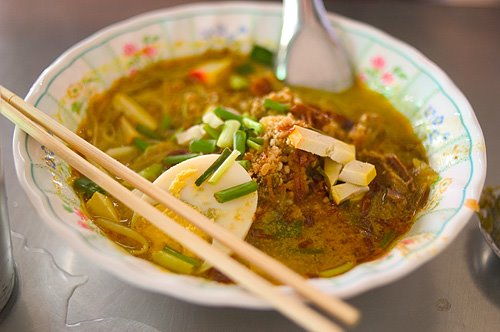
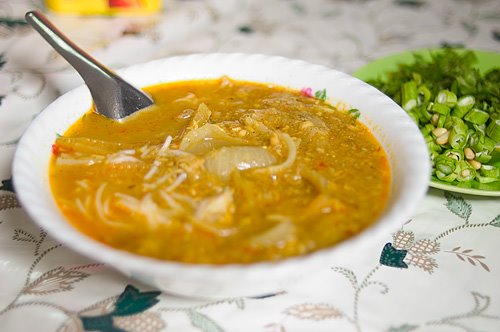
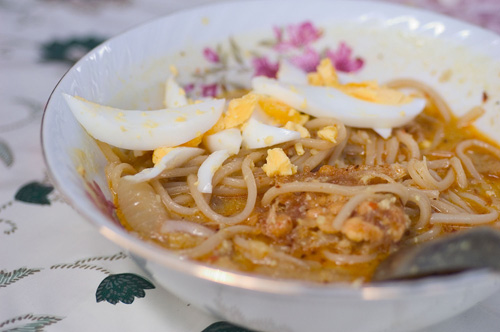
I went to the restaurant with the obvious desire to have a bowl (or two) of khao soi, but in the time-honored tradition of Thai ill-preparedness, they were temporarily out (it was, after all, 12:30!), and would I mind waiting? This was actually a blessing in disguise, as it allowed me to stray from the well-eaten path and order something different for once. This Something Different was khanom jeen naam ngiaow:

The dish is of Shan/Thai Yai origin, and is actually quite similar to a spicy, sour spaghetti. It is made by frying ground pork in curry paste with small, sour tomotoes. Water and pork spareribs are added, and topped with everybody's favorite, cubes of coagulated chicken blood. This is then served over fermented rice noodles. Possibly the best part of the dish is the deep-fried crispy garlic.I've eaten this dish heaps of times--and even make a mean version myself--but this was the first time I'd eaten it here, and I'll certainly have it again.

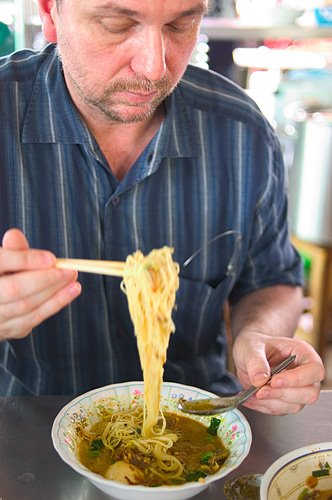
By the time I finished my nam ngiaow they were finally done making the khao soi:

I usually order beef khao soi, but they were out (!) today, so I had to settle for the chicken. Still very good, but this was probably the richest bowl I've ever consumed--I couldn't even finish all of it!

Thai with Thompson and Thanongsak

Was fortunate enough to have lunch with David Thompson, Head Chef of London's Nahm, and author of a big fat book on Thai cooking, and his partner, Thanongsak. I first met David when I interviewed him for an article on Michelin-starred chefs visiting Bangkok. We got to talking about Thai food and mentioned that there was a place near my house that makes an excellent khao mok plaa, fish biryani. He was intrigued, and yesterday we finally met up again, this time at the aforementioned restaurant.

The place in question is Yusup (probably a Thai corruption of the Arabic name Yusuf), a Thai-Muslim restaurant located along the Kaset-Nawamin highway in northern Bangkok. I had unknowingly driven past this place literally thousands of times before a friend recommended it to me. After my first visit I soon became a regular customer, and have been wanting to take people there for ages.

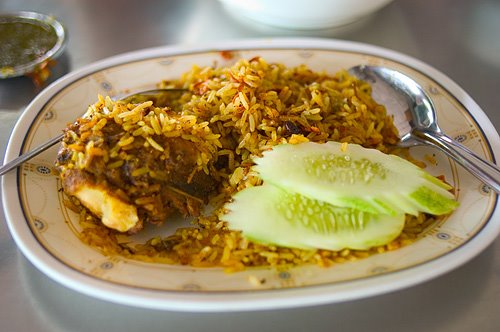
David and I started with the requisite khao mok plaa:

Not a particularly evocative pic--was focusing more on eating and chatting about Thai food, but you get the idea. For those of you not familar with this dish, biryani, called khao mok in Thai, is rice cooked with spices and meat, which in Thailand is almost always chicken. It's an amazing concept, but, as David mentioned, never seems to fulfill its potential. Most of the time it's just rice colored yellow with turmeric (or food coloring) with some crap chicken thrown on it. The good men and women at Yusup however, know what's going on and load their version with spices, peas, minced carrots and fresh herbs. Other than fish they also have beef, goat, and the ubiquitous chicken versions.

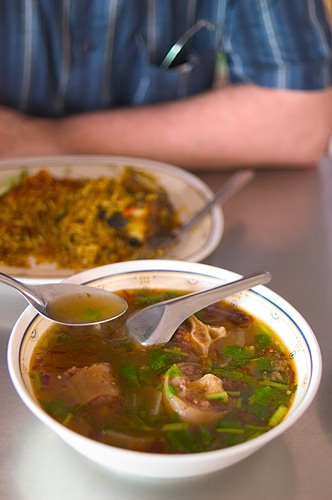
This was accompanied by sup haang wua, oxtail soup:

A Thai-Muslim speciality, this soup is both mouth-puckeringly sour (from lime juice and tamarind) and rich (undoubtedly the result of all that marrow and bones), and the oxtail has been slow-stewed until fall-apart tender. Amazing stuff.

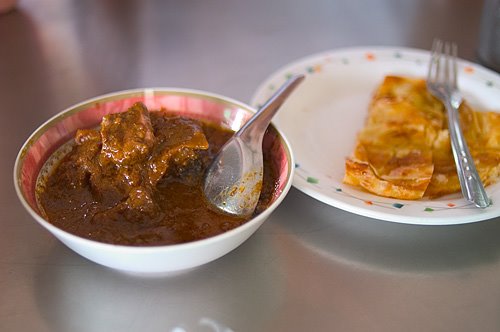
Thanongsak wisely ordered something outside of the two dish repertoire that I tend to stick to and chose matsaman nuea, "Muslim" curry with beef with roti, fried dough:

I found the matsaman to be one of the best coconut milk-based curries I've had in a long time; smooth, not too sweet, savory, and with a pleasant taste of coconut that, oddly enough, isn't usually found in these curries. The roti, on the other hand, were mediocre--not nearly as crispy and fresh as they should be.

And finally, after all this nosh, David shocked us all by ordering a bowl of kwatiao kaeng, "curry noodles:

This is a dish that one rarely sees around, and is more similar to the Malaysian laksa than anything Thai. David mentioned that he liked it the more he ate it:

but in the end commented that it could have used a final swirl of coconut cream to smooth it out.

Bangkok B&W Episode 3

Was in the Tha Phra Chan area today, an old Bangkok neighborhood along the Chao Phraya with lotsa cool stuff to see and eat.

This woman is making mataba, savory filled "pancakes":

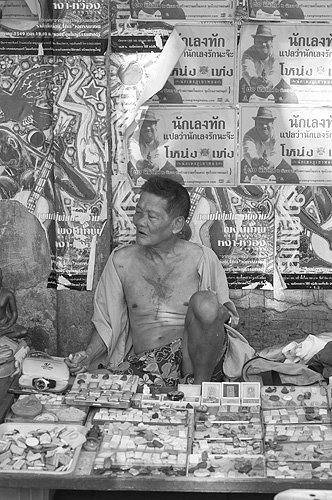
Maharat Road, running paralell to the river, is a virtual open air market, and this guy is selling the most common item, Buddha amulets:

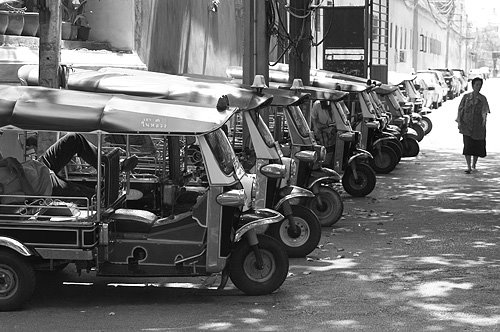
A line of tuk-tuks along the same street:

This was taken on a ferry boat crossing the river a bit downstream at Rajanee Pier:

A nice view of Bangkok

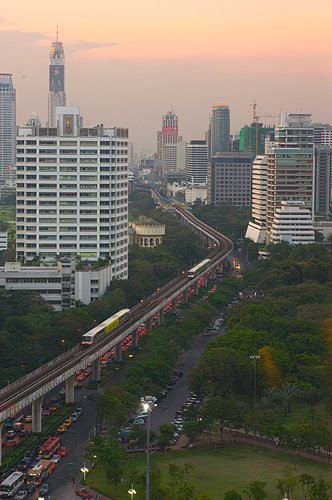
This pic was taken last night from D'Sens, the French restaurant located at the top of the Dusit Thani Hotel:

For the most part, Bangkok is a big ugly intimidating city, but there are some nice corners, views and neighborhoods here and there. This shot is over looking the BTS line, with Lumphini Park on the right, and Bai Yok, Thailand's tallest building, in the upper left hand corner.

I'm currently doing a piece on restaurants with nice views, so I'll try to include more pics like this. In terms of views, I would really recommend D'Sens, having nearly 360-degree views over the city from its 23rd-floor cockpit-like dining room. (The restaurant also has the most amazing bathrooms in the city, the men's urinal being a floor-to-ceiling window that gives one the sensation of literally pissing on the city! Great therapy for those fed up with urban life.)

Khrok Thong

Khok thong ("Golden Mortar") is the name of a popular isaan (North-Eastern Thai) restaurant near my house. For those of you not familar with ahaan isaan, this cuisine has a lot in common with the food of Laos, just over the Mekong River. This means a lot of grilled dishes, salads and soups, with very little of the Chinese-style fried stuff seen in Bangkok and southern Thailand. Additionally, people in isaan tend to eat glutinous or "sticky" rice with all their meals.

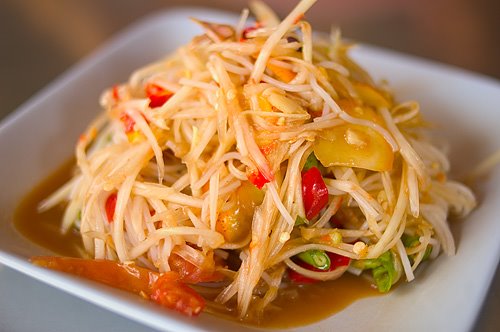
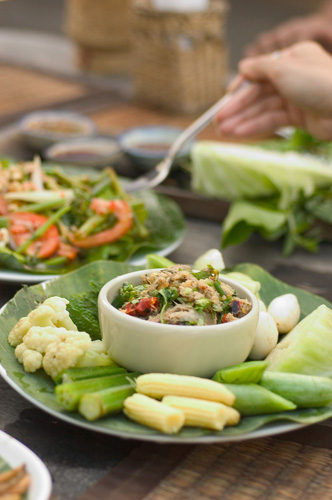
A staple of ahaan isaan is som tam, a type of "salad" made of unripe papaya pounded up in a mortar and pestle usually with green beans, tomatoes, chilies, lime juice, fish sauce, garlic and sugar. Today we ordered tam sua:

This is a particular kind of som tam that includes khanom jeen, fermented rice noodles. This may seem an odd combination, but the noodles do a great job of mellowing out the dish, which is typically very spicy. The yellow bits are the peel of ma kok, a kind of sour fruit (I think it's called Chinese olive, or something similar to that) that adds a tart flavor to the dish. (Ma kok, incidentally, is the origin of the name Bangkok, meaning a plain where lots of ma kok trees are found.) I'd venture to say that right now som tam is probably the most popular food in the country; EVERYBODY loves the stuff, and it can be found on virtually every street corner.

Another isaan favorite is khor moo yaang, "grilled pork neck":

This dish takes the fatty fatty meat (sometimes also known as the "collar") grilled and typically served with a spicy/sour/salty dip.

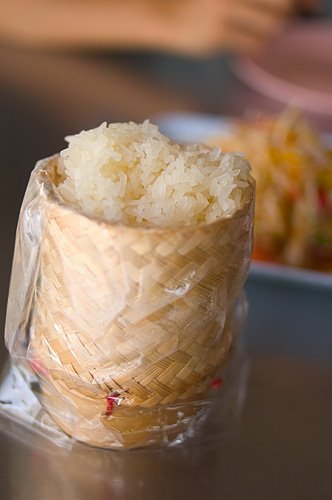
Isaan food is always taken with khaao niaow, "sticky rice":

which is eaten with the hands and rolled in a small ball before being dipped in any of the dishes present. The container its served in is known as a katip and is meant to hold the rice while at the same time allowing heat and moisture to escape. Unfortunately most restaurants put the rice in a plastic bag, which really defeats the purpose and often results in a mushy, sticky mess. Fortunately that wasn't the case today.

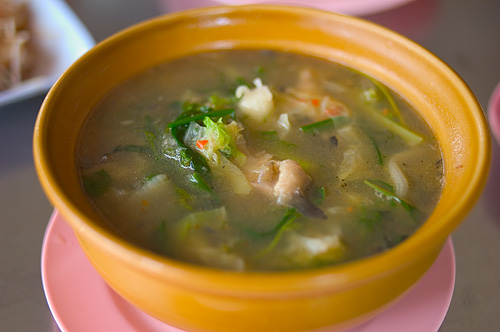
And finally we had kaeng om plaa duk:

Kaeng om is a type of soup typically revolving around lots of veggies and fresh herbs. This one was loaded with cabbage, lemongrass, basil, and most prominently, dill (known in Thailand as phak chii lao, "Lao cilantro/coriander"). This kaeng om was of the plaa duk, catfish variety.

Sukiiiii!

Possibly the most popular restaurant meal among middle-class Thai is suki-yaki, the Japanese hot pot dish that Thai refer to simply as sukii. For those not familiar with the dish, it's basically a do-it-yourself meal that revolves around a cauldron of boiling broth. You order raw ingredients and cook them in the broth.

Like noodles, this is another one of those dishes that Thai people love that I never really cared for until somewhat recently. I really enjoy it now, as it revolves around my two faves: seafood and veggies, and is about as healthy as it gets.

There are several franchises serving suki in Thailand including MK, Coca and See Fah, but today we tried a new one, called simply, Hot Pot.

We like veggies so we ordered the veggie set:

We've got phak bung (the long green veggie), green onions, kheun chai (Chinese parsley), carrot slices, daikon slices, a few types of mushrooms, tofu, and in the back, glass noodles. We also ordered a few other, mostly fish-related, side dishes such as squid, fish, fish balls, and fish "noodles".

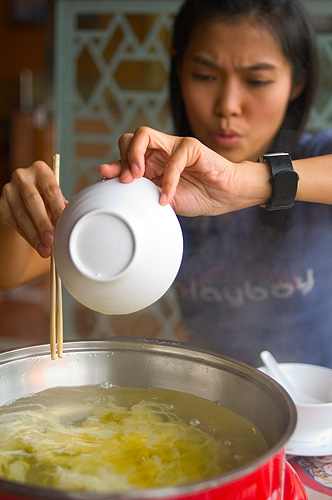
This is Khuat taking the first step: pouring the beaten eggs into the broth:

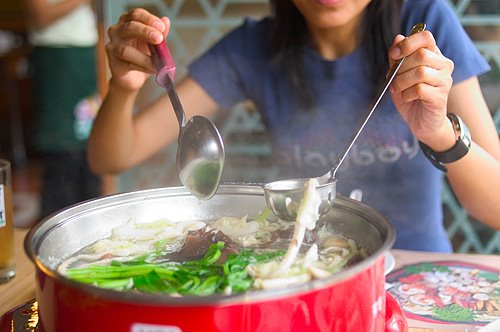
When the broth boils again, then we start piling the rest of our ingredients in:

Wait a few minutes until they're cooked, and dig in!

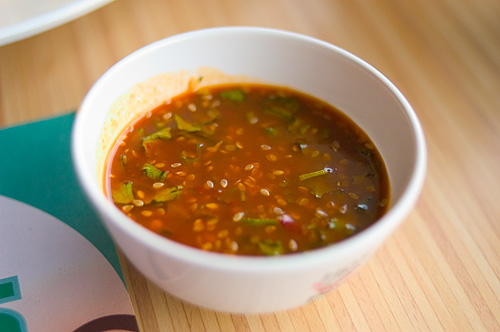
The Thai way to eat this is to take an ingredient out, and dip it in the sauce below before shoving it into the gob:

It's a largely sweetish/sourish sauce with sesame seeds and cilantro, and which is usually accompanied by a separate dish of optional minced garlic, minced chilies and limes to make it really Thai. I think the sauce is just OK, but Thai people really seem to love it. Personally I like to sip the broth, which I imagine is the Japanese way of eating sukii, but which nobody here seems to do.

In general, I felt that Hot Pot's take on the whole thing was very mediocre. It's really hard to do a bad job of suki--it really just depends on the quality of the ingredients--and in this case the seafood we ordered was obviously past its prime, and the veggies neither attractive nor fresh. Much better in my opinion is Coca, especially considering that they have a half-broth/half-tom yam cauldron, and lotsa fresh veggies and seafood.

Raan Rot Det

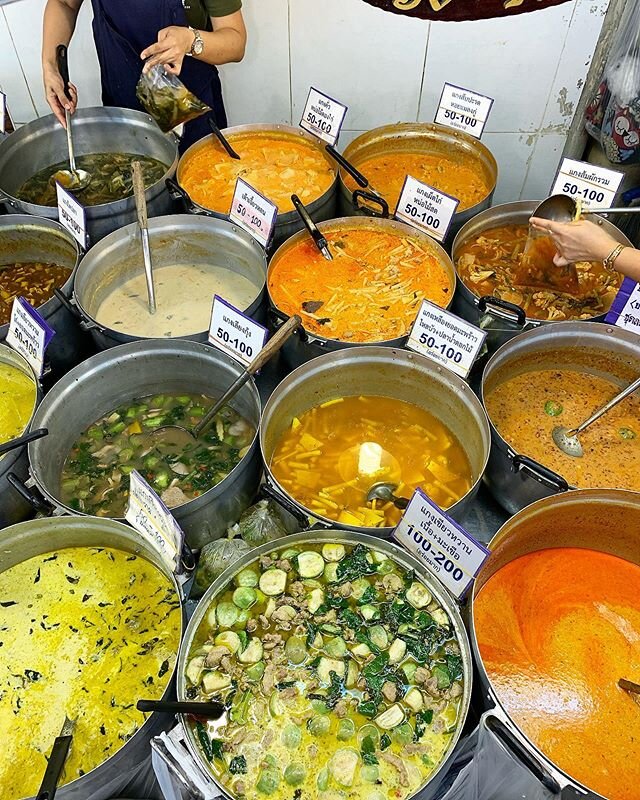
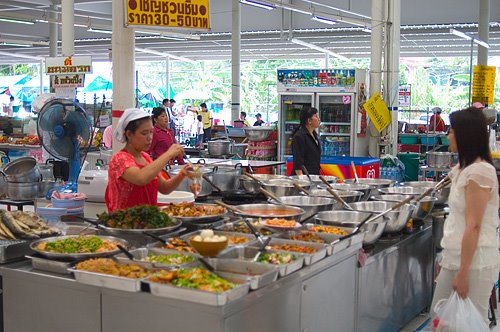
Raan Rot Det ("bold taste shop") is the name of a curry stall at Or Tor Kor market that I've been eating at for years:

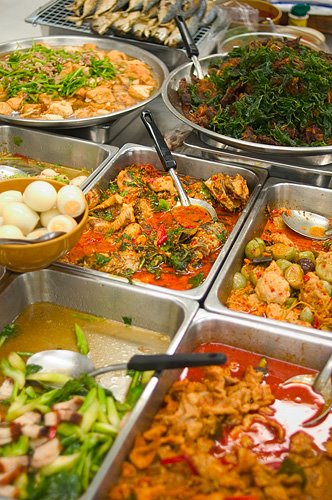
The food isn't amazing, but it's consistently good, and there's an amazing variety of curries, fried dishes and soups:

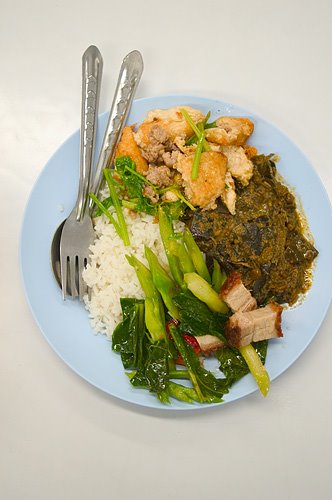
I tend to order the same things, and here what I had last time I stopped by:

At 12:00 is a stir fry of tofu with ground pork and kheun chai, Chinese celery; at 3:00 is kaeng khii lek, a southern-style coconut curry that combines the bitter leaves of the khii lek tree and grilled fish; and at 6:00 phak khanaa kale/chinese broccoli fried with oyster sauce and barbecued crispy pork belly.

More Noodles

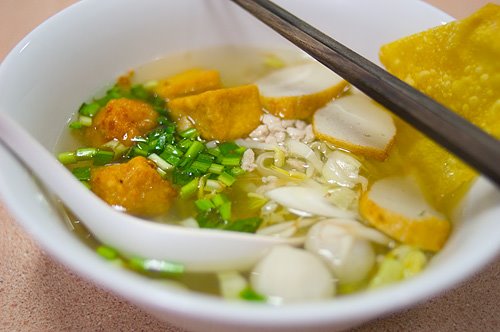
Casual readers of RealThai must get the impression I'm noodle obsessed. In fact, I hadn't hardly eaten noodles at all the first several years I worked here. I always found Thai noodle dishes too sweet, and the various pork/beef/fish balls that seem to accompany such dishes are, for the most part, shockingly nasty. In recent years I've opened up a bit and have found a few noodle dishes I really enjoy, including the topic of this entry, kwaytiao khae. I've mentioned this particular dish before here and here, and recently noticed a new shop not far from my house selling the stuff. Well, despite it's rather attractive appearance:

this was by far the worst bowl I've yet to encounter. If kwaytiao khae was served on board airplanes or in hospitals, this is what it would taste like. The broth was institutional and tasteless, and the various ball products tough, chewy and tasteless.

Khuat didn't have much better to say about her yen ta fo:

When I get a chance, I plan to feature the best kwaytiao khae I've had yet, which is sold virtualy on the side of the road in Chinatown. Please be patient.

Thai Muslim with Mike

Was recently fortunate enough to meet Michael Elliot, a Montreal-based food stylist (now there's an occupation that didn't exist 30 years ago!), fellow blogger, cool website owner, and fan of Thai food. Michael and friend were passing through Bangkok and we met up for lunch a few days ago. As I've done in the past when others have visited, I like taking people to a brilliant Thai Muslim place down near the Oriental Hotel. The restaurant, called (if I remember correctly) Muslim Home Cooking, is relatively new, and specializes in Indian-influenced Thai-Muslim cuisine.

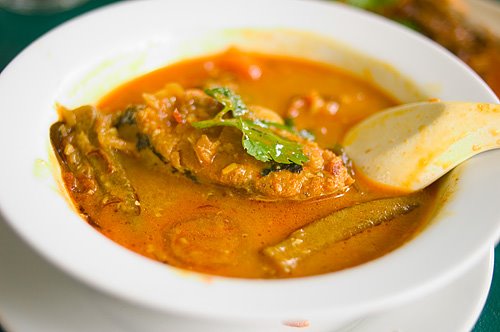
We started with a speciality of Thai Muslim food, fish curry:

This Thai Muslim staple sees hearty "steaks" of fish (usually plaa insee, Spanish mackerel) in a thick, sour curry broth. Usually there a few vegetables thrown in for shits and giggles, in this case okra and tomato (sometimes also eggplant or green bananas).

This we followed with mutton spareribs in curry sauce:

I've never come across this dish in Thailand and assume it is Indian-Muslim in origin. It's a great dish; we finished every drop of the curry sauce, and really enjoyed the garnish of crispy deep-fried shallots.

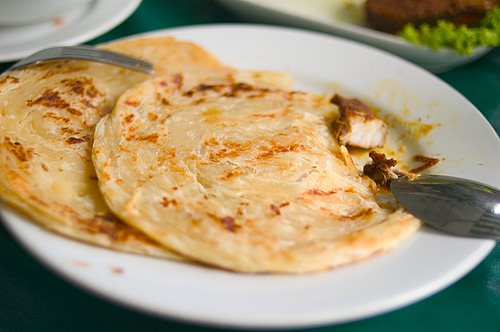
As one usually does when eating Thai Muslim we skipped the rice altogether and instead took our curries with the cripy pancakes known as roti:

Other highly recommended dishes here include the khao mok (briyani), which is served with a raita (cucumber-yoghurt mixture), a sweet and sour sauce, and a savory eggplant dish. The restaurant is located virtually across the street from the French Embassy in the Haroon Mosque area.

More Myanmar

Spent another Saturday morning in the company of Daw Than Than Myint and John Parker eating Burmese food. This time it was mohinga:

a thick, fish-based broth that is often considered the national dish of Myanmar. The noodles used are similar to the fermented rice noodles known in Thailand as khanom jeen, and the broth fortified with ground fish, shallots/onions, and the edible soft pith from the innermost stalks of the banana tree. In Myanmar this is usually accompanied with the fresh veggies seen in the pic, as well as a kyaw, crsipy deep fried vegetables. Daw Than Than Myint claims this is the best mohinga in Bangkok.

Our Mohinga was taken with wetha lon kyaw, literally "fried pork balls":

ground pork mixed with herbs and spices and deep-fried. They are taken with the spicy/sour dipping sauce seen in the background. Personally, I found this a bit unusual, as the Burmese aren't real big meat eaters, and I can't recall having come across any dishes using pork in Myanmar. Perhaps it's some sort of adaptation made for Thailand?

ThaiDay: The Michelin Movement

The Michelin Movement (ThaiDay, 31/03/06)
World-class chefs are in high demand in Bangkok these days. What do the chefs think of their stardom?

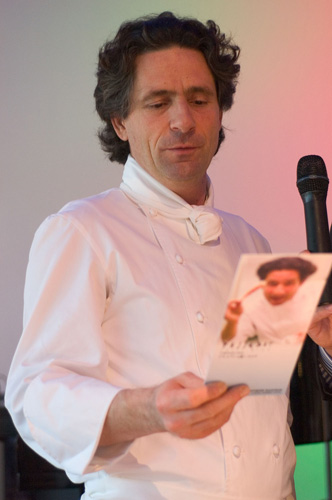
Gerald Passedat appears tired, and rightfully so: just a few days earlier he was probably happily filleting fish in the kitchen of Le Petit Nice, his two Michelin-star restaurant in Marseilles, southern France. Today the chef is in Reflexions, the Plaza Athenee Bangkok’s French restaurant, trying to balance answering the questions of the local press with preparing a six-course meal for more than 30 people. This is Passedat’s first time in Thailand, not traditionally a stopover on the route of Michelin-starred chefs, and he’s obviously trying to make the most of it. “Asia is important for us [chefs],” he explains. “We’ve got to travel and see what’s happening, new types of cooking and ingredients.”
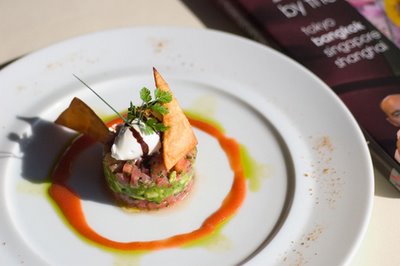
Important indeed. This month alone, chefs from no fewer than six Michelin-starred restaurants are paying visits to Bangkok’s top hotel restaurants. From David Thompson, Head Chef of London’s Nahm, the only Thai restaurant ever awarded a Michelin star, to Pierre Gagnaire, Head Chef of the eponymous three-starred Paris restaurant considered by many as one of the finest in the world, Bangkok has seemingly been inundated by this virtual constellation from the culinary stratosphere.

This interest in high-end dining is hardly new however. Bangkok’s first effort in this area began in earnest back in 2000 with the initiation of the World Gourmet Festival. This event brought in chefs from virtually every corner of the world, and was generally considered a critical and financial success. The event has continued to be held every year since, and in late 2005, the concept was taken to an extreme with the Epicurean Masters of the World. This event saw 10 chefs with a total of 19 Michelin stars brought together under one roof—something that rarely occurs even in Europe. The Michelin accolades of the chefs involved were liberally touted during this event, setting a precedence that will be difficult to follow, and perhaps also whetting the appetite of Bangkok diners to crave the occasional star with their meal.
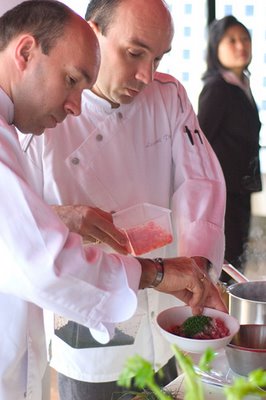

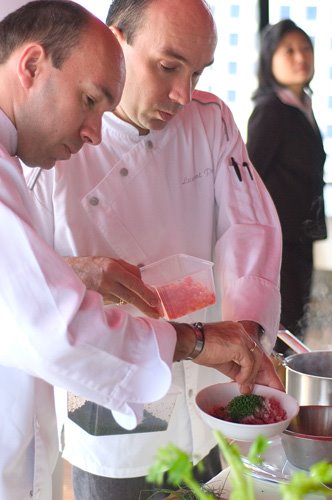
The brothers Pourcel prepare their dishes at D'Sens at the Dusit Thani Hotel.

This month’s largely coincidental culinary deluge may well be the result of consumer demand, but it is also an illustration of the current trend for chefs to leave their comfort zones and be exposed to new influences. During this month I was fortunate enough to meet with some of the visiting chefs, and gained some interesting insights regarding Michelin stars, local ingredients, as well as the state of fine dining in Bangkok.

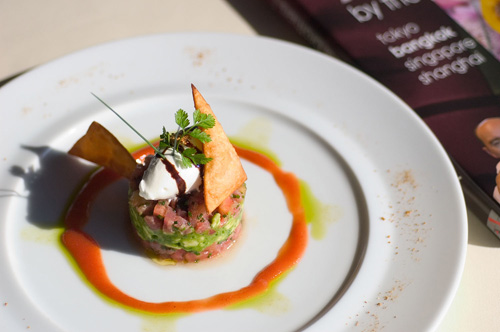
Two chefs who are no strangers to neither Asia nor Michelin stars are twin brothers, Jacques and Laurent Pourcel, of Le Jardin des Senses in Montpellier, France. Established in 1988, their restaurant quickly accumulated praise for its Asian-influenced Mediterranean cuisine, and at one point was awarded three Michelin stars. Since then, the Pourcels have used their acclaim and skills to establish successful restaurants not in the usual suspects of London and New York, but rather in Bangkok, Tokyo, Singapore and Shanghai.
Despite their obvious success, the topic of Michelin stars can be a touchy subject for the Pourcel brothers; after having held on to three stars for four years, in 2004 Le Jardin des Sens was downgraded to two, where it still remains today. With this in mind, I visit D’Sens, the restaurant in the Dusit Thani that the Pourcels oversee, and ask brothers what they feel are the negative and positive attributes of running a Michelin-starred restaurant. “The downside is that you’re seen as an “expensive” restaurant,” explains Laurent, “Although now you can find some places in the guide that are reasonable.” Jacques adds, “Nobody knows the judging standards. The system isn’t perfect, but the chefs who receive two stars are generally very good chefs and they deserve it.”

I mention the current flood of high-ranking chefs, and ask the brothers if they think that diners in Bangkok are really ready for such high-level dining. “Thais still expect traditional cuisine,” replies Jacques Pourcel. “They aren’t yet used to modern [cuisine], but there is still time to learn to appreciate new flavors and ingredients.” Ironically, in the case of the Pourcels, many of the “new flavors and ingredients” Jacques speaks of are actually staple ingredients in Thailand: passionfruit, coriander, tamarind and coconut milk are among the ingredients that the Pourcels have seamlessly integrated with traditional French cooking enough to make them unrecognizable even to Thais.
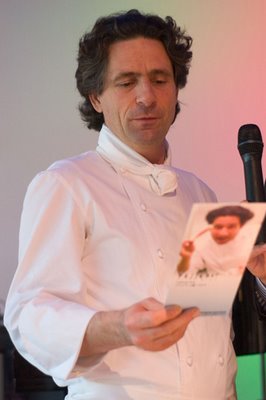

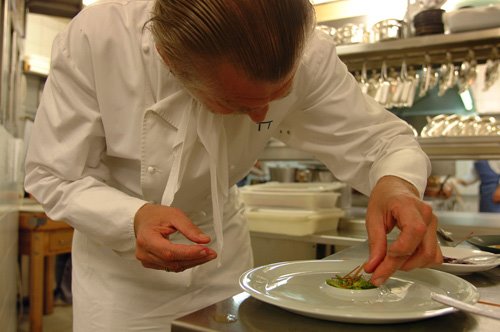
Two-star French chef Gerald Passedat.

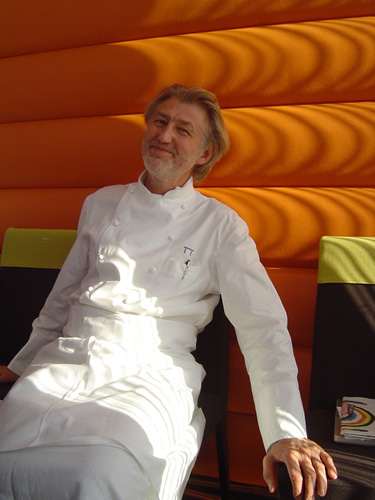
French Chef Pierre Gagnaire, who is currently in residence at the Oriental’s Le Normandie, has never been to Bangkok before, but it was really only a matter of time. Gagnair is Head Chef of a restaurant in Paris considered among the finest in the world (and firmly clutching three Michelin stars), is the virtual inspiration for an entire school of gastronomy, and is considered by both chefs and diners alike to be among the finest chefs in the world.

Despite all this, Gagnaire is fully conscious of how tenuous culinary fame can be, having experienced a well-publicized financial collapse while running a previous three-starred restaurant. That restaurant folded, but Gagnaire eventually came back—in Paris of all places—and with his current restaurant, Pierre Gagnaire, again holds three stars. I ask Gagnaire if there’s a negative side to having a three-stars. “What’s bad is that you can lose them,” explains the chef. “Say you’ve got a film director, and he wins an Oscar. He can put it on his mantelpiece, it’s his for life,” explains Gagnaire through a translator. “With three stars, you don’t get them for life, you have to fight every day to keep them.”
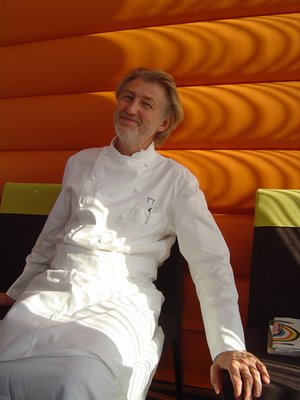

Chef Pierre Gagnaire at the Oriental.

Gagnaire is certainly willing to fight, and does this by challenging diners with new flavors and textures (he calls them “disturbing minor details” or “multi-sensory hits”). I ask him if he thinks diners in Bangkok are ready for food of this level. “When it’s being done in a sincere and honest way, people don’t need to have a lot of references and knowledge about the cuisine to appreciate it,” explains the chef. However when traveling, Gagnaire admits that he feels less inclined to experiment. “It would be great to do something like a lemongrass infusion, but that’s not what people here want,” he explains.

Of all the chefs currently in town, Australian Chef David Thompson probably has the least enviable job of all: cooking an exclusively Thai meal for diners in Bangkok. This is nothing new to Thompson, who, after virtually stumbling upon Thai food more than twenty years ago, pursued this then-obscure school of cooking, eventually culminating in Nahm, his London restaurant, as of yet the only restaurant specializing in Thai cuisine to have been awarded a Michelin star.
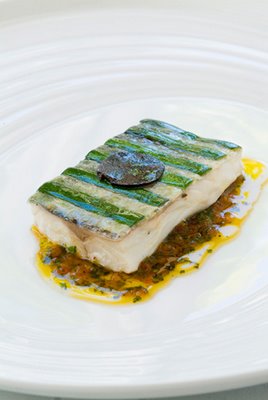

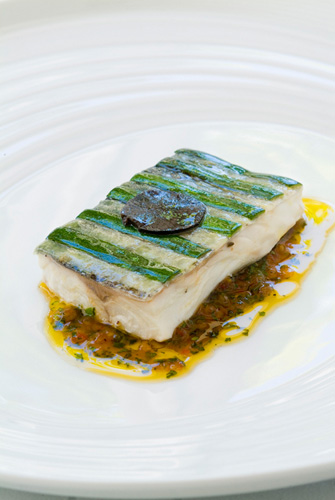
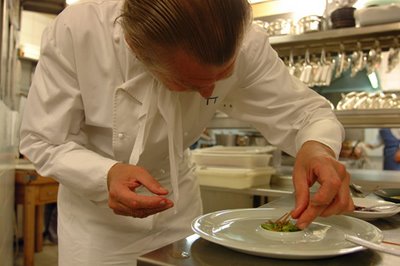
Gerald Passedat's Loup Lucie, sea bass prepared in his grandmother's style.

Despite the unique accolade, Thompson is tangibly cynical about his star, and when I ask him about the benefits it has brought, he says straight faced, “It gets you into restaurants easily.” After laughing, he continues, “Any cook worth his fish sauce shouldn’t succumb to the idea of doing things for awards,” he explains. “If you start to become preoccupied with what other people think of you, or what awards you might garner, then you start to lose the point of why you’re doing it in the first place.”

I ask Thompson, who is currently in Bangkok preparing his take on Thai food at the Metropolitan Hotel’s cy’an, if he feels that Thais are becoming more sophisticated in their dining tastes. He replies, “I think it’s concomitant with the incredible boom that’s happened in this country, where people are becoming more affluent and wish to display their affluence. Thais have always been a status conscious society, and this is yet another way to display that.”

Despite the media attention and consumer interest, for most hotels, hosting a Michelin-starred chef is not necessarily a profitable venture. “For us it’s a tradition,” explains Konstantino Blokbergen, Director of Food & Beverage of the Oriental Hotel, whose restaurant, Le Normandie, has been hosting three-star chefs for almost 20 years. “But there is a cost associated with it. Financially, we try to break even, but it’s not done to make money. It’s an investment meant to last. It brings customers back.” In any event, it seems an investment that many hotels are willing to make, and with rumours of a possible Michelin Guide to Asia in the air, can also be seen as a sign of greater things to come.

Back at Reflexions, two-star chef, Gerald Passedat is posing for photos and trying his best to look cheerful. Earlier I had a chance to ask him how important getting the third Michelin star is to him. “When you have three [stars] you can open restaurants anywhere in the world and do whatever you want,” he explains. “But naturally, my goal is simply to make the customers happy.” Judging by the reaction from Bangkok’s diners, I would say that Passedat and his colleagues have been, without a doubt, successful in this area.

Guide to the Guide
The Guide Michelin, the source of all the stars, and undoubtedly the most influential restaurant guide in the world, started with practical beginnings. Introduced in 1900 by Andre Michelin, head of the eponymous tyre company, the guide was meant to assist motorists by listing lodging and restaurants, as well as provide information on mechanics, garages and bathrooms. In 1923 the guide began to review restaurants independent of accommodation, and in 1926 the star rating system was introduced, in which a star symbol was shown next to restaurants “noted for their fine cuisine”. In the 1930’s the star system was expanded to include the two and three-star system that still exists today.

The Red Guide, as the book is often called, covers 10 countries, mostly in Europe, although there is now a guides for New York City. Although much of the prestige of receiving a Michelin star is often associated with the chef, the prize is actually given to the restaurant, thus it is slightly inaccurate to describe someone as a “Michelin-starred chef”. Of the more than 5,000 restaurants reviewed in the 2004 UK and Ireland Guide alone, only 11 received 2 stars (“excellent cooking, worth a detour”) and 3 received three stars (“exceptional cuisine, worth a special journey”), making the stars very elusive indeed.

Despite the prestige associated with the stars, in recent years Michelin Guide has been subject to a fair amount of controversy. The book is regarded by many as being far too influential, and in 2003 a well-known French chef committed suicide, allegedly due to concerns that his restaurant was to be downgraded by the guide. In 2004 a former Michelin reviewer wrote a book describing the review standards as lax, and the Michelin inspectors are sometimes regarded as having a French bias.
ThaiDay: Gourmandise in a grotto

Gourmandise in a grotto (ThaiDay, 30/03/06)
Enjoy upscale Chinese in a subterranean eatery at Siam Paragon.

Why is it that restaurants feel a need to intimidate us? Take for example the entranceway of the new Crystal Jade Restaurant in the basement of Siam Paragon. Perhaps its design is based on some ancient method of feng shui meant to deter less wealthy diners, but this dark, towering cavern doesn’t exactly say Come, dine with us! Meeting with some friends for the purpose of this review, we met in front of the restaurant at 5:00 on a Saturday afternoon, only to find the place seemingly closed. Given the day and time, we knew the restaurant had to be open, however, I was the only one who dared ventured down the intimidating, cave-like hallway. Wishing I had brought carabeeners and some rope, I plunged in and was eventually able to find somebody who told me that the restaurant didn’t open until 5:30, but that we were welcome to come inside.

My first experience with this Singaporean chain of restaurants was at the somewhat less frightening but preposterously named Crystal Jade La Mian Xiao Long Bao at the Erawan Bangkok. At this informal restaurant, dough is slapped, twisted, pulled and stretched before one’s eyes into what must be some of the most delicious Chinese-style noodle dishes in Bangkok. The atmosphere here is bright and friendly, and to date it’s the only place in town where I’m willing to pay 150 baht for a bowl of noodles. The latest Crystal Jade enterprise specializes in Cantonese cuisine and is a more formal effort: lotsa glass, lotsa bottles of wine, and numerous tanks of semi-live seafood—no kitchen views or slaphappy doughboys here.
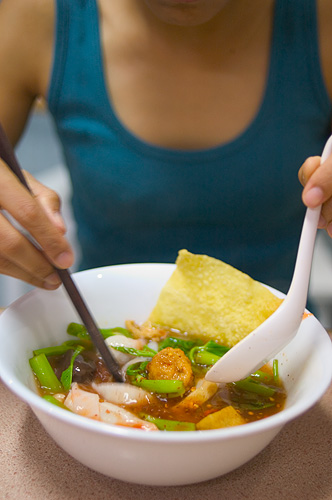
We cowered into the lofty but empty marble-and-glass dining room, and took our seats around an immense round table. Our waitress was from Singapore and couldn’t speak Thai, and when asked for her recommendations, did her best to steer us towards some of the pricier dishes (“Do you like lobster?”). I abstained, and dove directly into the interesting list of appetizers: The crispy eel (170 baht) lived up to its name on both fronts, and was coated with a dark sauce suggesting the brininess of soy sauce and the sweetness of tomatoes The smoked pig shank and jellyfish (180 baht) was a bewilderingly bizarre combination on paper that somehow worked well in reality, coupling chilled slices of stuffed pig’s trotter with chilled preserved strips of jellyfish. The crispy beancurd with pepper and salt (130 baht) was no more or less than the name suggests, but reminded me of how delicious simple ingredients can be when prepared the right way.


The crispy fried eel.

My dining companions chose the entrees, and the highlight of these was without a doubt the sautéed pork collar with XO sauce (285 baht). The Chinese rightly appreciate fatty cuts of meat, and the paper-thin slices of pork neck were flash fried with chunks of celery and just enough dried chili to rise above the XO sauce (a Chinese flavoring sauce—not the brandy) to make the dish stand out from the others.


The pork collar in XO sauce.

Similar in form but not in flavor was sautéed sliced beef with mixed mushrooms (220 baht). The beef was almost ridiculously melt-in-your-mouth tender, but the presence of gelatinous oyster sauce—also evident in some of the other dishes we had ordered—was tedious. Indeed, maybe it was our bad luck in ordering, but much of the food seemed to be of the sticky stir-fry, slimy soup variety that Chinese restaurants outside of China seem incapable of moving away from.


Chinese broccoli in oyster sauce.

Smartly avoiding the cornstarch altogether was the excellent steamed garoupa (100 baht/100g), which was just barely cooked, and served with a silky-smooth broth swimming with scallions and laced with hints of sesame oil. We also ordered a few soups, including the “Sichuan” hot and sour soup (120 baht) and the crab claw, bamboo fungus and vegetable soup (200 baht), both again, of the slightly slimy variety, the latter being of the extremely flavorless variety.

Due to the fact that there weren’t many diners, and perhaps realizing that I was doing a restaurant review, there were at least four service staff at our command at all times. This meant that, in the tradition of good Thai service, we were kept thoroughly watered. In the course of our one-hour meal, I consumed enough tea to put the Chinese National Mah Jongg Team to shame.

In the end, our meal certainly did not turn out to be the intimidating experience that we feared, but rather, somehow oddly familiar. The food was probably better than average, but seemed for the most part to be the same dishes we’ve all seen before, but in a sleeker package. Maybe it’s got something to do with the feng shui?

Crystal Jade Restaurant
Street Level, Siam Paragon
02 129 4343

ThaiDay: Eating with the neighbors

Eating with the neighbors (ThaiDay, 30/03/06)
Explore the largley unknown landscape of Burmese cuisine.

Although the two countries share a long border, a similar religion, and a great deal of history, the relationship between Thailand and Myanmar (Burma) would not be described as amicable. Much of the two countries’ mutual history is one of conflict rather than cooperation, and though some elements of Burmese culture have entered Thailand, the country’s culinary traditions are not one of them. Ask an average Thai what a Burmese eats and you will undoubtedly get a blank stare. Actually, ask just about anybody outside of Myanmar what the Burmese eat, and you will probably get a blank stare. Myanmar’s cuisine, like many other aspects of this secluded country, is largely a mystery to the outside world.

Myanmar cooking, like Thai and the majority of cuisines in the region, is a rice-based cuisine. Rice is seen as the centerpiece of a meal, and other dishes, most commonly curries and soups, are regarded as accompaniments to the rice. Due to the country’s location between Thailand and Bangladesh, Myanmar cuisine is a mixture of South and Southeast Asian cooking styles and ingredients, integrating the dried spices and lentil soups of the subcontinent, and the fish-and-fresh-herbs cuisines of its neighbors to the east. In theory this would seem to imply a vibrant, exotic cuisine, but factors such as poverty, international isolation, and conflict have not allowed the Myanmar food to progress, as has been the case in India or Thailand. Nowadays, food in Myanmar is often more about subsistence than indulgence.


A coconut milk-based noodle dish similar to the thai dish 'khao soi'.

This doesn’t mean that Burmese food is bad though. At its best Myanmar cooking is hearty, savory and comforting, the same attributes one would attribute to say, Portuguese cuisine. At the opposite extreme, the food can be salty, heavy, and most of all, extraordinarily oily. Curries, a staple of Myanmar cooking, are often served with a thick layer of bright red oil, and this oiliness is usually the first thing that visitors to Myanmar notice about the food. In general however, sour and salty flavors predominate Myanmar cuisine, and the food is significantly more mild that that of Thailand or even India.

If all of this isn’t too off-putting, and you’re willing to try something new, there is a corner of Bangkok where one can sample authentic Burmese cooking. Soi ABAC, off of Ramkhamhaeng Soi 24, is a virtual mini-Yangon, and is home to many Burmese immigrants as well as four restaurants serving a variety of authentic Burmese dishes.


Daw Nwe, a respected Burmese chef, cooking at her restaurant in the Ramkhamhaeng area.

I visit Soi ABAC on a Saturday with my former Myanmar language teacher, Daw Than Than Myint, and Burmese student and Myanmar food aficionado, John Parker. We begin our meal at Daw Nwe’s (as is the case in Myanmar, the shops generally don’t have names per se, and are typically named after the owner/cook), according to Daw Than Than Myint, the best Burmese restaurant in the area. When we arrive Daw Nwe had actually closed shop, and was in the process of single handedly preparing a meal for several hundred people for a funeral the next day, but was kind enough to prepare a few bowls of ohn no hkauk hswe for us. This coconut milk-based noodle dish is thought to be the basis for the northern Thai dish, khao soi, and is served every Saturday at Daw Nwe’s restaurant. Served with condiments of sliced limes, sliced shallots, boiled egg, and crispy deep-fried vegetables known as a kyaw, ohn no hkauk hswe is savory but not heavy, and like most Burmese food is mild rather than spicy.

With Daw Than Than Myint acting as a translator, I ask Daw Nwe about Myanmar food, in particular, why Myanmar curries tend to be so oily. “We feel that if we invite a guest or donate food, and the curry isn’t oily, you’ll look stingy,” she explains. I ask her if the Burmese feel that the liberal use of oil contributes to the taste. “When you compare bland food with oily food, the oily food tastes better,” she says. “The oil helps the flavors to mix and taste rich.” For those willing to try more Burmese specialties, on Wednesday and Saturday Daw Nwe makes mohinga, a noodle dish often regarded as Myanmar’s national dish, and on Thursday is dan bauk, the Burmese version of khao mok or briyani.

Across from Daw Nwe’s is Ma Hlaing’s , a good example of the kind of rice and curry shop that one can find all over Myanmar. Inside, a glass case displays a selection of meat and fish-based curries, soups and thoke, Burmese-style “salads” similar to Thai yam. I choose the ma kyi ywet thoke, a salad of tender tamarind leaves. The dish is pleasantly tart from the tamarind leaves but savory from the garlic-infused peanut oil used to bind almost all thoke. I also order a bowl of nga phe lon hin, fish ball curry, a dish I have enjoyed many times in Myanmar. Unlike Thai fish balls, which often have a manufactured taste and texture, Myanmar nga phe lon are made by hand using fresh fish, and are soft and generously flavored with garlic, ginger and other fresh herbs. The fish balls are fried and are served in a oily curry that should be eaten with rice. Ma Hlaing also serves ngapi ye, a potent Myanmar-style “dip” served with rice and fresh vegetables, a dish provided free of charge by virtually all curry shops in Myanmar.

From Ma Hlaing’s we head further down the soi to Ma Che Ma Cho Sain (“Mrs Love and Mrs Sweet’s Shop”). This is another typical rice and curry shop, this time serving a few Myanmar regional dishes. Daw Than Than Myint urges me to try wetha ne ponyegyi, pork sautéed in a paste made from soybeans, a specialty of the Pagan area. The dark appearance of the dish is off-putting, however, the earthy, concentrated taste of the bean paste is not entirely unpleasant. I follow this dish with chin baung ne hmit chin ye, a sour broth of bamboo shoots and roselle leaves. This dish is another favorite of Myanmar curry shops, and features prominent sour and salty flavors and well-cooked vegetables. As we eat, Myanmar music videos play in the background, providing an appropriate soundtrack for our culinary expedition.


A fragrant curry of homemade fish balls at Ma Hlaing's Burmese restaurant.

Our last stop is at the restaurant run by Ko Tayo (“Mr China”), a Myanmar of Indian descent. Ko Tayo serves Indian and Nepalese-influenced Myanmar dishes, and like many of the restaurants in the area, has a small selection of Myanmar food products, cosmetics, and herbal medicines for sale. Having already eaten at three restaurants, my companions are only interested in shopping at this point, and I take the opportunity to order a cup of lephet ye, Burmese tea. The sweet taste of the tea, the bubbly sound of Burmese conversation and the smells of Myanmar food make me feel like I’m back in Yangon—until I remember that I was never very far away to begin with.

To reach the restaurants, go down Soi ABAC past the entrance of the university until you reach a residential area and the first four-way intersection; the restaurants are all located within a short distance of this intersection and are easily recognizable by their Burmese-language signs out front.

Michelin Star Mania

This month there are no fewer than 10 chefs from Michelin-starred restaurants visiting Bangkok. I'm doing a piece on this for ThaiDay and have been fortunate enough to taste the food of, and meet a few of these guys: Jacques and Lourent Pourcel, Gerald Passedat, Pierre Gagnaire, and David Thompson. This being RealThai, the most interesting of these for me was obviously meeting David Thompson, chef of Nahm, the only Michelin-starred Thai restaurant in existence, and the author of the big, fat book Thai Food. Mr Thompson was lovely, as well as extremely knowledgable about Thai food, and we spent a pleasant hour mostly talking about regional Thai dishes. Mr. Thompson also offered some invaluable advice for those of you trying your best to make your name known in the restaurant world and earn that elusive Michelin star: sleep with the reviewer.

The Magical World of Thai Baked Goods

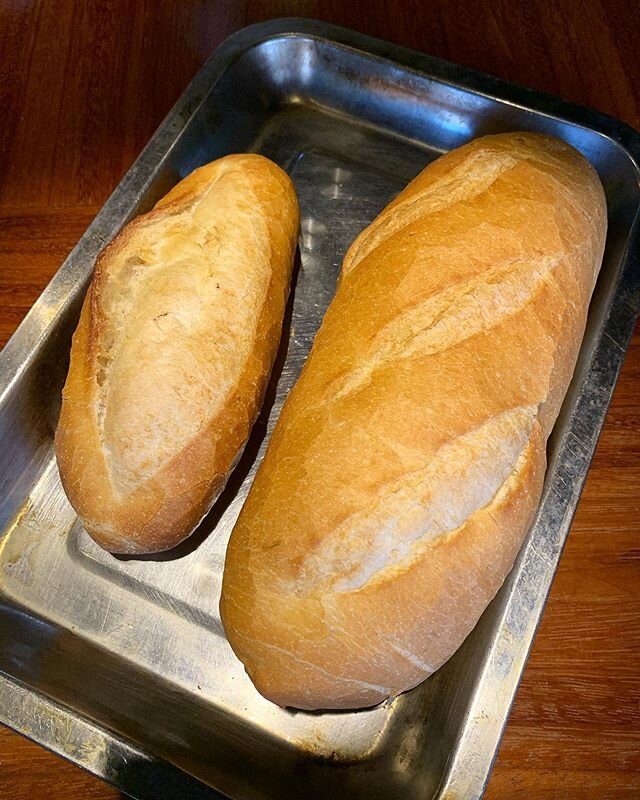
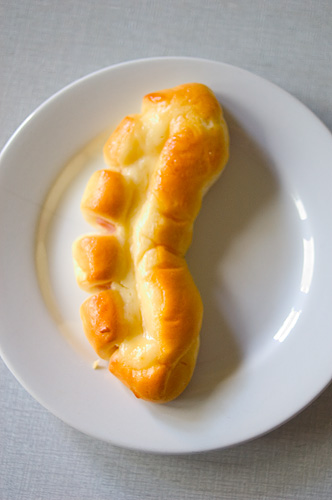
Today's journey through the world of bizarre Thai bread takes us to the local Yamazaki to visit our friend, Banana Ham Bun. Hey, there he is, say cheese!

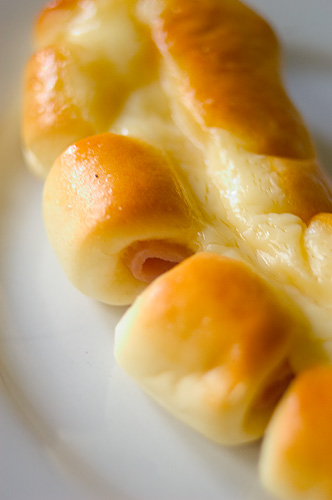
As far as I can tell--and I actually tasted this one--Banana Ham Bun's only connection to banana is its shape. The inside is filled with a slice of luncheon meat ham, and the top coated with a generous layer of "cheese", as this close up reveals:

However, the thing that shocked me most about the Banana Ham Bun (other than the appalingly bad concept and lack of any banana flavour) was its greasiness. I normally try to handle these breads as little as possible, but in the course of actually consuming a small bit of this one, I actually had to touch it, and my fingers were almost instantly coated with gratuitous Banana Bun grease...

Phik 101: A Thai Chili Primer

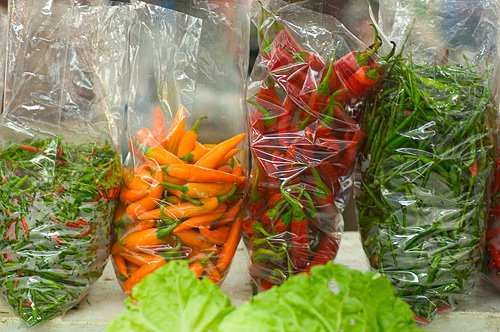
Thai chilies

There have been some interesting questions at eGullet lately regarding the different chilies used in Thai cooking. This is by no means an exhaustive list of all the chilies used in Thailand, but the five below are by far the most commonly used. I've tried to describe what they look like, how they're used, and their spiciness.

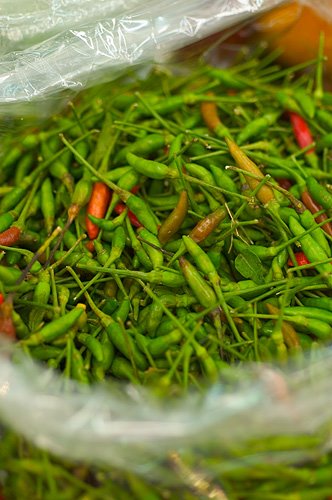
The most commonly used chilies in Thailand are undoubtedly phrik khii noo, literally, "mouse dropping chilies":

These are generally also the hottest chilies in Thailand, and can range from tiny in size (as pictured above), to almost 2-3 time the length shown above. They are used in almost every conceivable way: ground up in curry pastes, smashed up and added to stir fries, smashed up and added to soups or salads, or used in nam phrik, Thai-style "dips". Dried phrik khii noo are used in curry pastes to add a spicy taste.

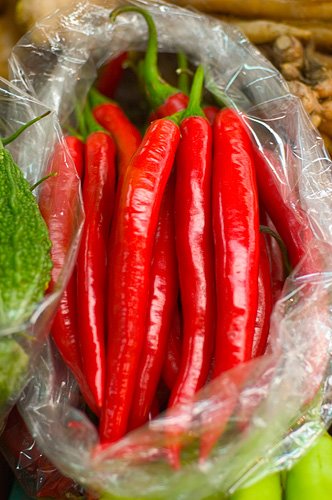
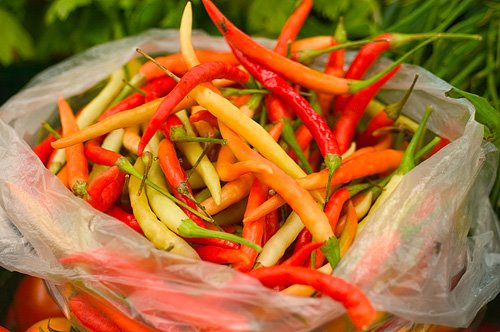
Another common kind of chili are phrik chii faa, literally, "pointing at the sky chilies", apparently for the way they grow:

Phrik chii faa generally range from mild to slightly spicy, and come in three colors: green, red, and orange. They are most commonly used as a garnish. They can be sliced into rings and preserved in vinegar as a condiment for noodle dishes, or sliced or julienned and used to garnish curries such as kaeng phanaeng. Sometimes they are used fresh in curry pastes, but this is generally to add color or body, rather than spiciness.

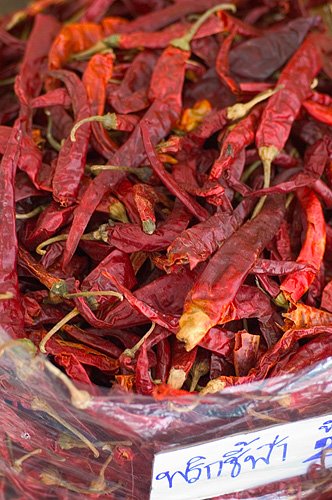
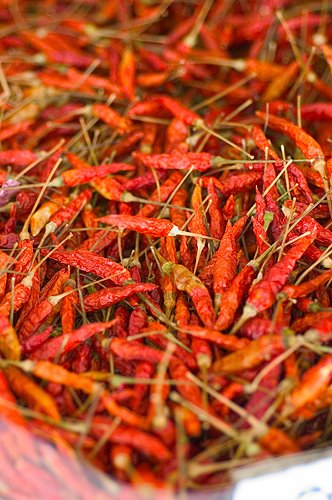
Phrik chii faa are also dried:

Dried phrik chii faa are an essential ingredient in most curry pastes, and provide red color and body, although, as mentioned above, not a lot of spice.

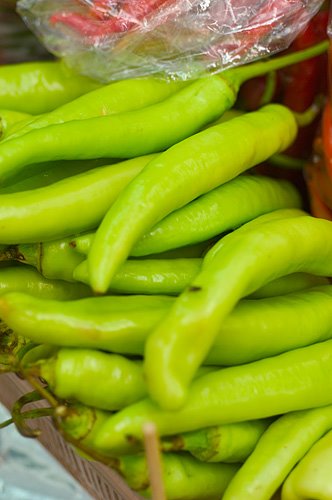
Another chile that is most commonly used as a garnish are phrik yuak:

These are usually mild, and are almost always the pale green color shown above. Sliced, they can garnish a variety of dishes, and are especially popular in Thai Muslim cuisine, where they are somtimes stuffed with fish and steamed or boiled.

Phrik karieng:

can at times be the spiciest Thai chilies of all. They are recognized by their yellow and orange colors (although they are normally somewhat shorter than the ones shown above). They are eaten fresh in some northern and northeastern Thai dishes, but are more commonly dried:

and ground up to be taken as a conidment with noodle dishes.

Phrik num:

are almost exclusively associated with the northern Thai dish, nam phrik num. This dish sees the chilies grilled along with shallots, garlic and tomatoes, and then pounded together into a spicy "dip". The chilies are typically longer than phrik chii faa, and can range in spice from hot to very hot. In northern Thailand, they are often a darker shade of green than shown above.

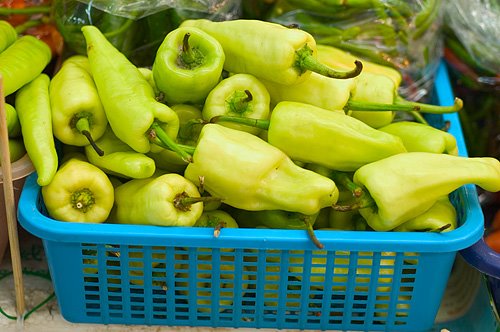
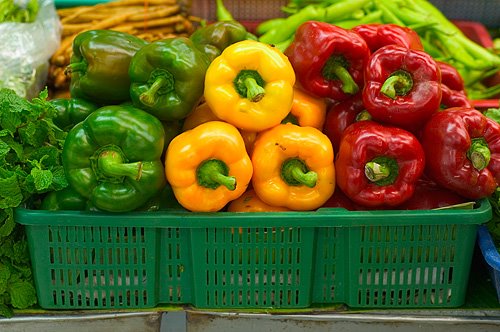
And finally we have bell peppers, or phrik yak ("giant chilies"):

These are virtually only used in stir-fried dishes of chinese origin, and are very mild.

ThaiDay: Introductory course

Introductory Course (ThaiDay, 23/03/06)
One outstanding restaurant is Thai Food 101 for those looking for an overview of the cuisine.

I hadn’t eaten at Hualamphong Food Station for years, and had been meaning to include the restaurant in an article I was writing. Somewhat grudgingly (the restaurant was never easy to find the best of times) I set off to relocate it in the maze that is Sukhumvit Soi 34, but after 40 minutes of searching, came up empty-handed. After trying unsuccessfully to call the restaurant for directions, I went back another day, only to meet the same fate. It wasn’t until long after I had given up hope in ever having another meal at Hualamphong Food Station that I noticed that the restaurant had relocated virtually across the street from my house. And when I say relocated, I really mean it; the various wooden structures that previously formed the restaurant had been taken apart, moved across town, and reassembled at their present location alongside the Kaset-Nawamin Road.

I’m certainly not the only one who has had a hard time located Hualamphong Food Station. Over the years, many a visiting foodie and even a significant number of long-term Bangkok residents have undoubtedly had the pleasure of getting lost on the way to the restaurant. The leafy, rambling assortment of wooden buildings was one of Bangkok’s best-kept “secrets”, and although it was always more popular among foreigners, was recognized for its authentic and delicious Thai food. Hualamphong’s new location is a virtual carbon copy of the original Sukhumvit restaurant, but is located in area that is frequented almost exclusively by middle and upper class Thais; people who conceivably know their how mok nor mai from their nam phrik num, and I was curious to see if this somehow had an effect on the food.

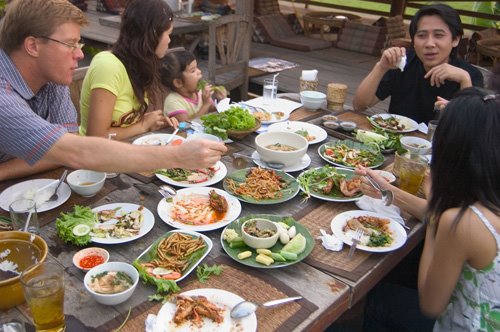
Sitting down at Hualamphong’s wooden tables, the emphasis on good food is immediately evident; how many other Thai restaurants serve a complimentary amuse bouche? In this case it’s a long wooden tray with three kinds of chili dips and an attractive array of fresh vegetables, including such obscure regional herbs such as phak khayaeng and ton or. Hualamphong is best known for its takes on regional Thai cuisine, and the menu is a virtual culinary map of the country, including dishes such as the northern style sausage known as sai ua, an obscure jackfruit salad from the northeast, and budu song khrueang, a chili dip from the south. Although I commend the restaurant’s efforts to feature unusual dishes, I wonder how many diners actually order dishes such as fried ducks’ beaks, ants’ eggs, or the northern specialty, fried bamboo worms (although I’ll admit, the worms, 80 baht, are actually quite good).

Despite featuring dishes from every corner of Thailand, Hualamphong seems to be most confident in its execution of isaan food, and the best dish of our visit was the preserved pork salad mixed with crispy seasoned rice (80 baht), a dish of Vietnamese origin that Thais know as naem khluk. I’ve had this dish elsewhere numerous times, yet am almost always disappointed. This is a pity because the idea behind the dish is wonderful: a spicy/sour mixture of crispy deep-fried rice with fresh herbs, peanuts, and fermented pork. However, more often than not, the rice tends to be a gray, mushy pulp laced with alarming bits of pork skin. At Hualamphong there are still alarming bits of pork skin (it’s unfortunately a prerequisite in this dish), but the rice is crispy, tart and flavorful; the best version of this dish I’ve tasted yet. Another winner in the same genre is steamed mushrooms served with chili sauce (70 baht), a simple but delicious dish that features a variety of mushrooms steamed over a broth containing lemongrass, shallots, galingale and basil, and served with a piquant dipping sauce.

Slightly less successful are the restaurant’s attempts at southern Thai cuisine. Fried beef with southern-style chili topping (100 baht) employs stringy strips of beef that resembled isaan-style nuea daet diaow, and sadly lacked the requisite savory “dryness” of the original. Another dish with southern roots, spicy fried sataw (a pungent southern-Thai vegetable) with river prawn (150) was a disappointingly mild effort at a dish that is normally very intense. Indeed, much of the food at Hualamphong is somewhat toned town, but when it concerns Thai regional cooking this can be to the diner’s benefit, as it allows one to truly experience the flavors of the often unfamiliar herbs, fish and vegetables.

Another plus about Hualamphong Food Station is the restaurant’s excellent service staff. The waiters are friendly and helpful and appear to be confident about what they do. After several months in its new location, Hualamphong Food Station continues to be a restaurant that celebrates good food, and is one of the few places in town that recognizes the treasure that is Thailand’s regional cooking. And best of all, it’s actually possible to find.

Hualamphong Food Station
Kaset-Nawamin Road (near the second stoplight from either end of the road)
01 300 9700, 01 634 1892

ThaiDay: Chili me softly

Chili me softly (ThaiDay, 23/03/06)
Discovering the delights of Thai cuisine need not be a spicy, complicated experience.

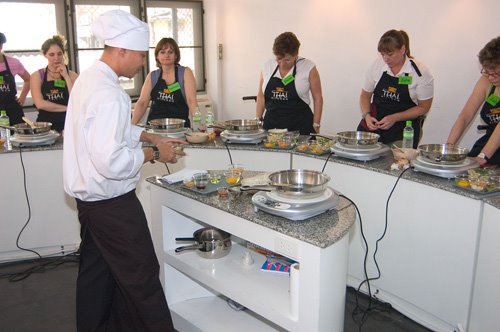
Since the Thai food craze of the1990’s, Thai food has remained popular in the west, but much of this fame has been relegated to restaurants. For many home chefs in the US and Canada, Thai cuisine still carries an intimidating air of the exotic, and most people would rather not make something that can simply be bought at the Thai takeaway around the corner. Additionally, many of the ingredients essential to Thai cooking are misunderstood, or simply not available abroad, as well as the fact that Thai food has the reputation for being extremely spicy—something that intimidates many westerners. In short, there still is a lot to be done to promote Thai cooking internationally, and in an effort to do this, a food journalists’ tour of Bangkok was recently organized by Epicurean International, a US-based company that sells Thai cooking ingredients. During a week in Bangkok, myself and 11 other food writers and editors from North America took part in a Thai cooking school, visited various factories, and tasted Thai food at some of Bangkok’s best Thai restaurants. For many of the participants, this was their first experience with authentic Thai food, and was an introduction to the cuisine’s cooking and flavors. For me, the experience allowed me to see Thai cuisine for the first time once again, and also highlighted some of the trials of introducing an authentic Asian cuisine to North America.

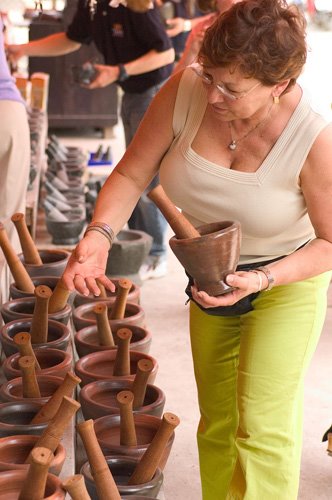
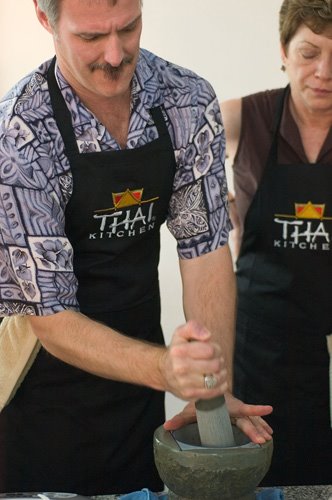
Our crash course in Thai cuisine began with two days at the new Epicurean Kitchen Cooking School. As an introduction, we were given an explanation of the various Thai ingredients by the host of a Thai cooking show in the US. As we learned about the various uses of galingale, lemongrass, chilies and coriander, the actual herbs were passed around the table for each of us to touch, smell and taste. When kaffir lime leaf was brought up, Fraya Berg, a food editor at Parents magazine, mentioned the current trend of using the Thai word makrut to describe the leaf, as kaffir is a derogatory term in some countries. Others had questions about the use of frozen or dried herbs as opposed to fresh, as well as questions about the acceptable substitutes for the more obscure Thai ingredients. I felt that many of these concerns were good examples of the issues that Thai food has never been faced with domestically, and that it will have to overcome in order to become popular abroad.

During our two days at the cooking school, we learned to prepared more than 10 dishes, and most were surprised to learn that the actual cooking processes involved in making Thai food are often quite simple. “I enjoyed learning that the blending of Thai flavors is fairly straightforward and based upon a group of basic flavors: galangal, lemongrass, chilies, coconut milk and fish sauce,” explained Julie Miltenberger, a food editor at Family Circle Magazine. When asked what she sees as potential roadblocks to making Thai commonplace in the west, Miltenberger suggested that, “The greatest obstacle I foresee […] is the lack of fresh Thai ingredients in the marketplace. If ingredients are readily available, the food is very easy to assemble.” Gwynneth Galvin, a frequent contributor of food-related articles to Woman’s World magazine, thought that nomenclature might be a potential problem. “I’ll take these recipes back to the US, but I’ll have to rename them, as most people in the US aren’t familiar with the Thai names,” she explained.

Despite the fact that Thai ingredients are as simple as the cooking processes used to cook them, many suffer from the misconception that they are unhealthy (coconut milk) or just plain odd (fish sauce, shrimp paste). A visit to two factories where both of these staples are produced helped to clarify some of the misunderstandings surrounding Thai food. At Rungroj Fish Sauce Factory in Rayong, we learned that fish sauce is a pure product, comprised only of anchovies and salt, and that the highest quality fish sauce is the result of the first “pressing”, as one writer referred to it. At Merit Food Products in Cholburi, we saw that coconut milk is not the sweet juice that is found in young coconuts, but rather the liquid that is extracted from mature coconut meat. After visiting these factories, I felt that if people in the west were aware of the processes that go into making these ingredients, they would be more apt to use them.

Another factor that has slowed the progression of Thai food abroad is its reputation for being spicy. However, based on the comments of the journalists, this impression may not always be true. “I thought [Thai food] would be too hot for me, but I don't think I had one unmanageable dish,” commented Susan Katzman, a freelance food and travel writer, after several Thai meals. “The heat in all we tried enhanced flavor—not overpowered it.” Janice Cole, a food editor at Cooking Pleasures magazine added, “Thai food has developed a reputation for being very spicy in [the US]. While that appeals to many people, it also deters many people. What I found out on the trip is that Thai food can easily be made in a variety of heat levels and people can season their own food to their taste with chili sauce on the side.”

Along with Thai food, the popularity of Thai beer is also growing abroad, and I was able to learn more about this facet of Thai cuisine when I visited the Boon Rawd brewery with well-known Canadian beer writer, Stephen Beaumont. Normally the factory is not open to the public, but through a previous arrangement we were given a private tour by the brewery’s German-educated brewmaster, Tavesak Sujjayan. After our tour we were able to sit down and taste some of the brewery’s beers, including Thai, Leo, Kloster, Asahi, and Singha. After tasting the beers and discussing the flavors, Beaumont concluded that, “…variety is not the greatest strength of Thailand's breweries. Most every beer brewed in the country is a variation on the pale lager theme, with flavors ranging from borderline non-existent to sweetish and straw-like…” Beaumont described Singha as his favorite among the beers, which he described as “well developed and moderately full-bodied.” Although after seeing the factory I did gain a new appreciation for Singha, it’s clear that domestic Thai beer still has a long way to go before it will be well regarded outside of Thailand.

At the end of a week, Thai food appeared to win over this food-savvy crowd in a number of ways. Susan Katzman suggested that, “Thai cooking would translate well here in America for those on ‘health’ quests, being low calorie, high color, low fat, [and] full of flavor…” Janice Cole added, “I think one area Americans know little about are Thai salads and I think Americans will be very receptive to learning more about [them].” As an afterthought, Katzman added, “I came home totally addicted to sugar. Who would have thought I could crave those strange looking desserts, but yes, give me mango and sticky rice, or gnocchi-type dumpling in coconut milk over chocolate cake and I'll be happy.” Each of us took something different away from this experience, but hopefully it will lead to a greater understanding of this exotic cuisine, encourage people in the west to cook Thai food, and hopefully, add a bit of spice—but not too much—to the western palate.

How To Make: Phat Fai Daeng

Phat fai daeng literally means "fried with fire" and refers a style of flash-frying vegetables where the oil is ignited by the cooking flame, giving the dish a desireable "smoky" flavor. The most typical vegetables to be cooked this way are phak boong ("morning glory"--not the flower), phak khanaa ("Chinese broccoli"), and a Thai vegetable known as phak krachet. I make this dish almost every week; it's easy, nutritious and delicious.

An important element of this dish is the sauce. Here's what I use:

On the left is Heinz brand oyster sauce, and on the right, tao jiaow, a sauce of whole fermented soybeans. Some people will also use a touch of fish sauce or sii ew (Thai soy sauce), but I really like the simple combination of these two ingredients. It's essential to have your mise en place, the sauces and a bit of water, ready and easy to reach. This whole dish will take no more than about 1 1/2 minutes to make, so timing is essential.

Today I'm using young phak khanaa. I've taken the leaves and chopped them into largish pieces, and have halved the harder stalks (sorry, forgot to photograph this!). I usually soak them in cool water to crispen them up before frying.

In a mortar and pestle, grind up a healthy (or my case very healthy) amount of phrik khii noo (tiny Thai chilies) and a few cloves of garlic. Grind them together just enough to break them--you're not making a paste here. (Sometimes I like to throw a few peppercorns in at this step. This is a personal preference, definately not a Thai thing, but tastes good.) Set aside.

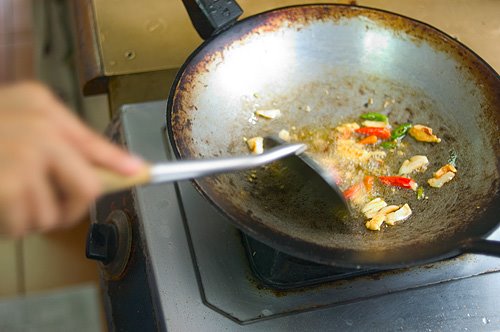
Heat a generous (4 Tbsps?) amount of cooking oil, and fry the smashed garlic and chilies over med-high heat for about 20 seconds, just long enough to make them "wilt":

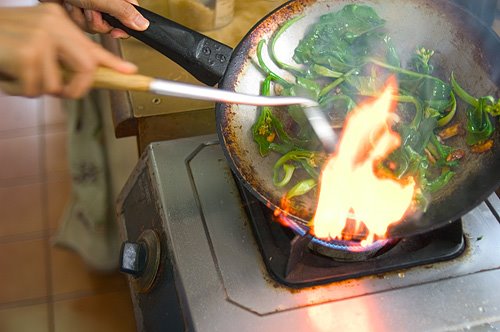
Then turn your heat up as high as possible, add about 1 Tbsp of the tao jiaow (be careful, it's very salty), give a quick stir, add the veg, top with some oyster sauce, and a couple tablespoons of water. Now the fun starts: stir the mess up while tilting the pan to one side. If you've used enough oil it will ignite in a big fat beautiful flame:

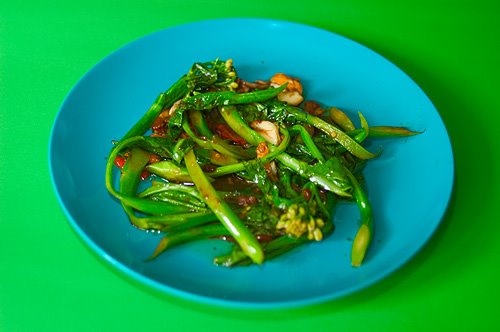
Continue to do this several times during the cooking process to ensure that wonderful smoked flavor. Again, this should not take more than 1 minute, and you want the veggies to be just cooked, preferably still crispy and ever-so-slightly undercooked:

Done.

How To Make: Plaa Som

Plaa som ("sour fish") is usually associated with a type of whole fermented fish popular in NE Thailand. As much as you all love rotten fish, it's unfortunately not what I'm going to be making for this lesson. Today's plaa som is actually a southern dish that takes a hearty Spanish mackerel steak, fries it until cripsy, and coats it with a sour, chili-based sauce.

You'll need a spanish mackerel (plaa insee) steak of about 200-300 grams.

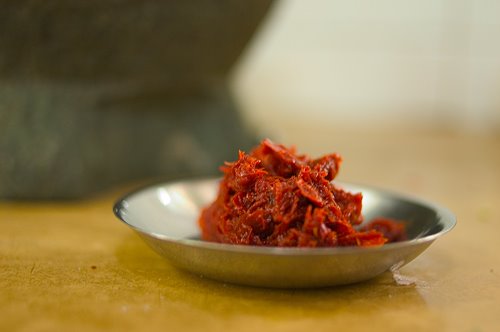
And, as usual, you'll need to make a curry paste:
Large dried chilies (soaked in warm water until soft) 5
Salt, 3 tsp
Garlic, 10 (small) cloves
Shallots, 3

Other ingredients
Sugar, 1 1/2 Tbsp
Vinegar, 1 1/2 Tbsp
Water, 1/4 cup

Onion, 1/2 sliced
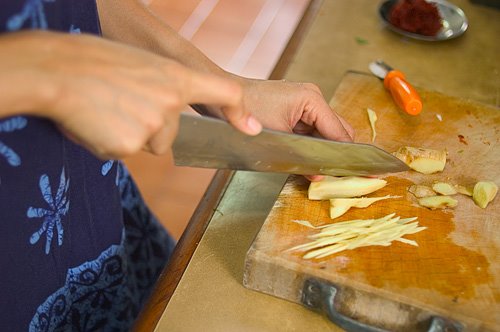
Ginger, one medium root, chopped

Using a mortar and pestle (or food processor) grind the chili paste ingredients up finely. Set aside.

Chop your ginger and onion.

Combine the sugar/vinegar/water mixture. Set aside.

Taking your mackerel steak, rub a bit of salt into it (this helps to prevent it from sticking to the pan), and fry it in a generous amount of oil until crispy and somewhat golden.

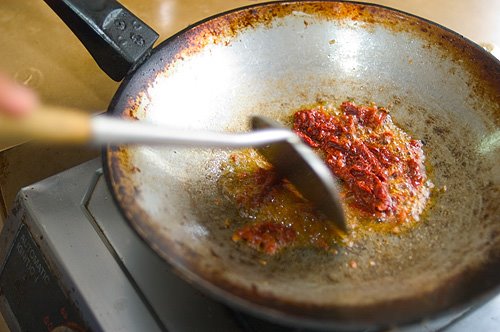
Remove fish and let drain. Remove all but about 1-2 tablespoons of the oil, and add the curry paste ingredients. Fry until blended and fragrant.

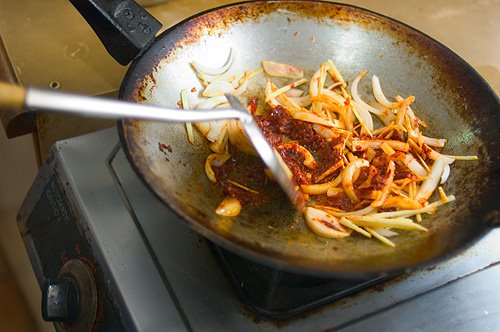
Add onion and ginger, and fry until onions begin to soften.

Add sugar mixture and fry, stirring constantly, over medium heat until slightly reduced. Add more water if the sauce becomes too dry, and continue cooking until sauce is reduced somewhat.

Put fish on plate and cover with the onion/sauce mixture.

Done.