Hint: The vendor was out of tomato sauce.
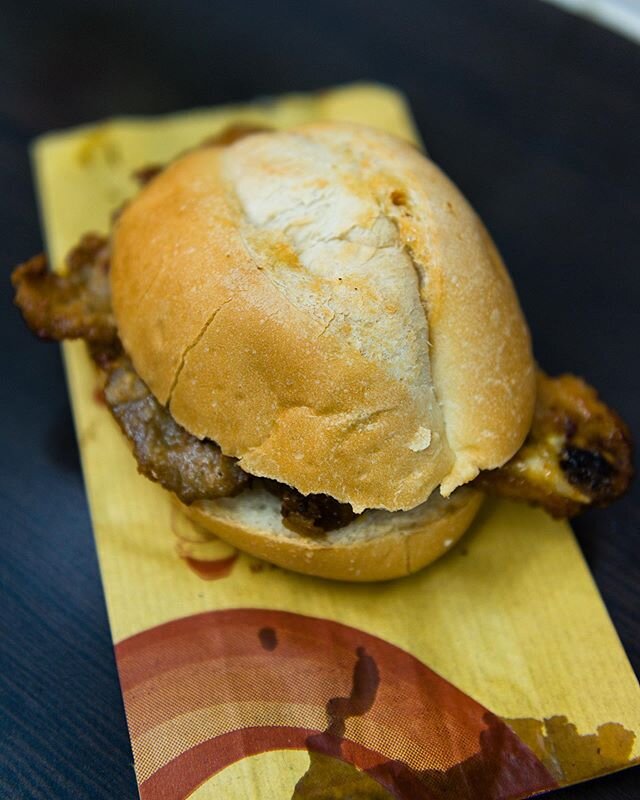
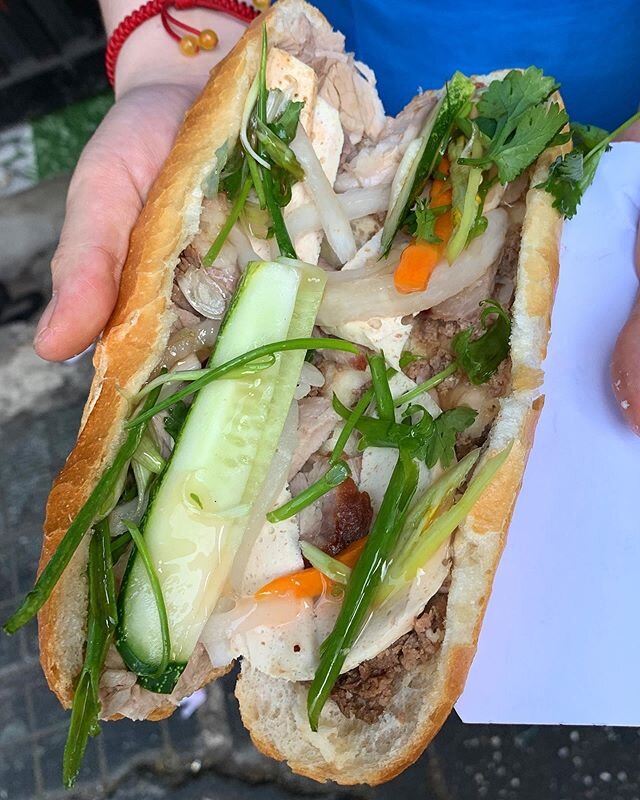
Hint: The vendor was out of tomato sauce.
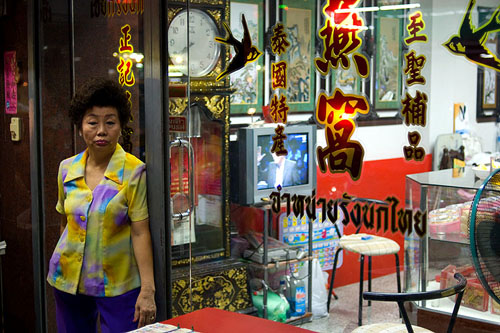
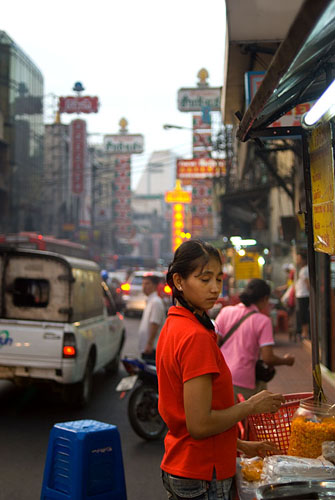
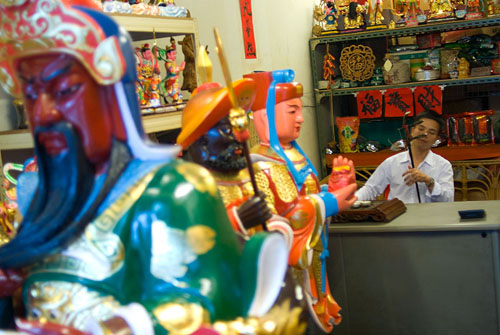
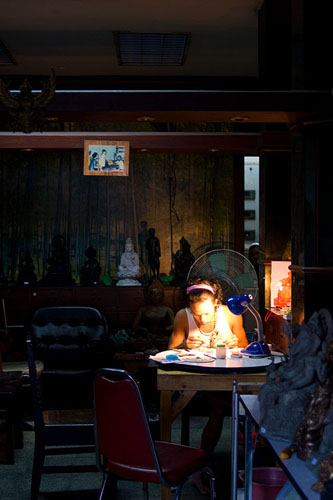
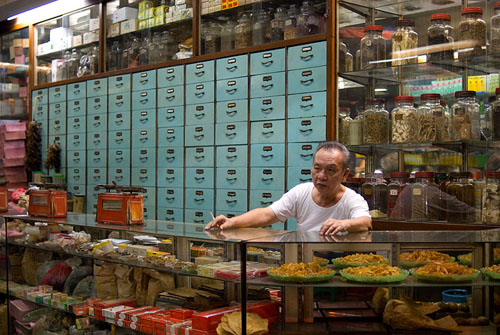
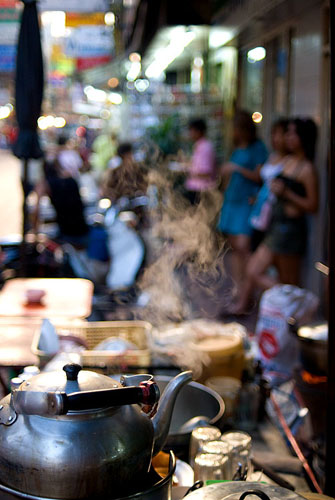
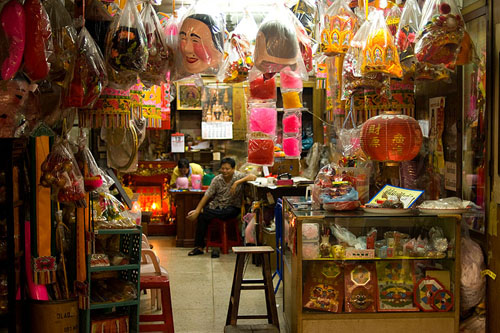
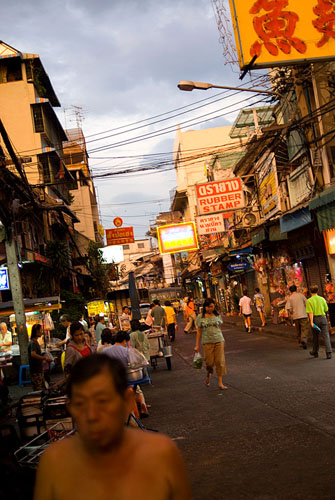
Something of a mini Southeast Asian food bloggers summit was held a couple weeks ago here in Bangkok. This involved Hock of Gut Feelings, Phil formerly of Phnomenon and currently The Last Appetite, and me of here, and any day now, Gut Feelings. Aided with my in-depth Bangkok food experience, as well as a handy illustrated map provided by food-blogger-in-spirit Aong, we attacked Thanons Tanao and Mahanop, leaving nary a crumb behind.
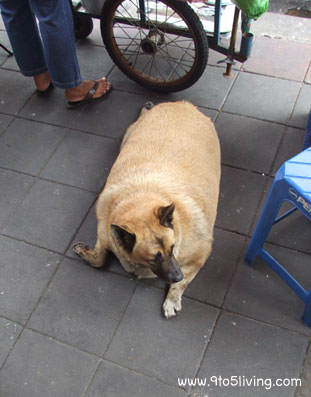
I've mentioned most of our stops in previous posts, so I'll just touch the one new place I visited, Ko Lun. Directed by Aong's map, we entered Thanon Mahanop and turned right at the fat dog:
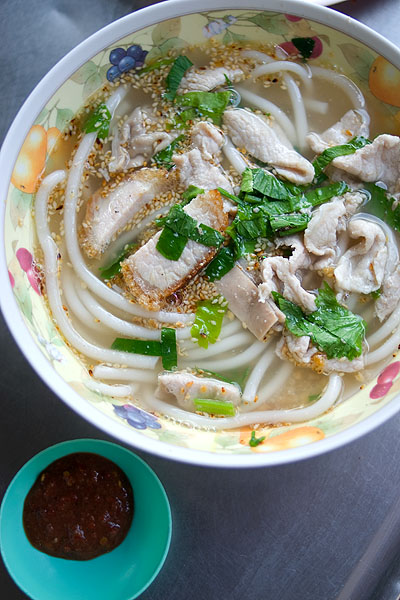
and started with the recommended khanom jeen hailam, Hainan-style noodles (pictured above). The dish took the form of a clear, rather bland broth, with hearty udon-like noodles, and deep-fried and par-boiled pork, and oddly, toasted sesame seeds. It wasn't much to write home about until you added the tiny bowl of seasoned shrimp paste, an unusual but tasty condiment for a noodle dish.
The restaurant's other signature dish is goat stewed in red sauce:
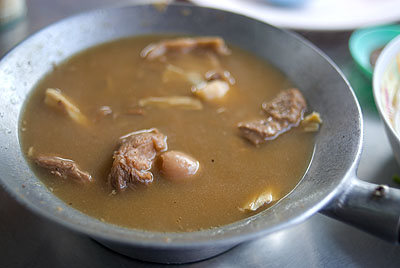
It was good--although perhaps not as flavourful as the deeply-coloured broth would suggest. The goat was still pretty tough, and was supplemented with tofu skin and offal:
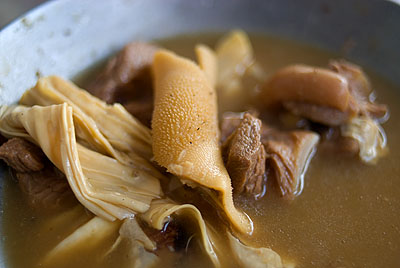
The dish was served with rice and two dipping sauces, one very much like the spicy/sour Thai seafood dipping sauce, another of finely shredded dried galangal that I found absolutely delish.
Despite the big names and egos involved, it was an enjoyable day, and the Summit went generally well until Phil unsuccessfully tried to score us a free meal by promising to blog on the restaurant ('Do you know who I am? No? Does a little thing called Phnomenon ring a bell? Bitch...').
Ko Lun (Google Maps link)
Thanon Mahanop
089 010 2123
8am-4pm
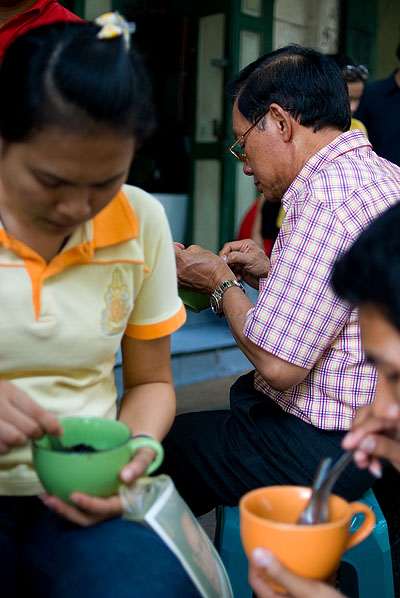
Grass jelly is a dessert of Chinese origin that can be found virtually everywhere in Southeast Asia. If you're not familiar with it, have a look at this piece I wrote last year for a domestic paper.
My favourite place in Bangkok to eat grass jelly is an old shophouse just a few steps away from Tha Chang. There are a couple of chairs and tables inside, but most people simply sit on the stools set out along Thanon Maharat, as shown in the picture above.

The grass jelly itself has subtle 'herbal' flavour, and is served with crushed ice, but my favourite part is the unprocessed cane sugar, naam taan daeng, that the dish is topped with:

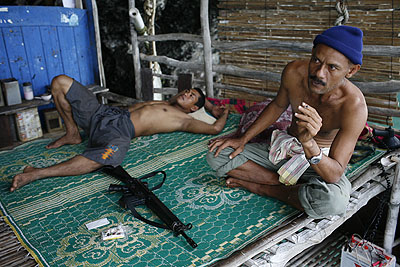
I'd like to urge any readers in Bangkok to visit the 9 Days in the Kingdom photo exhibition currently being held on the 8th floor of ZEN, Central World. The exhibition is the offshoot of the book of the same name that features the images of world-famous photographers such as Greg Gorman, David Alan Harvey, Steve McCurry, Mike Yamashita, Abbas, Eric Valli, et al over a nine-day period in Thailand during January, 2007. James Nachtwey's images on an AIDS hospice are particularly moving, and I really enjoyed shots by Surat Osathanukhrah, Dow Wasiksiri, Gueorgui Pinkhassov and Ben Simmons. And as an added bonus, I'm actually featured in one of the images! Mad props to the first RealThai reader who finds me.
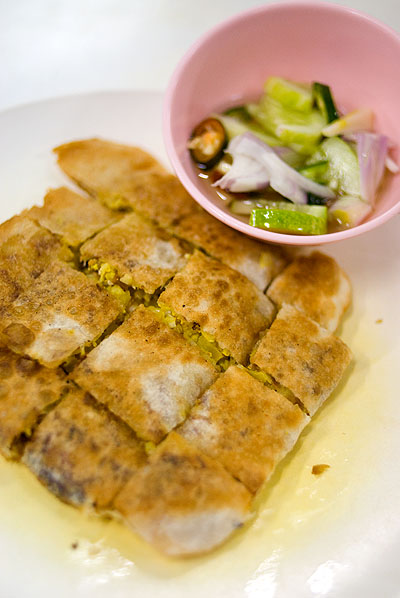
Roti Mataba is the name of restaurant on Thanon Phra Athit that has been made extremely popular by its place in the Lonely Planet guide. It used to be quite good, but standards have dipped in recent years and I'd not really recommend it any more. The Roti Mataba I'm mentioning today is an entirely different place.
Found around the corner next to Thammasat University, this Roti Mataba is located at the beginning of the impossibly narrow alleyway known as the Tha Phra Chan Market. We were simply here for a snack, and ordered a mataba (pictured above), a Thai-Muslim dish similar to a stuffed pancake. This one was filled with minced chicken that had been mixed with a delicious 'curry' mixture and egg. Mataba are always served with ajaat, a sweet/sour dipping sauce that includes sliced chilies (the mild type) and cucumber.
The restaurant itself is tiny cave-like affair:

(Click here to see a larger version.)
and since there's no ventilation, and virtually everything the restaurant makes is fried, the entire place is coated with a thin film of oil. It's also very hot, but despite all this, it really is an ideal place for a snack, as they serve a huge variety of drinks, as well as every imaginable type of Thai snack-type food, including hoy thord (fried oysters), spring rolls, som tam, and in particular, yam plaa duk foo:

the salad of crispy deep-fried catfish.
Roti Mataba Tha Phra Chan (Google Maps link)
081 309 6780
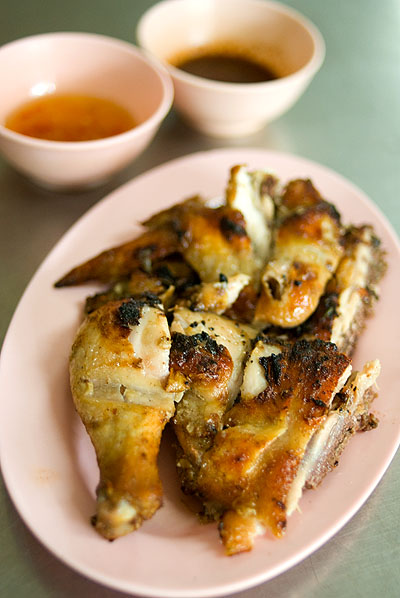
Another day, another Bangkok food legend. Today's gem is Likhit Kai Yaang, an ancient isaan restaurant next door to Ratchadamnoen Thai boxing stadium in Banglamphu. Likhit doesn't appear to have changed much since its apparent grand opening in 1960-something, and is not unlike, I imagine, a Soviet-era mess hall. And as was probably the case with Soviet-era mess halls, I wouldn't particularly advise looking into the cave-like kitchen.
Kai yaang means grilled chicken, and this is what people come here to eat. The birds (in this case kai baan, the Thai version of free range chicken) are first marinaded in a secret mixture, which I'm thinking must include at the least garlic, coriander seeds and/or roots and perhaps a bit of turmeric, before being grilled over coals outside the restaurant by an expert:

The result is a crispy skin redolent of the delicious marinade, and flesh that is tender and slightly smoky. Lovely indeed. Other than the restaurant's namesake, Likhit also does the issan staples, including a delicious som tam:

tap waan, liver:

grilled catfish:

and tom saep, a spicy/sour issan-type tom yam:

All wonderful, in particular the som tam, but the chicken is the reason I'll come back.
Likhit Kai Yaang (Google Maps link)
74/1 Thanon Ratchadamnoen Klang (next to the Thai boxing stadium)
02 281 1094
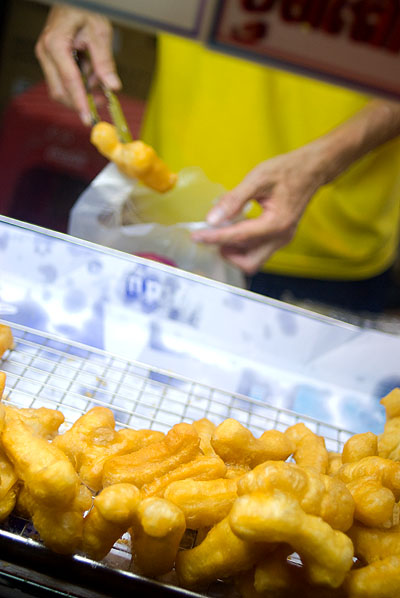
Still in the Thanon Tanao area of Banglamphu, virtually across the street from K. Phanich and Nom Jo (I told you there's a lot of good stuff to eat here), exists a second-generation shop that specializes in making one product: paa thong ko. Essentially deep-fried bits of dough, it's a simple dish, and the owner has been making them in the same place for fifty years, taking over from his parents after they were too old to run the business.
The paa thong ko are served with a sweet milk-based dipping sauce flavoured with (and turned green by) bai toey, pandanus:

They are best eaten right away, when they're still hot, but I was surprised to find that the paa thong ko remained relatively crispy a good half hour after we bought them.
Paa Thong Ko Sawoey (Google Maps link)
540 Thanon Tanao
02 222 2635
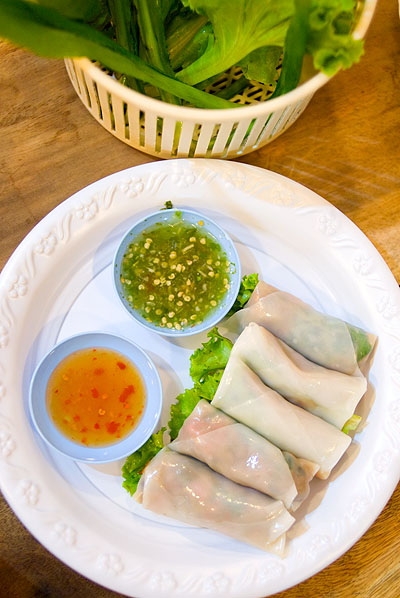
Virtually next door to K. Phanich is Nom Jo, a small restaurant that specializes in, of all things, milk. This is an odd variety of Thai restaurant that, I assume, dates back to the days when milk was something not generally available in Thailand and Thais had to go to specialist restaurants to drink it. Nowadays milk can be bought everywhere, but the restaurants still exist, and have begun to sell a variety of dishes to stay alive.
At Nom Jo ('Jo's Milk') we skipped over the milk altogether and went directly to kuaytiao luy suan, literally 'noodles on an adventure in the garden'. I really have no idea regarding the origin of this name (can anybody help?), and can only assume that it has to do with the fact that the dish is served with a large variety of fresh herbs and veggies.
As shown above, the dish is similar in form to spring rolls, the main difference being that kuaytiao luy suan are 'wetter' and more savoury. With lesser versions of this dish, when you break the noodle wrapper, the typically 'dry' filling tends to tumble out. With Jo's version, the filling, a mixture of ground pork, carrot and shiitake mushrooms, and a few other things I can't recall, had been sauteed before being placed on a lettuce leaf and bundled in the noodle. This helped hold the mixture together, and the seasoning during this process also provided a salty, savoury taste. The rice-flour noodle wrapper was also very nice, and was thick and toothsome without being soggy or heavy.
The dish was served with two sauces: a delicious spicy/sour one similar to that served with Thai seafood, and another sweet sauce similar to the one Thais eat with fried chicken, not to mention herbs including basil, mint, sawtooth coriander and lettuce.
Nom Jo also serves what look like some very interesting Chinese-Thai stews and curries, not to mention a variety of drinks (both milk and non-milk).
Nom Jo (Google Maps link)
Thanon Tanao (next door to K. Phanich--look for the cow sign)
089 788 6417
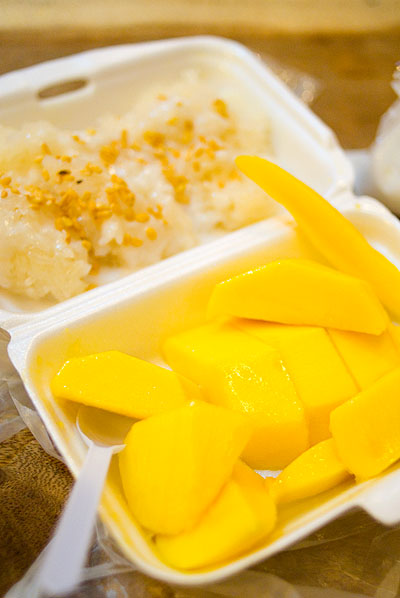
Mango and sticky rice is, like phat thai and tom yam, one of the few Thai dishes foreigners seem to be familiar with even before arriving in Thailand. On Khao San Road there are even a couple mobile mango sticky rice carts that wander up and down the streets, scavenging for hungry new arrivals. I haven't tried these carts, but doubt they're anywhere as good as the stuff sold literally across the way at K. Phanich.
K. Phanich only sells khao niaow moon, sweetened sticky rice, and a few other sweet/savoury toppings; if you want to eat your rice with mango you can buy one from the woman waiting patiently out front. We arrived late in the day and she apologized several times that she only had slightly sour mangoes left. She choose what she reckoned to be the sweetest one and proceeded to peel and slice it for us:

K. Phanich has no seating, so we took our booty to the shop next door (another interesting place that I'll blog about next) where, after ordering a few more things to eat, we combined about half of the sticky rice with the mangoes, poured over the still-warm salty-sweet coconut dressing, and sprinkled the lot with the crispy dried peas (the peas don't provide much taste, but provide the dish a wonderfully crunchy texture). The mango was slightly sour, but I thought it was a pleasant counterpoint to the very sweet rice and sauce. This dish, like many other Thai desserts, also has a slightly salty flavour, and is best eaten slightly warm, which really allows the bizarre but delicious salty/sweet combo. to shine.
If you'd like to try to make this dish at home, here's a recipe from Pim.
K. Phanich
431-433 Thanon Tanao
02 221 3554
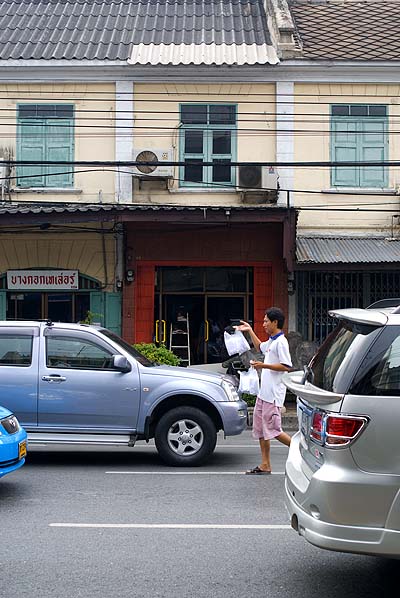
Nakhorn Sawan Street, just outside Banglamphu in old Bangkok, is home to Talaat Nang Loeng, one of the older and more interesting markets in town. However the street is probably even more associated with the several shops in the area that sell kluay thawt, deep-fried bananas. This snack, also sometimes known as kluay khaek, is found just about everywhere in Bangkok, but what's special about these bananas is the way they're sold.
As illustrated above, the vendors take their product directly to the streets, waiting for a red light and weaving between stopped cars.

Technically, this is illegal, and every time a policeman comes, the vendors scream warnings at each other and run away frantically. I saw this happen several times in the nearly 15 minutes I watched them at work and thought that it seemed an awful nerve-wracking way to make a living.
Eventually I took a seat and tried the bananas. Although they're normally sold in bags of two for 20 baht, I bought a single bag for 10. The bananas of the particular vendor I bought were decent; not too greasy, but could have been a bit sweeter (and I prefer the ones with sesame in the batter). While I sat and crunched through my bag, I chatted with the vendors while they screamed at their co-workers in the streets when cops drove by. One vendor told me that he was particularly annoyed with journalists who had pretended to want to buy bananas, only to snap pictures and leave without buying anything.
I was recently forwarded this New York Times article about dining in Portland, Oregon (one of my three 'hometowns', along with Bangkok and Stockholm). Other than making me slightly homesick, I was surprised to learn that a Thai restaurant is among those currently creating a buzz back at home. I did a bit of research and found that Pok Pok, the restaurant mentioned, serves not just Thai, but ahaan isaan, northeastern-style Thai food. The self-proclaimed 'shack' was also voted the Oregonian's Restaurant of the Year. Two detailed and generally favourable blog reviews can be seen here and here (I particularly like this bit: "Fortunately the lighting is is much better than what you’d typically find in Thailand."). Sounds very interesting. Has anybody been?

I used to think khao soi, the northern Thai curry noodle dish, was nearly impossible to find in Bangkok, but in the last few weeks I've run across it more than a couple times. My latest discovery was ironically only a few kilos from my house, under the Ram Intra Expressway near the intersection with Lad Phrao.
Arriving just after lunch with my generally reliable food sidekick Aong, we were dismayed to find that they only khao sois remaining at that time were the pork and seafood varieties. This was immensely disturbing news, as khao soi is almost exclusively served with chicken or beef (a sign of the dish's Muslim roots). Pork is a lazy substitute and seafood khao soi is a heresy beyond words, and those responsible for the concept should be forced to eat...seafood khao soi for the rest of their days. Grudgingly, we chose the pork (shown above). The dish was a decent, if not mediocre take on the dish, but lacking the creamy, oily, spiciness of Faa Haam's nearly-perfect bowl. The sides (pickled mustard cabbage, sliced shallots and lime) also seemed of substandard quality. Sophaphan also serves the Shan noodle dish, naam ngiaow, as well as some northern Thai standards and som tam. Good in a pinch, I reckon, or if you're in the neighborhood (make sure you come early), but you'll be much happier if you make the trip over to Viphawadee to eat at Faa Haam.
I've also come across khao soi on Sukhumvit Sois 22 and 31; stay tuned for a detailed investigation.
Khao Soi Sophaphan
86 Soi Inthraphorn (under the Ram Intra Expressway not far from the intersection with Lad Phrao)
02 530 6292
Mon-Sat, 9am-4:30pm
Addendum: In flipping through my replies to this blog, I recently received a comment from a woman who's doing a blog exclusively about khao soi in New York City! Honestly, I was surprised enough to find out that one can actually get khao soi in in the US (it's hard enough to find in Bangkok), but even more shocking is the price: $16 for a bowl of khao soi??!!?? Maybe I'm spoiled living here, but the price I payed for the bowl above, 30 baht--slightly less than $1, feels about right to me. Guess I won't be going home anytime soon...
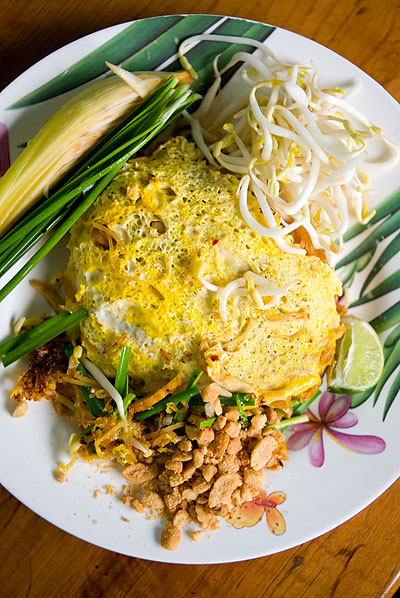
I recently spent a couple days in the town of Chanthaburi. Discovering a new place is always fun, but sometimes it's better to have a guide, and on this trip I was fortunate to be accompanied by a well-connected half-Chanthaburian food freak.
Rice noodles, the main ingredient in phat thai (shown above) are associated with Chanthaburi, and we stopped by a factory where they still make the noodles the old school way, by drying them in the sun on bamboo racks:

Rice noodles are also used in kuaytiao muu liang, another dish associated with Chanthaburi:

We at at a place outside of town called Phrya Trang (address below). The broth gets its dark colour from a combination of local herbs, and its slightly sweet taste from the addition of pineapple. I'd say it was somewhat similar to kuaytiao ruea, but not quite as intense.
Root herbs are actually a very important part of the local cuisine in Chanthaburi, and a walk through any of the city's markets will reveal several kinds of plants generally not used elsewhere in Thailand, such as krawaan:

and young krachaay:

Being close to the sea, seafood is also a big deal, and the markets are stocked with heaps of fish, shrimp and squid, and even odder things, such as horseshoe crabs:

The ones above have already been grilled, and you only eat the eggs (often made into yam, Thai-style salad); there is no meat.
If you're at Chanthaburi's main market in the morning and find yourself in need of a snack, you can do like the locals and stop by this tiny stall selling paa thong ko, deep-fried bits of dough:

The stall is very popular, as the line of impatient motorcyclists suggests. Unlike elsewhere, in Chanthaburi paa thong ko are served with a thin, sweet/sour sauce, somewhat similar to that sometimes served with deep-fried chicken elsewhere in Thailand.
Muu Liang Phraya Trang
60/1 Moo 12 Tambon Tha Chang
039 339 761
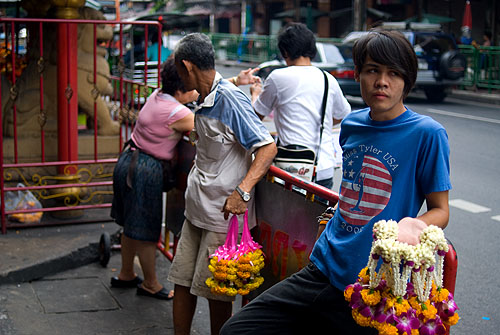 Selling garlands in front of Wat Kammalawat, Thanon Charoen Krung
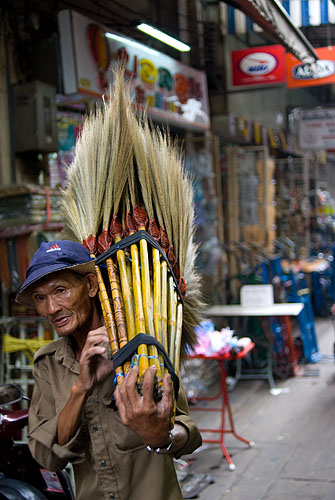 Broom-seller in the market alley of Sampheng
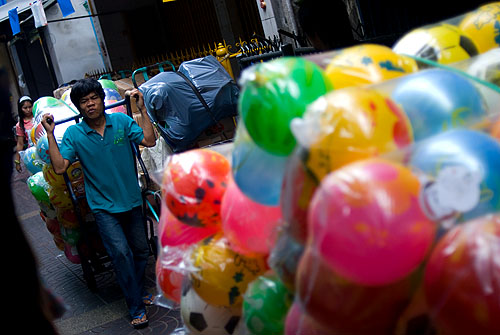 Moving merchandise at Sampheng market
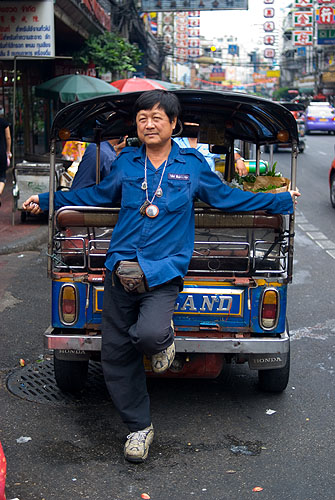 Tuk-tuk driver, Thanon Yaowarat
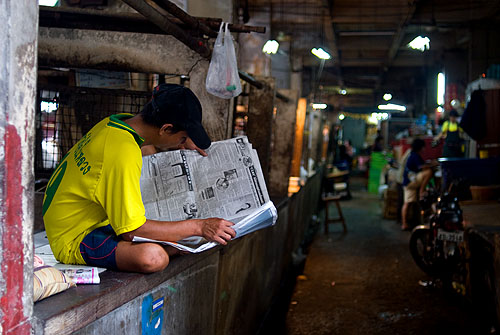 Taking a break from butchering, Talaat Mai
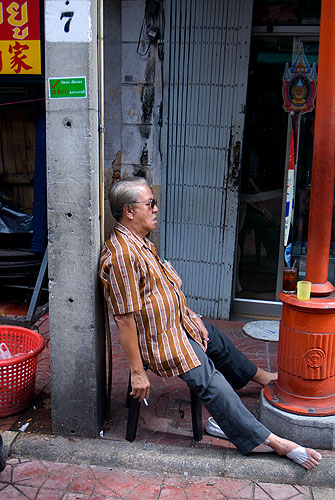 Taking a break from... something, Thanon Phaatsaay
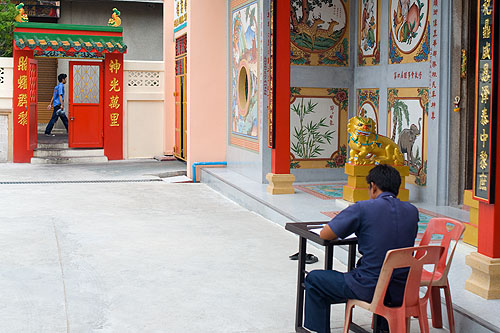 A Chinese temple/school near Thanon Songwat
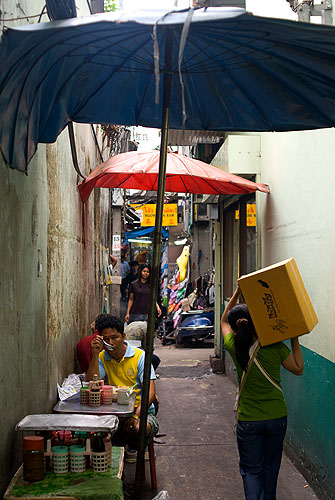 The narrow alleyways of Sampheng are barely large enough for umbrellas
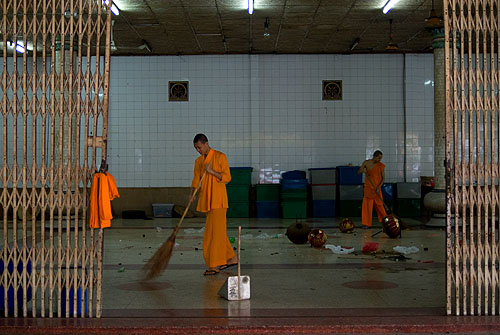 Sweeping up at Wat Mangkorn Kammalawat
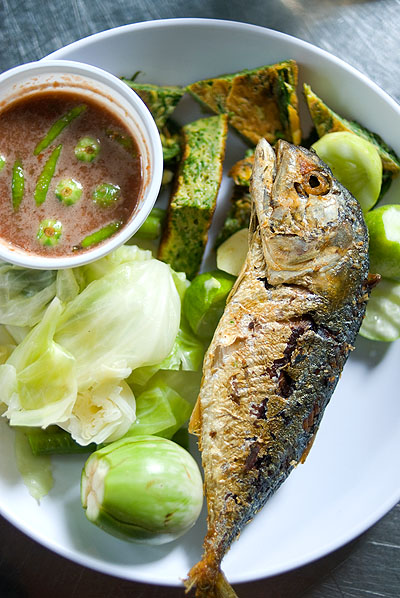
If you've ever looked at my photo blog, The Old Main Drag, you'll have noticed that I tend to spend lots of time in Yaowarat, Bangkok's Chinatown. For the last few months, I've been working on a photo project that will be shown Bangkok's own Kathmandu Photo Gallery late next year. As a result, I've been going to Yaowarat at least once a week, often more. My favourite time to take pics in Yaowarat is early in the morning, and after a couple hours of walking and shooting, inevitably I get pretty hungry. Despite the variety of eats in Chinatown, I always end up eating at a streetside curry stall off of Thanon Phaatsaay called Jay Kii.

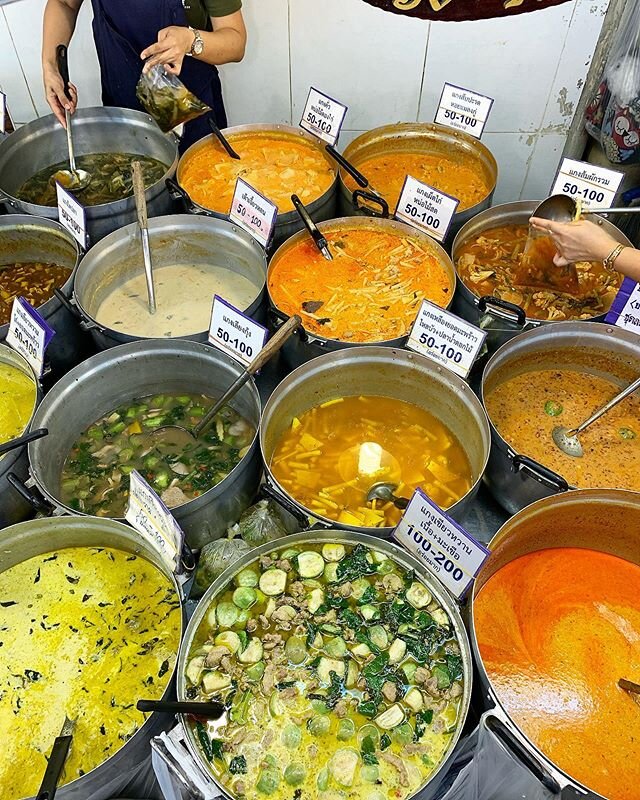
Jay Kii sells a variety of Chinese-Thai curries, stir-fries and soups:

These include an excellent kaeng khiaow waan look chin plaa kraay, green curry with fish dumplings, some nice soups, namely jap chai, the Chinese-style vegetable stew, or an excellent bitter gourd stuffed with pork in broth. But I always tend to go for her daily 'specials', such as this morning's naam phrik kapi 'set' (pictured at the top of this post), or her excellent khao khluk kapi (shown in this post). After some eats, and a glass of iced coffee from the stall in the same soi, I'm usually ready to wander for another hour or so before heading home.
Jay Kii
Thanon Phaatsaay (virtually next door to Iea Sae Coffee Shop) (Google Maps link)
7am-noon (or until all the curries are sold out)
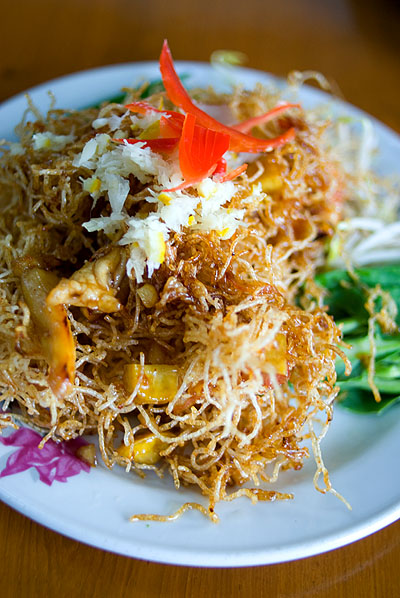
Chote Chitr, a six-table restaurant in the Banglamphu district, has gained something of an underground following since it was mentioned in a New York Times article a few years back. I first learned about Chote Chitr (pronounced chote jit) from Suthon Sukphisit, author of the Bangkok Post's excellent weekly Thai food column, Cornucopia. Suthon told me that it is of his favourite places in town to eat, and in particular he always orders, mee krob, 'crispy noodles' (pictured above). He explained that Chote Chitr is one of the few places that makes this dish the old school way, using the peel of som saa, a certain kind of citrus fruit, to flavour the sauce. The sour/citrus flavour of the som saa is indeed very prominent in the dish, which despite appearances, wasn't as sweet as I feared. In fact, it was a very nice balance of sour, sweet and savoury, with a satisfying crunch. There were a few prawns and squid bits thrown in, a topping of shredded pickled ginger, and sides of Chinese kale and beansprouts. I've never made the dish, and have no idea where to get a good recipe. Any ideas?
For other good eats in this area, check out this post.
Chote Chitr
146 Thanon Phraeng Phuthon
02 221 4082
10am-10pm
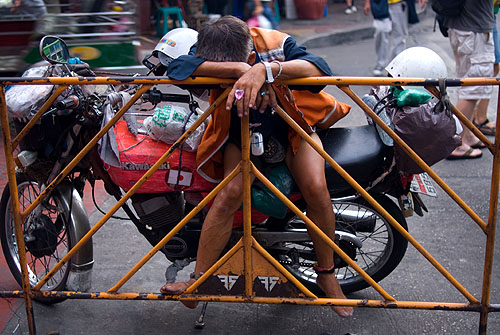 Sleeping motorcycle taxi driver
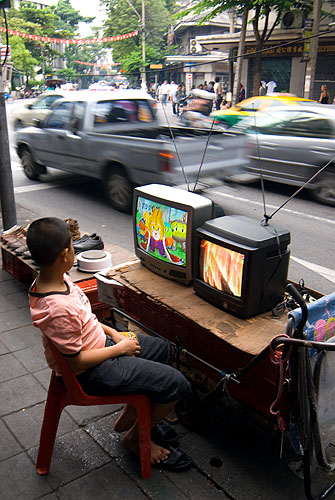 Much of life is lived on the streets in Bangkok's Chinatown
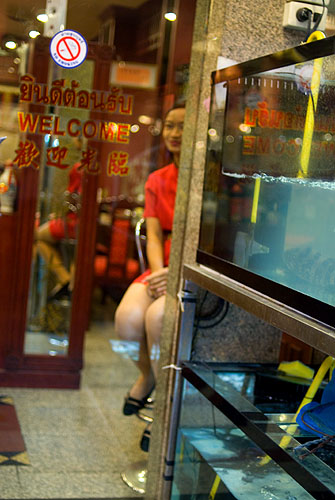 Hostess at a Chinese restaurant, Yaowarat
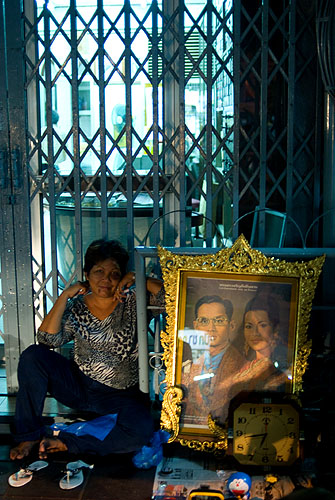 Selling used items
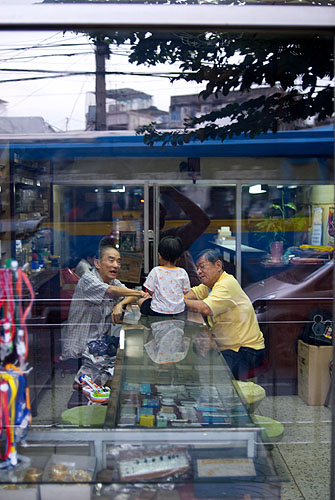 Reflections in a shop front, Thanon Charoen Krung
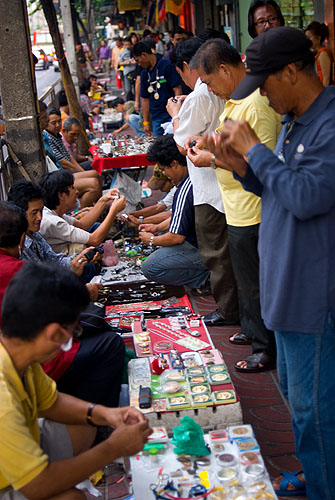 Looking at Buddhist amulets and used goods, Thanon Charoen Krung
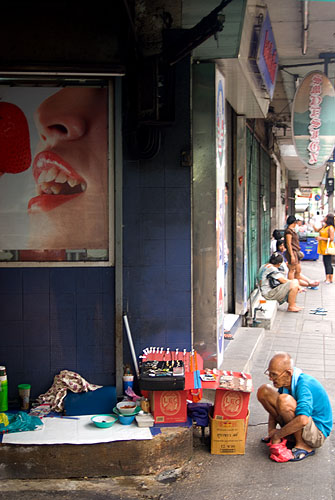
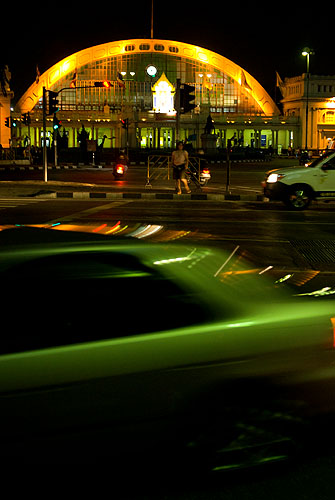 Hua Lamphong, Bangkok's main train station
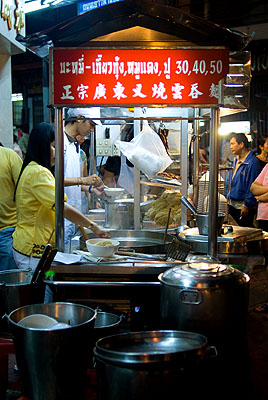
Bamii, wheat noodles served with muu daeng, barbecued pork, is a dish you can find just about anywhere in Bangkok. The vast majority of stalls are leased out by a franchise called Chai Sii, and are mediocre at best. The noodles at these stalls tend to be quite pasty, and the barbecued pork is largely flavourless meat that appears to have been painted with a overly-sweet red sauce. I'm sure there must be some good bamii out there, but the only place that has reached my lofty standards thus far is Mangkorn Khao ('White Dragon'), way out in Chinatown.
I always order kiaow naam:

wontons in broth. The wontons are filled with ground pork that has been mixed with an ungodly amount of ground black pepper, garlic and coriander roots, and wrapped around a single shrimp. The broth is subtle, but fragrant, and includes a few bits of greens and deep-fried pork rinds. Eat this and I can guarantee you'll still be tasting the warm black pepper/garlic/coriander root flavour a good half-hour after leaving. It's a nice feeling.
I like to follow this with a bowl of bamii haeng muu daeng, 'dry' noodles with barbecued pork:

The noodles at Mangkorn Khao are slightly thinner than those you'll find elsewhere, and are toothsome and have a pleasant nutty flavour. The barbecued pork appears to have really been barbecued, and is slightly crispy and fatty, almost bacon-like. If pork is not your thing, you can also get crab meat, which I usually do at lesser stalls, but the pork here is so good I can't pass it up. If you order your noodles 'dry', the broth is served on the side, and I like to add just a couple tablespoons to loosen up the noodles.
Mangkorn Khao was mentioned previously here.
Mangkorn Khao
Corner of Thanon Yaowarat and Thanon Yaowaphanit (across the street from the corner of Th Yaowarat and Th Plaeng Naam)
Every day 7pm-12am (but they often run out as early as 10 or 11)
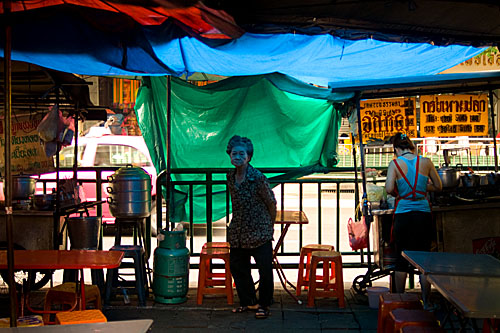
Off of Thanon Charoen Krung
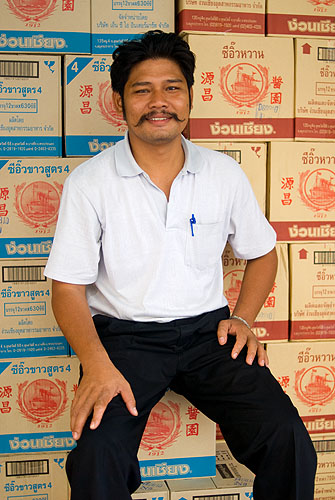
Thanon Yaowarat
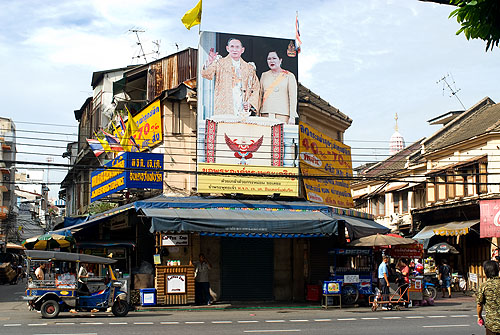
Thanon Yaowarat
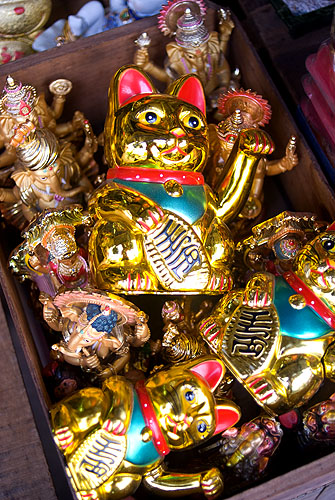
Lucky charms, Thanon Yaowarat
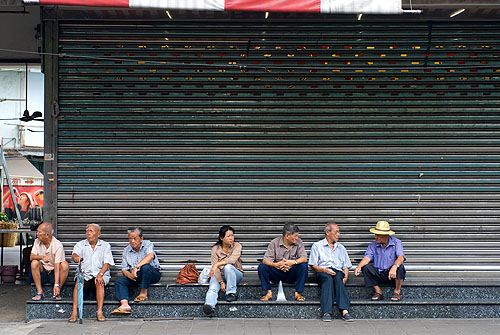
Waiting, Thanon Charoen Krung
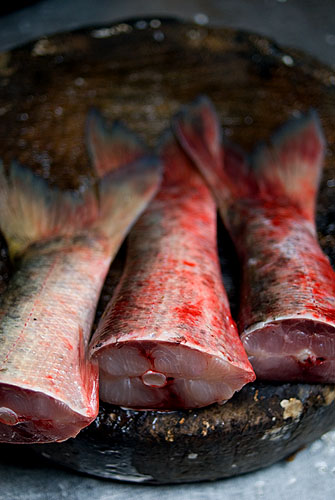
Talaat Kao
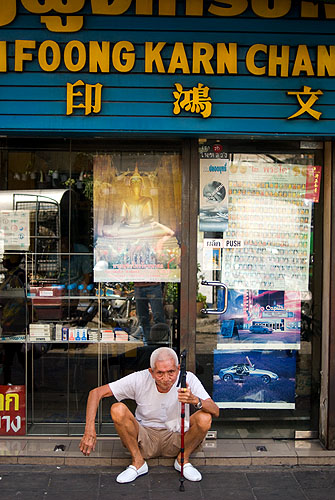
Thanon Plaeng Naam