Eat this dish

_DSC4499.jpg

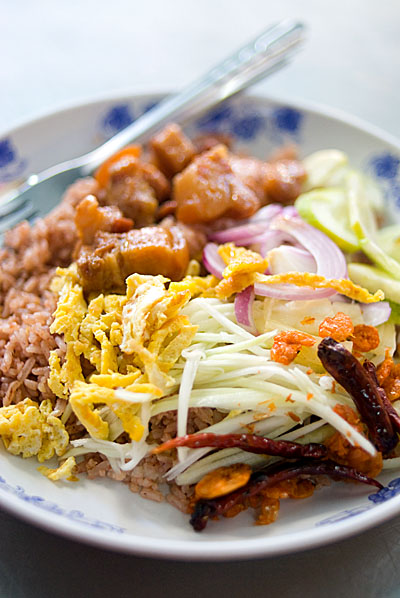
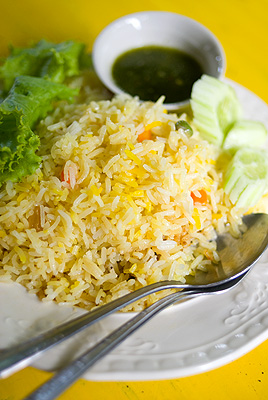
There are heaps of good things to eat in Thailand. But if there was one dish that I would recommend to visitors, particularly because so few foreigners seem to be familiar with it, I would choose khao khluk kapi. This literally means 'rice mixed with shrimp paste', which is a poor description of this vibrant dish that seems to include every favourable flavour and texture in Thai cooking.

The dish is based around rice that has been fried, or sometimes boiled, with shrimp paste, giving it a pleasant fishy odour and a greyish-brown hue. This rice is topped with ingredients that usually include shredded green mango, slices of cucumber, a thin omelet that that has been sliced into strips, thinly sliced shallots, thinly sliced green beans, crispy deep-fried dried shrimp, and sometimes a few slices of kun chiang, Chinese-style pork sausage, and small slices of pineapple. There's always a side of muu waan, pork belly that has been braised in palm sugar and fish sauce, a garnish of few dried chilies deep-fried until crispy, and often a slice of lime. The dish is often, but not always served with a dish of clear broth.

The dish is salty from the shrimp paste, fresh and crispy from the veggies, sweet from the fruit and muu waan, and can also be spicy, if you decide to mix in the chilies. I like to mix everything together beforehand to ensure that I get a bit of each flavour/texture in each mouthful.

For more in-your-face khao khluk kapi action, check out the excellent version done at Ratana; an acceptable take at a local noodle stall; a decent but scant version at Tha Chang market; an improvised version at the Suan Lum Night Bazaar; and a haphazard dish at a local restaurant.

Jay Fai

_DSC4313.jpg

Jay Fai is probably the most famous place in town to get phat khii mao ('drunkards' stir-fry'), the spicy fried noodle dish that, like the name suggests, seems to combine just about everything in the kitchen. People go to Jay Fai because the noodles are good, but her restaurant might actually be more famous because the noodles are expensive. Now, 200 baht (about $7) may seem like chump change to those of you reading this in the West, but it's a helluvalot for noodles here in Bangkok. Expectations run high.

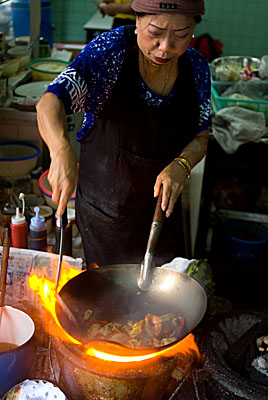
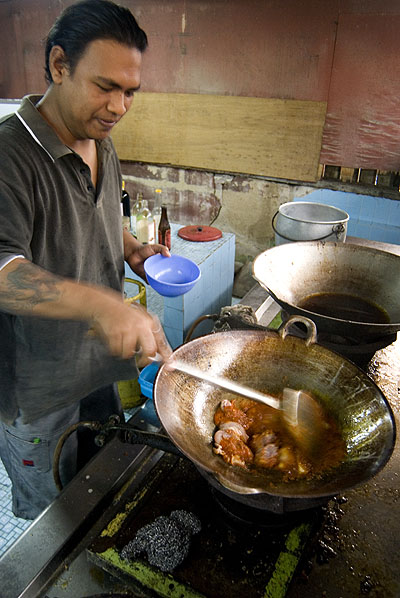
I got there at 5pm, just as she was opening, which meant having to wait through a lengthy prayer and offering session at her spirit altar. Jay Fai began by pouring a good half-litre of cooking oil into a smoking hot wok. This was followed by two large prawns. After deep-frying these, she tilted the wok to pour out nearly every last drop of oil, reassuring me the entire time that "It won't be oily, it won't be oily..." And indeed, without adding any additional oil, she followed with the rest of the ingredients: the wide noodles known as sen yai, squid (both fresh and pickled), minced garlic, crab meat, chopped green beans, long slices of carrot, baby corn, palm heart, shiitake mushrooms, and finally, a healthy handful of holy basil leaves and a dollop of fresh chilies. While she sprinkled the lot with fish sauce, she explained that if the mixture stuck, she loosened it with a bit of broth, not more oil. The result:

_DSC4320.jpg

was delicious: meaty, smoky, garlicky and only slightly oily. Was it worth 200 baht? Taste is subjective; try it yourself and decide. I'll certainly be back.

Jay Fai
327 Thanon Mahachai
02 223 9384
5pm-2am, Sun-Fri

Khrua Thalay

_DSC4263.jpg

On Sunday I was lucky enough to go to a new place with some new friends. New Friend #1 Hock spent several years on the professional banana boat circuit, but after a near-fatal collision with a dolphin, is currently flipping burgers at an anonymous Bangkok restaurant. His wife, and New Friend #2 Maytel is a self-confessed full-time blogger (Half Asian Tourist, Gut Feelings) and part-time academic. And there was New Friend #3, who I will refer to as New Friend #4, and who, although it's only marginally relevant, somehow reminded me of Australian chef David Thompson.

The new place was Mae Phim Beach in Rayong. In the Thai tradition, half of the beach is devoted to fresh seafood shacks, one of which, Khrua Thalay, Hock and Maytel had been to a few times previously. Rummaging though glass cases of live seafood, Hock chose Moreton Bay bugs, which our lovely chefstress suggested deep-frying with garlic:

_DSC4256.jpg

Very nice, and actually a first for me.

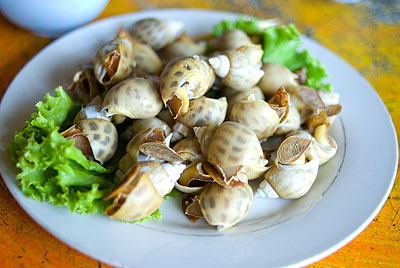
Somebody wanted whelks (pictured above), another novelty for me--I had only known them as hoy waan. We had grilled, and dipped into the famous Thai seafood dipping sauce, they were wonderful.

I ordered hoy phat chaa:

_DSC4276.jpg

clams fried with fresh herbs, including garlic, kaffir lime leaf, holy basil and krachaay. The clams were just done, and the balance of flavours nearly perfect.

Hock ordered plaa kraphong, seabass that was splayed and marinated with fish sauce before being deep-fried and served with a green mango dressing:

_DSC4271.jpg

The fish was slightly salty and the salad provided the sweet and sour. There was balance.

And along with balance there was also a generous portion of fried rice with crab:

_DSC4273.jpg

A lovely meal and a lovely day.

Khrua Thalay Seafood
Mae Phim Beach
07 138 7598

Yentafo Kruengsong

_DSC4234.jpg

The restaurant is named after yen ta fo, a Chinese noodle dish that has become very popular in Thailand in the last few years. For many foreigners, the dish, which includes delicacies such as coagulated blood, pickled squid and fish balls, not to mention a disturbingly bright-red broth, is rather off-putting. I previously felt this way, but have learned to embrace the weirdness of yen ta fo and now consider it one of my favourite noodle dishes, especially when consumed here.

On a recent visit, Aong ordered a bowl, which at this restaurant, is immense:

_DSC4242.jpg

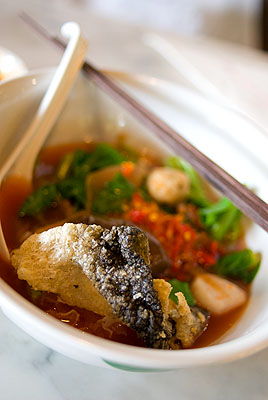
It includes all the weird stuff mentioned above, as well as phak boong, deep-fried fish skin and heaps of chili. Oh, and apparently somewhere in there are some noodles.

This restaurant also makes some very good non-noodle dishes, and I ordered khao phat nam phik long ruea:

_DSC4248.jpg

rice fried with a particular type of chili dip (nam phrik long ruea) and served with sides of battered and deep-fried and fresh veggies. Very nice, but not as good as their khao nam phik khai poo, rice served with a spicy chili dip made from crab eggs.

We also ordered a couple sides, including deep-fried fish skin:

_DSC4226.jpg

which tastes much better than it sounds. The crispy skin is served with nam phrik phao, a sweet/spicy chili dip. Ironically, I usually pick the skin off when I eat fish, but like eating this stuff, especially with the dip.

There was also an assortment of look chin plaa, fish balls:
_DSC4246.jpg

served with a delicious dipping sauce not unlike that typically served with seafood in Thailand. I particularly like the kiaow plaa, fish wontons (far left); the 'wrapper' is made from fish, and the filling is ground pork pounded up with fresh herbs.

For more yen ta fo-related mirth, refer to the yen ta fo eating contest (sponsored by Yentafo Kruengsong) that my buddy Kelly took part in last year.

Yentafo Kruengsong

(various locations about town: check this link for the one nearest you)

A taste of Luang Prabang in Bangkok

_DSC3927.jpg

Joy Ngeuamboupha (above) and Caroline Gaylard of Tamarind restaurant in Luang Prabang have been making their delicious Lao food at the Sheraton Grand Sukhumvit this week. As part of the occasion, a small, but elite group of the city's media was invited to take part in a cooking demonstration of three traditional Luang Prabang dishes taught by Joy himself.

Joy, a native of Luang Prabang province, and Caroline, an Australian, originally collaborated to make a cookbook of authentic Lao recipes. This led to, as these things do, a restaurant, and in 2005 Tamarind was born. Today their restaurant is still one of the only handful of places in Luang Prabang where visitors can sample authentic local dishes, and the owners have made it their mission to introduce people to authentic Lao food.

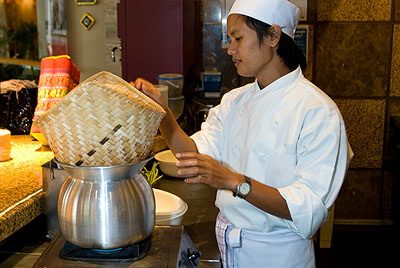
Before going through the dishes Joy taught us, here are a few tips from Joy about sticky rice, the Lao staple:

-Sticky rice should be soaked for 12 hours before cooking
-After soaking, the sticky rice needs to be washed three times; the first time gently squeezing the rice, the second two simply rinsing until eventually the water runs clear
-Sticky rice should be steamed for about 30-40 minutes, uncovered; when steam begins to rise from the top of the rice, take the sticky rice out, flip it over, and steam for another five minutes
-When the sticky rice is done, keep it in a katip, a permeable bamboo basket; keeping the sticky rice in a sealed container will cause it to become inedible mush

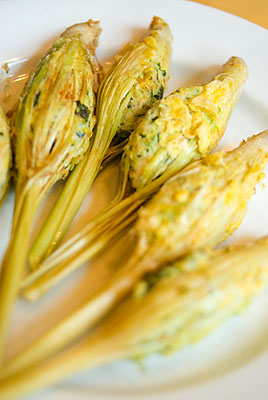
Oua Si Khai - Stuffed Lemongrass
_DSC4065.jpg

Joy began by showing us how to make several long slices in the bottom parts of largish stalks of lemongrass:
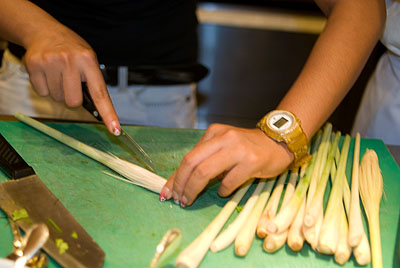
_DSC3987.jpg

After being softened (with a pestle) and opened, the stalks were then stuffed with a filling of ground chicken that had been blended in mortar and pestle along with salt, garlic, spring onions, coriander and kaffir lime leaf:
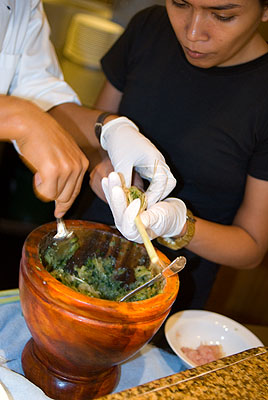
_DSC4001.jpg

The lemongrass sticks were then dipped in an egg wash and deep-fried:
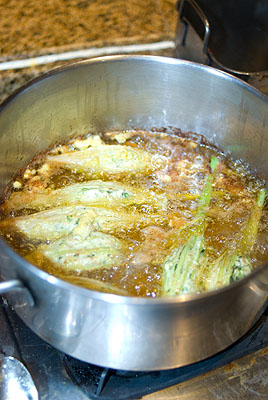
_DSC4038.jpg

until the meat was just done, resulting in the finished product seen above.

Jaew Makok - A "Dip" of Roasted Chilies and Makok
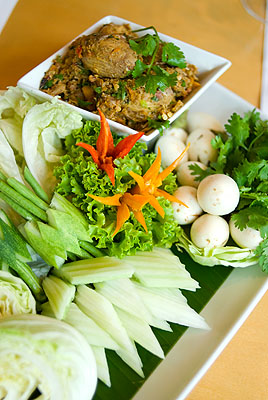
_DSC4062.jpg

This one might be a hard dish for many of you to make at home, as makok, also known as hog plum, is undoubtedly quite hard to find abroad. I wouldn't really recommend substituting anything, but would just say that it's there to provide a sour flavour to the dish.

Joy had a bowl of previously-roasted chilies (the large ones called phrik chee faa), shallots, garlic and the makok, the green fruit shown below:
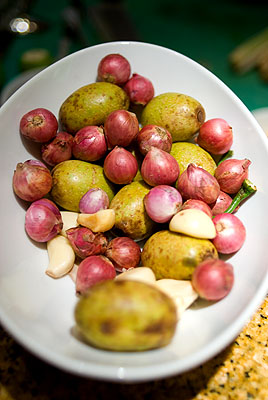
_DSC3978.jpg

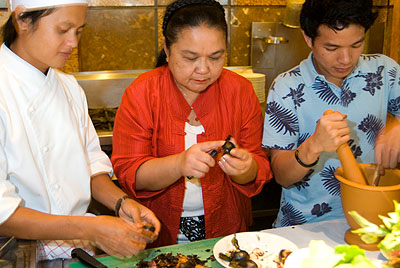
He told us to peel the burnt bits off before mashing the mixture up in a mortar and pestle along with some salt and that very Lao of flavourings, MSG:
_DSC3963.jpg

To this mixture Joy added a handful of deep-fried pork rinds, some chopped coriander and green onions. Still using the mortar and pestle, he mixed the ingredients again, adding a few tablespoons of water as it was quite thick. The finished dip should be salty and sour in flavour, and is served with sticky rice and fresh veggies and herbs.

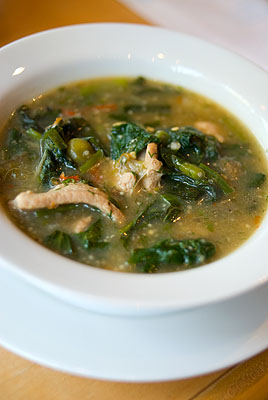
Or Lam - Thick Luang Prabang-Style Vegetable Stew
_DSC4055.jpg

This is one of my favourite Luang Prabang dishes. It should have a spicy/bitter flavour, the result of the addition of sakhaan, a vine used in Luang Prabang cooking. Joy brought several chunks of sakhaan to Bangkok, and showed us how it should be used.

He began by peeling and quartering the sakhaan, and soaking it in water:

_DSC3938.jpg

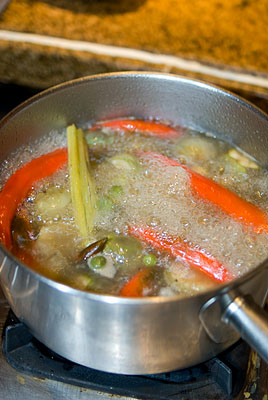
While this was soaking, Joy brought a couple stalks of lemongrass, a few round eggplants, a couple cloves of garlic and a handful of pea eggplants to a boil:
_DSC3984.jpg

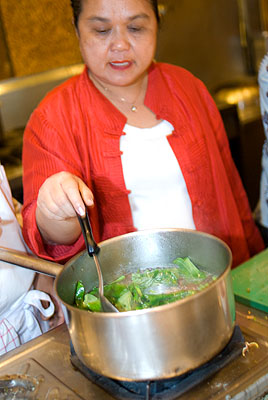
A few minutes later he added some sliced pork and the sakhaan. The mixture was left to simmer for about a half hour, or until as Joy said, "The eggplants are soft." When this was accomplished, he removed all the solid ingredients, except for the pork and sakhaan, reserving the broth. He then pounded the now-soft herbs and veggies in a mortar and pestle until a rough paste was formed. This paste was re-introduced to the simmering liquid, along with a couple tablespoons of paa daek (Lao-style fish sauce), chopped green beans, more pea eggplant, mouse-ear mushrooms (het huu nuu), tamlueng, a vine-like leaf, and khao buea, sticky rice that had been soaked in water then broken up into a course powder, a traditional thickening agent:
_DSC4014.jpg

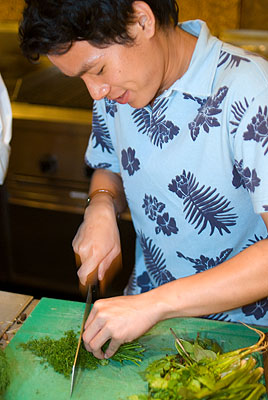
While this was simmering, Top was ordered to chop up a huge amount of dill, coriander, green onions, sawtooth coriander and Thai basil:
_DSC4017.jpg

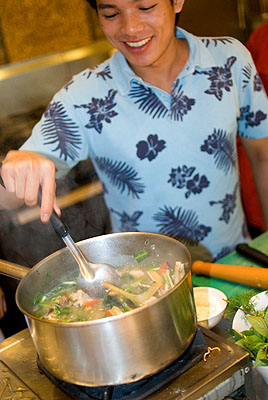
Which he happily did. When the most recently-added veggies were just about done, the chopped herbs were stirred in:
_DSC4032.jpg
and the mixture left to simmer for a couple more minutes. Enjoy with sticky rice and Beer Lao.

If you just can't get enough Lao, check out this photo essay on Luang Prabang food I did for Lonely Planet a while back; a still-unpublished piece I wrote about Luang Prabang food; some super cool Lao recipes; and an article about Lao food I wrote that ran in the US food mag, Intermezzo.
Fashion tips from a military dictator

Thai_culture_poster.jpg
(A larger version can be seen here.)

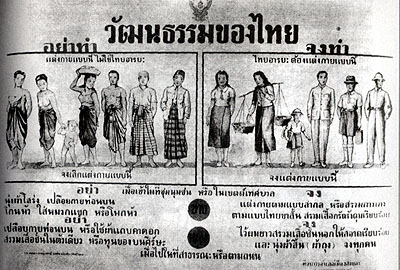
I came across this interesting item at Wikipedia. It's a poster advocating how Thais should and should not have dressed during the conservative Phibulsongkhram era (1938-1945). It reads:

Thai Culture
When in communal or official places
When in public or on the street

(left side)
Do Not
Dressing in this manner is not part of Thai custom
Men:
Do not wear a sarong or expose the upper body
Do not shave your head or wear a Muslim-style hat
Women:
Do not expose the upper body or wear a shawl
Do not wear only underclothes or carry things on your head

(right side)
Do
Thai custom entails dressing this way
Men:
Do wear international-style clothes or Thai style short trousers
Do wear a proper button-down shirt
Women:
Do wear your hair long and a clean, proper outer shirt
Everybody must wear a proper skirt

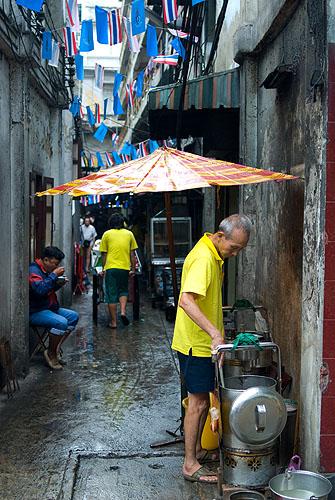
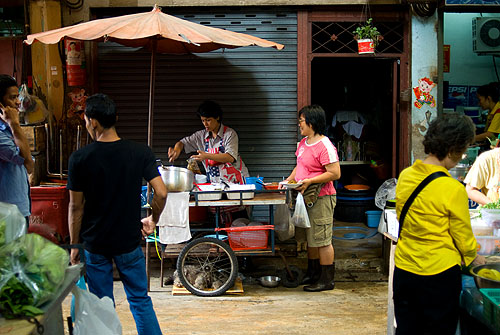
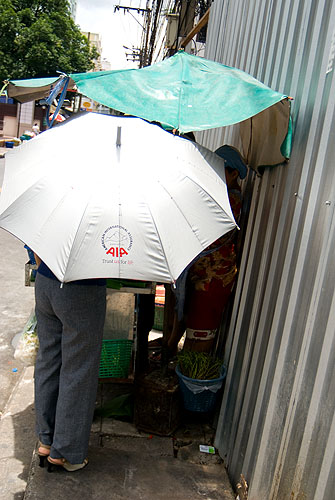
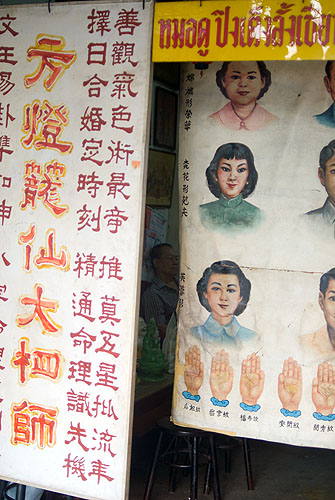
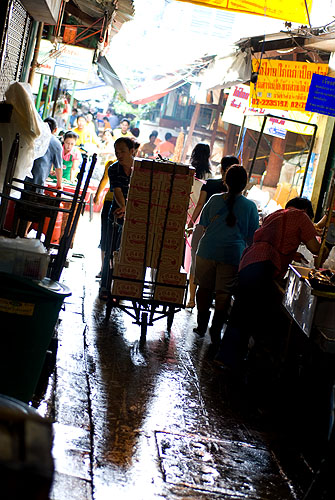
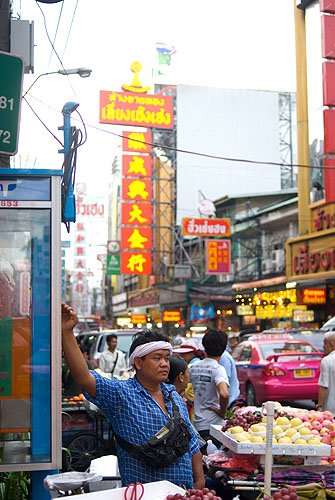
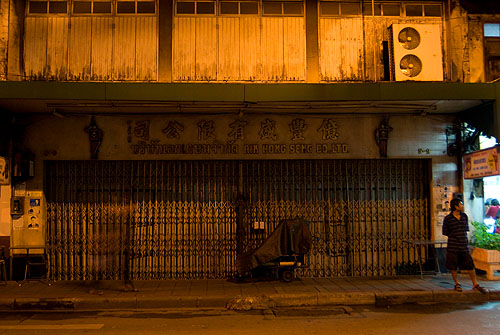
Chinatown, September 3, 2007

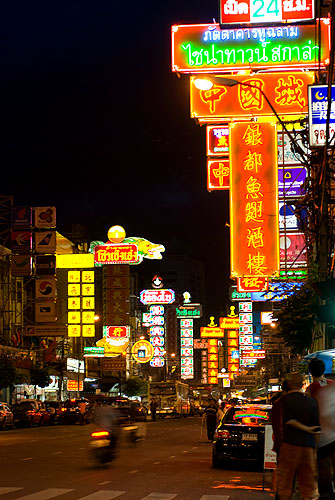
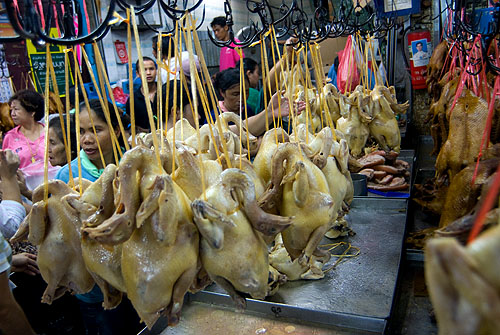
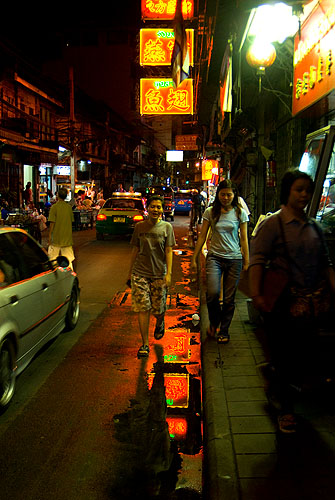
The results of yet another trip to Yaowarat, Bangkok's Chinatown.

_DSC3488.jpg
Near Talaat Kao

_DSC3405.jpg
Casket maker on Thanon Charoen Krung

_DSC3534.jpg
Off Thanon Plaeng Naam

_DSC3515.jpg
Gold shop, Thanon Yaowarat

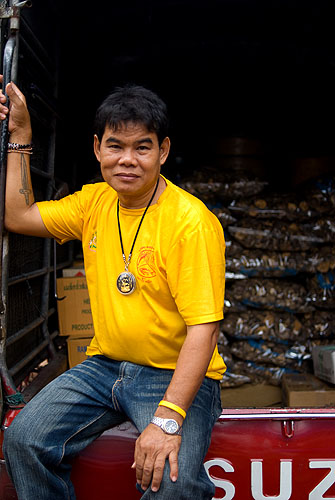
_DSC3520.jpg
Porter, Thanon Yaowarat

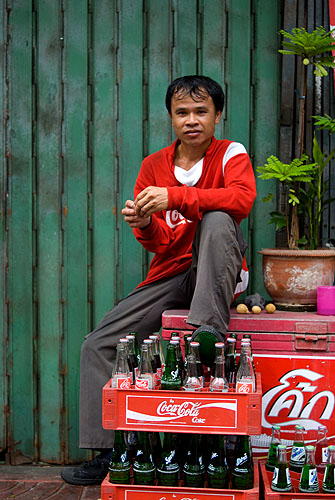
_DSC3546.jpg
Coke vendor, Talaat Kao

_DSC3500.jpg
Talaat Kao

_DSC3512.jpg
Talaat Kao

_DSC3414.jpg
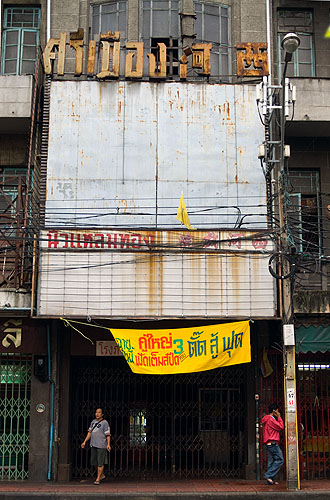
Old theatre, Thanon Yaowarat

Fatima

_DSC3308.jpg

I recently met with Suthon Sukphisit, the author of the Bangkok Post's excellent weekly Thai food column, Cornucopia (ever Saturday in the Outlook section of the Bangkok Post). Khun Suthon is a gold mine of information about Thai food and hole-in-the-wall restaurants in Bangkok, and was kind enough to give me a few interesting leads that I will certainly follow up on these pages. One of the places he mentioned was a khao mok, biryani, stall near the Haroon Mosque off of Thanon Charoen Krung. According to Khun Suthon, the stall serves what he considers the best khao mok in town, but is only open on Fridays, the biggest Muslim prayer day.

Curious, I headed down last Friday to check it out. The stall was a bit hard to find, but after asking around I located a long table topped with snacks and sweets and three immense pots of biryani:

_DSC3312.jpg

I ordered a plate of khao mok nuea, beef biryani (pictured at the top of this post), but honestly was skeptical. The rice seemed to lack the deep yellow/orange colour of previous excellent biryanis, such as that of Naaz, and wasn't even topped with crispy deep-fried shallots! Despite appearances, the rice and the beef were both rich in flavour, the rice was perfectly cooked, and had a pleasant spicy flavour and was laced with sweet golden raisins and green peas. I'm not sure if I would call it the best khao mok in town, but sitting at the open-air table next to the mosque and chatting with the other diners, reckon it's undoubtedly the most atmospheric.

Among the other things available here are a variety sweet snacks, some very tasty samosas:

_DSC3309.jpg

and khao yam:

_DSC3311.jpg

the southern Thai rice 'salad'.

Fatima, the owner, and her helpers were very friendly and talkative, and when I asked why she only sold on Fridays, she said that "There are not enough customers in this neighbourhood!" Too bad, that.

Fatima
Next to Haroon Mosque
Friday, 8am-noon

Rosdee

_DSC1939.jpg

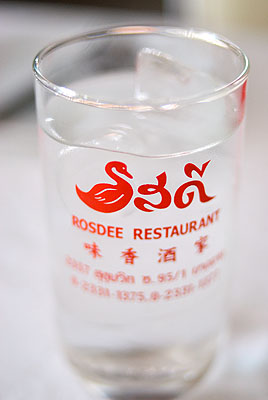
After all this time, I think I've begun to develop something of a sixth sense for finding good restaurants in Bangkok. It's reached the point where after a quick glance, I can usually tell if a place is worth entering. Take today's restaurant, Rosdee. Walking by one day, I think it was the cool swan logo (shown above) that initially caught my attention, but upon entering, the restaurant's uniformed and bow-tied waiters, geriatric Chinese-Thai customers and old-school atmosphere left no doubt in my mind that this meal was going to be good.

There was or suan:

_DSC3104.jpg

Oysters fried with egg and a sticky batter. At lesser restaurants this dish is like a tasteless, gelatinous blob. Here it was rich with garlic and barely-cooked egg, not to mention fresh, plump oysters. The batter served to hold the ingredients together, rather than dominate. Excellent.

On a previous visit I had crispy pork served over rice:

_DSC1941.jpg

The pork was perilously crispy, but tasty nonetheless. I was somewhat disappointed not to see the spicy/sour dipping sauce that usually accompanies this dish, but the side of pickled ginger was an interesting substitute.

I particularly enjoyed fish fried with black pepper:

_DSC3102.jpg

The fish had been deep-fried beforehand and was slightly crispy, and was re-fried with an insane amount of ground pepper, onions, sliced chilies, onions and green onion. There was so much pepper I found myself in a warm, peppery stupor afterwards. This is a good thing.

This being food of Chinese origin, one must order stir-fried veggies such as poy leng:

_DSC3108.jpg

a green leaf not unlike spinach, and khanaa, Chinese kale with oyster sauce:

_DSC1942.jpg

Salty, garlicky and only slightly oily. Perfect.

I was right.

Rosdee
2357 Sukhumvit (corner of Soi 95/1)
02 331 1375

Do have a look

veg guy.jpg

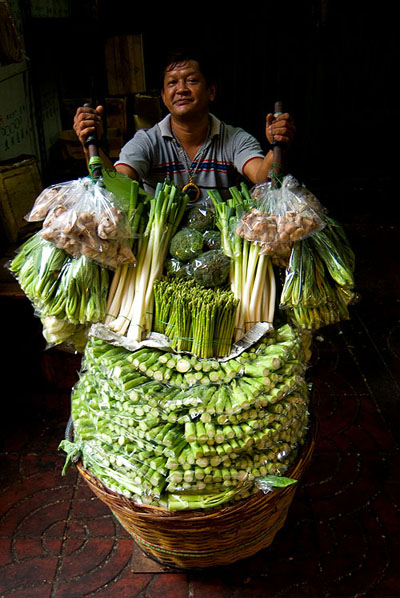
Although it still looks embarrassingly basic, I'm making more of an effort to update my photo blog, The Old Main Drag, on a regular basis these days. Despite the 'teaser' above, the images are not entirely food-related, but the vast majority were taken in Bangkok.

Baan Wacharachai Part II

DSC_9910.jpg

While in Ayuthaya we made a point of taking our friends to Baan Wacharachai, the restaurant we visited on our last trip. This place combines a wonderful atmosphere right on the river, outstanding Thai food, great service, and by Western standards, is very cheap--just about the perfect restaurant, I reckon!

We started with kapi khua, a 'dip' of shrimp paste sauteed with herbs and coconut milk:

DSC_9886.jpg

The dish had a strong flavour of smoked fish and was pretty spicy--not something I thought everybody would like, but most people seemed to enjoy it.

There was a 'salad' of thin slices of grilled pork collar:

DSC_9902.jpg

The pork was topped with a spicy/sour sauce similar to the Thai seafood dipping sauce, and was served with sides of tiny (but strong) cloves of garlic, slices of cucumber and tomato and garnished with mint. Delicious.

Tony ordered tom khaa:

DSC_9895.jpg

the coconut milk and galangal soup that is usually made with chicken, but done here with large prawns.

Sophie ordered mixed veggies sauteed in oyster sauce:

DSC_9888.jpg

I ordered kaeng liang:

DSC_9905.jpg

and somebody ordered chu chi plaa nuea orn:

DSC_9912.jpg

freshwater fish fried with curry paste. The curry sauce was tasty, but usually the fish is deep fried beforehand to make it crispy. Here fresh fish was used and Tony and I didn't much care for the texture.

There were a couple reruns from last time, including the spot-on yam thua phlu, wing bean salad:

DSC_9898.jpg

and the sublime plaa chon phao, grilled/smoked snakehead fish:

DSC_9892.jpg

served, as always, with three delicious dipping sauces. We ordered two of these, and hardly anything was left...

Baan Wacharachai
Wat Kasatrathirat
035 321 333

The Devil's in the Curry

_DSC2420 copy.jpg
Clive Monte Sta Maria making the Kristang dish, debal curry, in the kitchen of Restaurant San Pedro, Melaka, Malaysia.

I have an article about Kristang (mixed Portuguese-Malay) food in the October issue of Chile Pepper magazine. Anybody happen to see it?

Bann Kun Pra

DSC_9740.jpg

I spent last weekend in Ayuthaya with a group of friends. As mentioned previously, the quiet town is a wonderful place to escape big city life, and features great restaurants, (relatively) cool weather and lots of stuff to do. After arriving, we asked the staff of our guest house to suggest a good place to eat, and they suggested a place called Bann Kun Pra.
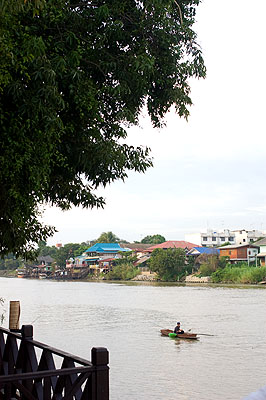
The hotel/restaurant is located in a beautiful antique building directly on the river, and has creative menu. Unfortunately, as the stereotype goes, the places with the best locations/view often have mediocre food, and this was definitely the case with Bann Kun Pra. The first warning sign should have been the fact that the restaurant serves its rice in cute animal shapes:
DSC_9751.jpg

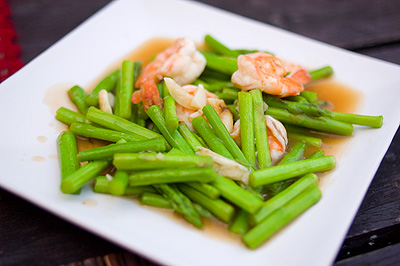
After beheading our turtles, we dug into the dishes we ordered, which included asparagus stir-fried with prawns:

DSC_9758.jpg

It was decent, although like most of the meal, bland and characterless.

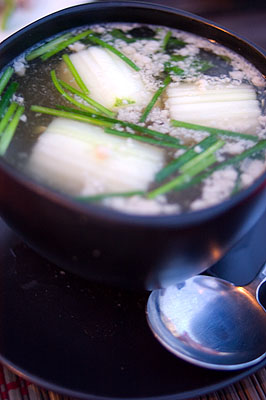
A soup of cucumbers stuffed with ground-pork:

DSC_9767.jpg

was, in my opinion, probably the nicest dish of the meal. The cucumber added a pleasantly sweet flavour to the broth, and the pork filling was peppery and tasty.

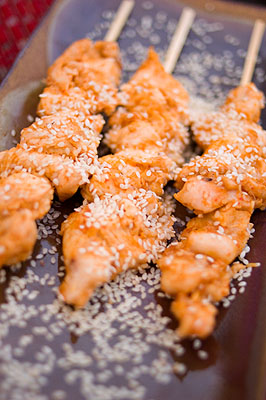
The sesame grilled chicken:

DSC_9763.jpg

was, despite appearances, slightly spicy and not bad, although very dry.

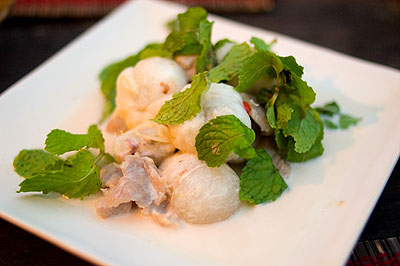
Possibly the biggest disappointment was the grilled beef and mangosteen salad:

DSC_9768.jpg

The dish sounded interesting on the menu, but the beef appeared to have been par-boiled, and other than a nearly tasteless coconut milk dressing, the dish had little flavour.

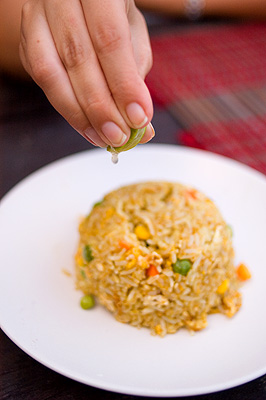
Carla ordered rice fried with curry powder:

DSC_9756.jpg

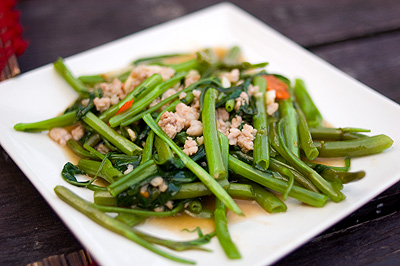
and Ron can apparently not go an entire meal without ordering flash-fried morning glory:

DSC_9748.jpg

Which is OK, as I'm the same way. Unfortunately Bann Kun Pra's take on the dish was bland and unnecessarily included ground pork.

DSC_9745.jpg

Again, I imagine Bann Kun Pra is a lovely (although slightly overpriced) place to stay, but not a very good destination for authentic Thai food.

Bann Kunn Pra
48 Moo 3 U-Thong Road
Ayuthaya
035 241 978