The best noodles in town?

_DSC1549.jpg

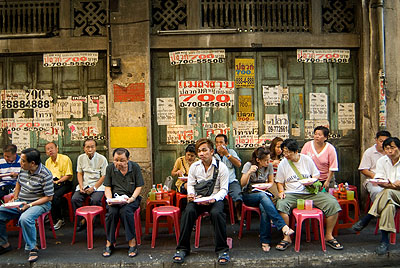
I'll admit, the issue of the best noodles in town is as subjective as it gets. Despite this, it's an issue that can result in heated debate, ill-tempered shouting and dissolved friendships. Fortunately, operating from the format of this blog, I'm able to provide some legitimacy to my vote for the Best Noodles in Town. So there. I originally came across this stall in Bangkok's Chinatown several months ago while waiting for a train at Hua Lamphong. I tried to find it many times since then, but only succeeded recently.

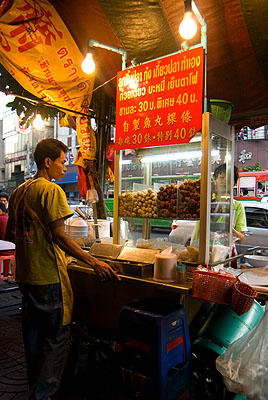
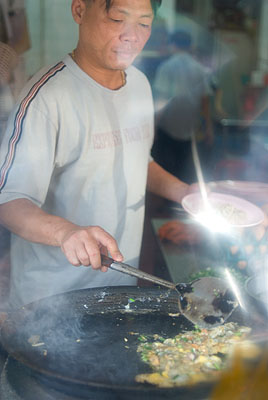
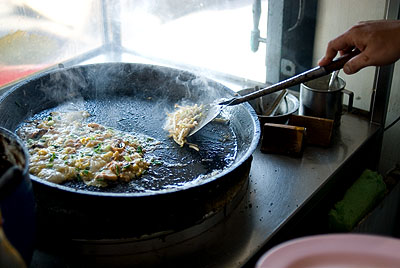
The tiny stall boasts three (maybe four?) tables on an incredibly polluted, noisy and hectic stretch of Thanon Yaowarat. This is literally street food; if the vendor sticks her bum out too far what blanching bean sprouts she's going to regret it.

_DSC1548.jpg

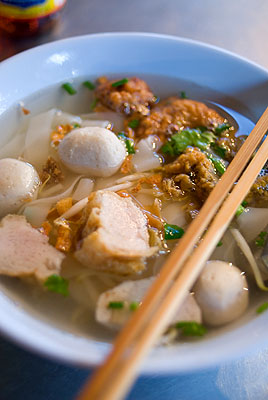
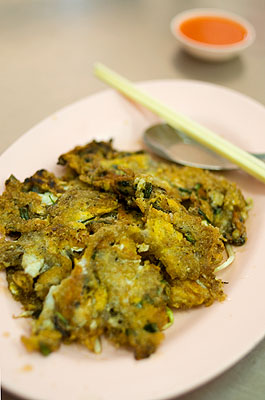
The stall's sign claims that the fishballs are all homemade, and this appears to be true. The balls are soft without being rubbery, and unlike most places, actually taste like fish--and fresh fish at that. The broth is clear but not bland, and heartily laced with cripsy deep-fried garlic, and what appears to be pickled garlic as well. I ordered kwaytiaow look chin ruam, mixed fishball noodle soup (pictured above), a dish combining four or five different kind of fish balls, a few par-boiled bean sprouts and a pinch of chopped green onion. I always order this with sen yai, the thick rice noodles, and top it off with a couple spoonfuls of the garlic/chili/vinegar sauce, and a splash of fish sauce.

Damn.

The noodle stall has no name as far as I can tell and is located on Thanon Yaowarat near the corner of Thanon Plaeng Naam. Good luck.

The new face of Yusup

_DSC1518.jpg

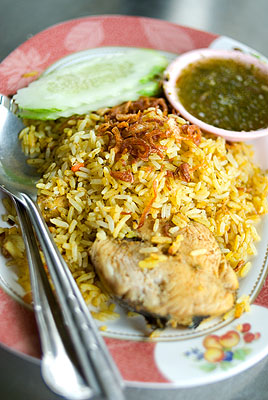
The sign says raachaa khaao mok, "The king of biryani," and that about says it all. Yusup Phochana, a Muslim restaurant located minutes from my house in northern Bangkok is probably my favourite place in town. I've mentioned it previously here and here, and just recently, after being shut down for a month, the restaurant moved into new digs even closer to my house. I'm happy, and thought it was high time remind people of its existence.

I ordered, as always, khaao mok plaa, fish biryani:

_DSC1509.jpg

You'll be hard-pressed to find another fish version of this dish in Bangkok, not to mention a khao mok this strong. Mr Yusup employs mackerel steaks that are cooked directly in the absolutely delicious rice, and topped with crispy deep-fried shallots, a couple slices of cucumber, and a sour/spicy/sweet sauce. The restaurant also does the ubiquitous chicken, and the slightly more unusual goat versions of the dish.

This was accompanied by sup haang wua, oxtail soup:

_DSC1504.jpg

a deliciously sour/spicy/salty broth loaded with fatty oxtail and topped with deep-fried crispy shallots. The broth is so flavourful and hearty you could almost stand a spoon up in it. Those not keen on eating oxtail can go for the sup kai, chicken soup, which is very similar.

Desert took the form of rotii waan:

_DSC1513.jpg

a paratha-like crispy pancake topped with sweetened condensed milk and sugar--a meal that would send most carbo-paranoid Americans running away screaming.

They've got lots of other stuff here: curry noodles, "Muslim" salad, mataba, satay, and some absolutely amazing curries, so I reckon there's something for everybody--other than vegetarians.

Yusup Phochana
Kaset-Navamin Highway
Open every day, 11am-2pm
05 136 2864, 09 923 8099

Detailed instructions:
Here's the bad news: for those located in central Bangkok, getting to Yusup Phochana is going to be something of a trek. The restaurant is located in northern Bangkok along the Kaset-Navamin highway (also known as sen tat mai). If you're coming from Mor Chit BTS/Phaholyothin, turn right at the Kaset Intersection onto the Kaset-Navamin highway. Go past the first stop light and the restaurant is on the left side just after a very large sign with the Swiss flag (as well as several Thai-language signs advertising the restaurant). If you get lost, go ahead and try one of the mobile number above, but I'm pretty sure these people don't speak English.

Hunan by way of England via Beijing in Bangkok

_DSC0981.jpg

I recently had a very fun dinner with friend, Hal Lipper and his wife, Jing. Hal is a talented and enthusiastic cook and was keen to try some recipes from his new cookbook, Revolutionary Chinese Cookbook: Recipes from Hunan Province by English cookbook author, Fuchsia Dunlop. The Beijing element mentioned in the title of this post refers to the fact that Hal lived in Beijing for many years and his wife is a native of that city. In fact, he has actually been working with his wife to compile her mother's family recipes in the form of a cookbook:

_DSC0925.jpg

and they have recorded over 100 recipes at this point. I was lucky enough to try a couple of them that night, including a simple but delicious dish of pickled cabbage:

_DSC0958.jpg

and an appetizer of grilled bell peppers served with 1000 year-old eggs:

_DSC0944.jpg

However the bulk of the dishes Hal made came from Dunlop's book. One dish that Jing grew up with, but that is also featured in Dunlop's book was something Dunlop calls Lotus Root "Sandwich" Fritters. Hal wasn't able to get ahold of lotus root so he used eggplant instead:

_DSC0932.jpg

As seen above, the "sandwich" refers to the use of two slices of eggplant surrounding a filling of ground pork mixed with egg. These are coated in a simple batter and fried until crispy:

_DSC0938.jpg

This was followed by Strange-Flavour Chicken, a combination of cucumbers, shredded chicken and a unique peanut sauce:

_DSC0966.jpg

According to Dunlop, "The curious name "strange flavour" derives from the a bizarre but deeply satisfying combination of salty, sweet, sour, nutty, hot and numbing flavours." This is probably true, but if one follows Dunlops seasoning suggestions for the sauce, the leading flavour is an deeply unsatisfying bland. Hal was forced to remedy the mixture with some extra vinegar and soy sauce and the result was quite nice, although not nearly as intense as Dunlop suggests.

One of the most unusual dishes of the evening was something that Dunlop calls Pearly Meatballs. This was a combination of ground pork, water chestnuts and spices formed into balls and coated with a mixture of sticky rice, ham and mushrooms:

_DSC0920.jpg

They are are then steamed:

_DSC0971.jpg

and the result was very nice; meaty and crunchy (from the chestnuts), but still requiring a boost in the seasoning department, and we were compelled to dip them in soy sauce.

The biggest disappointment of the night (for Hal at least) was Chairman Mao's Red-Braised Pork (shown at the top of the post, as well as on the cover of Dunlop's book). Hal chose to substitute the fatty pork belly with pork ribs, and despite doubling the spices called for in the recipe, the result was still rather bland. Even the braising liquid, reduced to a thick red sauce, was somehow lacking in flavour.

This was coupled with Dongting Stir-Fried Duck Breast:

_DSC0980.jpg

At this point Hal simply disregarded Dunlop's seasoning suggestions altogether and cooked the dish to taste. The result was a simple, but delicious (and well-cooked) stir fry, and probably the most delicious dish of the meal.

The New York Times' review of Fuchsia Dunlop's book can be seen here. The author of this review declares that, "Every recipe I tried was a rousing success." Not sure if Hal would agree...

Kopitiam

_DSC0747.jpg

In Bangkok nowadays you can find Sri Lankan, Korean, regional Japanese, southern Indian, Persian, Burmese and Lao restaurants, among others, but until recently, no Malaysian. Not a single restaurant. I find this exceedingly odd, as Malaysian food is undeniably delicious, and many of the ingredients and flavours of Malaysian cooking are identical to Thai. Not to mention the fact that Thai food (in particular tom yam) is very popular in Malaysia--why not the opposite?

This will probably remain a mystery, but I was delighted to come across Kopitiam, a Malaysian cafe/restaurant on Thong Lor. Kopitiam literally means coffee shop, but this tiny restaurant also serves a variety of Malaysian and Thai dishes. The owner, Georgette, is a native of Kuala Lumpur who has lived in Bangkok for 18 years. After several years of making Malaysian food for her friends, she decided to spread the love and open her own place, and the restaurant has been open about half a year now.

With her guidance, I began with nasi lemak, rice cooked in coconut cream and served with a variety of side dishes:

_DSC0771.jpg

Kopitiam's version was served with the traditional accompaniments of crispy fish and peanuts, squid sambal, a boiled egg, and somewhat unusually, the owner's savoury beef rendang. Nasi lemak is a simple dish, but very nice, and everything was excellent, the flavours just as I remember from breakfast in Penang or KL.

I also had rojak, the Indo-Malay-Singaporean salad of crispy fruits and veggies:

_DSC0801.jpg
my second dish this week. I'm not enough of a rojak expert to authoritatively differentiate between this and Boon Tong Kiat's, but will venture to say that I found Kopitiam's dressing a bit richer. Georgette was kind enough to show me hae ko, the prawn paste that is the essential ingredient in this sauce.

Kopitiam also serves Malaysian favourites such as roti canai, a couple kinds of laska, and of course, teh tarik. If you live in Bangkok and you're craving Malaysian you really don't have any other choice, but it's unlikely that you'll be disappointed.

Kopitiam
117/C Panjit Tower, Sukhumvit Soi 55
02 381 5881

Boon Tong Kiat Singapore Hainanese Chicken Rice

_DSC0390.jpg

I was recently in the Thong Lor area of Sukhumvit Road and came across Boon Tong Kiat, a restaurant selling "Singapore chicken rice". Despite having visited the country several times, I only recently became aware that chicken rice is Singapore's 'national' dish and was curious to see how it differed from the Thai version. The shop was also highly recommended by a friend, so I stopped by.

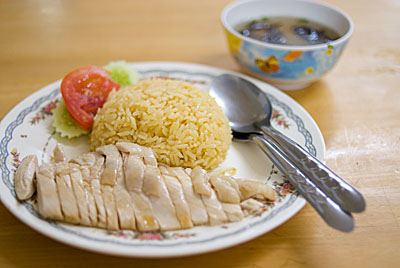
From the get-go, Boon Tong Kiat's khao man kai looks quite different than the domestic version of this Chinese dish. The rice had a slightly gold hue, which according to an extremely detailed sign inside the restaurant, was due to the use of "nine different spices". In addition to this, the sign explained that the rice was also "the finest jasmine rice in the country", and was first fried in a wok over high heat before being cooked over medium heat in a gas-powered rice cooker, before finally kept warm in a "Singaporean rice cooker". There was an equal amount of information regarding the cooking of the chicken, the majority of which escapes me now.

Culinary mission statements aside, it took only a simple taste to realize that Boon Tong Kiat is doing something special here. The rice was was fragrant with the "nine spices", galangal being the only one I could identify with some confidence, and was perfectly cooked, being both tender and toothsome. The chicken was also tender but not mushy, and was juicy and flavourful. This was the first time I'd seen this simple dish done to its full potential, and I loved it.

Halfway into the dish, I noticed that the restaurant also did rojak, a sweet/sour 'salad' of Indonesian origin known at Boon Tong Kiat as som tam singapore. I loved this dish from my visits to Singapore and couldn't resist ordering:

_DSC0396.jpg

Boon Tong Kiat's version was pretty spot on and combined par-boiled morning glory, crunchy bits of cucumber, pineapple, apple and the deep-fried Chinese dough fritters known as you tiao. This was topped with the thick, sweet/sour sauce and sprinkled with sesame seeds. The sauce wasn't as profound or thick as that I've had in Penang, but tasted more or less as it should.

In addition to chicken rice and rojak, Boon Tong Kiat also prepares a variety of Sino/Singaporean-foods. And despite Singapore being virtually a neighbor of Thailand, this shop, as far as I know, is the only place in town where you can find such dishes. Very highly recommended.

Boon Tong Kiat Singapore Hainanese Chicken Rice
440/5 and 396 Sukhumvit 55
02 390 2508

Jek Pui

_DSC9499.jpg Exploring Chinatown with Khun Suthon last week I was pointed in the direction of a curious streetside curry shop with no tables. As illustrated above (take a look at the guy in the white shirt), diners sit at tiny plastic chairs, holding a plate of rice and curry in one hand while they eat with the other. We didn't have time to visit the shop that day, but I was back in the area again and made a point of stopping by.

_DSC9739.jpg

As you can see above, things were a bit more "busy" this time. Fortunately for me the line was made up of those wanting to buy curry to take home. I wanted the entire table-less dining experience, and squeezed my way into the only free stool. A very loud gentleman shouted at me to order, and I timidly asked for a plate of green curry with fish balls over rice. In the meantime I was given a cup of weak iced tea, which the other diners and I put on an unoccupied stool. A moment later I was served, and like the others around me:

_DSC9766.jpg

raised my plate and dug in.

After a few minutes I realized that I was virtually the only one who ordered green curry. All the others had ordered kaeng karii, literally "curry", a Chinese take on the Indian-Thai-Anglo dish. This was served over rice with sliced phrik chii faa chilies and slices of the deep-fried Chinese sausage, kun chiang. My green curry was pretty good--a bit bland perhaps, but with excellent homemade fish balls--but the kaeng karii looked pretty amazing, especially with all those unusual toppings. Unfortunately I had some more eating to do that day and couldn't risk a second dish. Next time though...

Jek Pui Curry Shop Corner of Thanon Mangkorn and Charoen Krung 4pm-9pm

Big Mama

_DSC9618.jpg

I've been doing restaurant reviews for a local listings mag as of late and have decided to include some of the more interesting places here. However, I should make it clear that for each of these, my visit has been arranged ahead of time and I'm not paying for the food. Despite this, I'll do my best to be as objective as possible, and my goal is simply to spread the word of good eats in Bangkok, not to promote certain restaurants.

One of my first visits has to be one of the oddest restaurants in Bangkok. Big Mama describes itself as a pizzeria/Italian restaurant, but could be more accurately classified as Italian-American food with Thai accents as served to a Japanese and Korean clientele. Despite this geographical confusion, it works somehow, and I really enjoyed the majority of my meal.

Being a fan of salt and fish, I began with anchovy spaghetti:

_DSC9651.jpg

Which was served in an earthenware container, topped with a dough lid and baked for a few minutes. Upon arriving at the table, the staff opens this 'lid':

_DSC9634.jpg

to reveal steaming pasta topped with anchovies, chilies and parsley. However the best part was found at the bottom of the bowl, and was a 'sauce' of garlic and shallots sauteed in olive oil until they reached an almost creamlike state. This dish, with its disparate Italian roots, hearty American serving size, and Thai flavours, somehow really worked.

The pasta was accompanied by Greek salad:

_DSC9655.jpg

Which was just about perfect--a tasty, well-balanced dressing, delicious tomatoes and bell peppers (that I suspect come from the excellent Royal Project Foundation), and plenty of salty feta.

And this being a pizzeria, they encouraged me to try one of their pizzas, and provided a combo:

_DSC9653.jpg

The pizza, really the only disappointment of the meal, was topped with a bizarre combination of hot dog-like sausage, lunch meat ham, enoki mushrooms, bell peppers and cheese. Despite being made in a custom-built wood-burning oven, the pie just couldn't support the extreme variety of unrelated toppings and mostly went home in a doggie bag. A bit odd that they would choose this particular pie for me to sample. To be fair, the sauce was nice, and the dough OK, and I suspect a pizza of more subtle topping could very well be pretty good.

In addition to the colourful interior (first pic above), Big Mama also has a pleasant outdoor dining area:

_DSC9663.jpg

If I lived closer, I would easily make Big Mama my local Italian/American/Thai restaurant.

Big Mama Pizzeria
139 Asok Soi 1
02 259 0232

The best fried oysters in town?

_DSC9692.jpg

Exploring Chinatown the other day, Khun Suthon tipped me off to a tiny restaurant that he said made the best hoy tawt, fried mussels/oysters, in Bangkok. This caught my ear, as hoy thawt is a dish with such potential--who doesn't love eggs, oysters and oil? But it's also a dish that has disappointed me nearly every time I've ordered it (who likes ill-prepared eggs, oysters and oil?). Finding myself in Chinatown again recently, I made a point of stopping by.

_DSC9683.jpg

The restaurant is called hoy thawt jao kao plaeng naam, meaning that it was previously located on Thanon Plaeng Naam. After 11 years at that location they moved directly across the street, where they've been for four years now.

The hoy thawt made here are of the crispy variety, which basically means they fry the crap out of them:

_DSC9680.jpg

You have a choice between oysters or mussels, and I chose the latter. The plump, fresh-looking mussels were fried with egg, batter and lotsa garlic until bordering on burnt. This was then broken up and served on top of bean sprouts that had also been fried in oil. The result was predictably very, very oily, but undeniably delicious, and was served with a really nice spicy/sour sauce. Cholesterol issues aside, I think Khun Suthon just might be right.

Hoy Thawt Soi Plaeng Naam
Corner of Charoen Krung and Plaeng Naam roads (near the Cantonese shrine)

Mashoor and Manit

_DSC9607.jpg

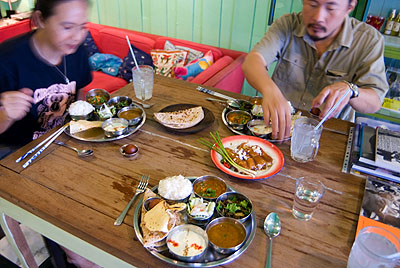
Continuing on my Lonely Planet assignment, I spent yesterday morning at Kathmandu, a photography gallery owned by one of Thailand's most lauded photographers, Manit Sriwanichpoom. Located in a restored Chinese shophouse on Thanon Pan (near the Hindu temple off of Silom), Kathmandu is one of the only galleries in Bangkok specifically dedicated to photography. It also happens to be located smack dab in the middle of one of Bangkok's most eclectic food areas. Within steps of Kathmandu you have Burmese, Persian, southern Indian, northern Indian, and some well-known Thai restaurants. After I finished shooting, Manit's wife was kind enough to supply us with thali from Mashoor, a northern Indian vegetarian restaurant located directly across the road:

_DSC9601.jpg

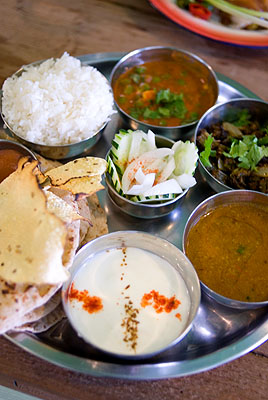
They comprised of (starting at 12:00 and moving clockwise) a curry of peas and paneer (fresh cheese), curried okra, dhal, home made yogurt, fresh chappitis and pappadum, gulab jamun and rice. Everything was excellent, and I can't imagine a better Bangkok Sunday outing than an exotic meal followed by a visit to the Hindu temple and a look at excellent photography on display at Kathmandu.

Mashoor
38 Pan Road
02 234 9305

Kathmandu Photo Gallery
87 Pan Road
02 234 6700

Me, In Swedish

A few months ago Swedish food journalist, food historian, editor, author and blogger (!) Göran Lager paid a visit to Bangkok. While here he interviewed me for the Swedish radio food program, Meny. I was honored to be involved in this, and we had a great time eating and talking about som tam. However I hate listening to my own voice, and the thought of my own voice stumbling over a language I haven't spoken in 10 years, well... Anyway, to hear the program go the this page and click the speaker symbol near the phrase "torsdag 1 mars 2007". Apparently our bit is towards the end. If you can't understand a thing, consider yourself lucky. (And let me know how it went.)

(15 minutes later: OK, I couldn't resist and listened to it, and other than a few cop outs into English, it wasn't that bad. Göran is an amazing editor, apparently.)

Chinatown with Suthon

I'm in the process of interviewing some locals for an upcoming Lonely Planet book and chose to profile Suthon Sukphisit, author of the Bangkok Post's weekly Thai food column, Cornucopia. I've been reading Cornucopia for years, and always thought Suthon must be the closest thing to a living encyclopedia on Thai food. I wanted to pick his brain about Chinatown, an area known for its food, and he was kind enough to meet me and show me around for a few hours last night. I've been to Chinatown many times, but going with Suthon was a truly eye-opening experience. He seems to be familiar with literally every tiny alley and side street, and took me to and pointed out some of his favourite food-related places.

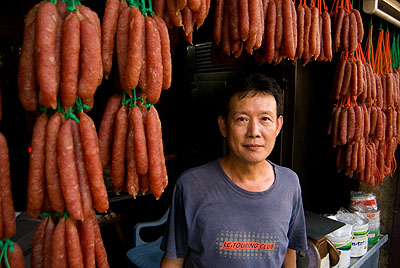
Our first stop was the subject of one of Suthon's numerous articles; an ancient house where a man named Thot is the second generation of his family to make kun chiang, Chinese-style sausage:

_DSC9491.jpg

Khut Thot still makes sausages by hand in the same place his parents did--an ancient Chinese shophouse on Thanon Plaeng Naam, the very house he grew up in:

_DSC9419.jpg

After mixing "good quality" pork with spices, he stuffs the casings and hangs them in a locker over warm coals:

_DSC9416.jpg

After a few hours of this, he'll move them to another locker where they'll dry for a day. The sausages are done at this point, but still need to be cooked before you can eat them. Khun Thot was kind enough to give me a bag of his kun chiang, which I'm really looking forward to trying.

Just a few steps away is a famous vendor selling khanom jeep, Chinese steamed dumplings:

_DSC9412.jpg

This vendor has gained a reputation for making the dim sum-style snack by hand using a traditional recipe, something he claims to have done for 50 years! He starts selling at lunch, and will remain on the street until he's sold everything:

_DSC9406.jpg

Served with a light soy sauce and deep-fried crispy garlic, the khanom jeep were delicious, and a world away from the recently-thawed, oily, tasteless clumps you'll find elsewhere. And later, in a backstreet scene reminiscent of medieval Europe, we even got a glance of how the dough wrappers are still made using traditional methods:

_DSC9392.jpg

Khanom Jeep Wat Yuan
Thanon Plaeng Nam (sold from a cart in front of Chinese temple)
12pm-7pm

Heading up towards Thanon Mangkorn we passed by a famous curry shop called Jay Puy. On the surface, it looks like any other street side curry shop in Bangkok, and I'd walked by it several times without noticing anything in particular. However Suthon pointed out one quirky aspect:

_DSC9501.jpg

Jay Puy has no tables--something that Suthon claims has no impact on the number of people who eat there. "In the rainy season they don't have a roof or umbrella," says Suthon, "but people still eat there!" The shop is known for kaeng karii, literally "curry", but a Chinese take on the Indian/Thai dish. Suthon explained that the curries here aren't as thick or as spicy as the Thai version, and that they are thickened with flour, as not to be so oily.

Jay Puy Curry Shop
Corner of Thanon Mangkorn and Charoen Krung
4pm-9pm

Our evening ended at a tiny, dark alley off of Thanon Plaeng Naam where Suthon wanted to take me to Jay Joo, one of his favourite restaurants in Chinatown, and a place he described as being more Chinese than Thai:

_DSC9494.jpg

"Real Chinese food has to made over a very, very hot flame," explained Suthon. As seen above, Jay Joo's coal-burning stoves were indeed very hot, and Suthon ordered plaa kiam buay, a deep-fried fish served in sour broth of salted plums and ginger; tao hoo song khrueang, deep-fried tofu served in a thick sauce with veggies; and kung kap plaa muek phat nam phrik phao, fresh shrimp and pickled squid fried in chili paste:

_DSC9545.jpg

Everything was outstanding, and coupled with the exotic atmosphere (a huge family eating nearby, rats underfoot) and a few cans of Singha, made a memorable meal that topped off a truly memorable evening.

Jay Joo
Soi Phiphaksaa 2 (located roughly between Thanon Plaeng Naam and Thanon Phadung Dao)
4pm-7pm

How I do it

10-01-2004_BKK_Thailand26 copy.jpg

I often receive emails asking about what kind of photo equipment I use or how I edit my photos. I'm flattered by this, as although I do earn my bread by taking photos, I've only been shooting professionally for a couple years now. Go back to the early days of this blog, and you'll see some pretty horrible pics and even worse editing. Regardless, I'm learning and improving all the time, and for those of you who care, the following outlines what I shoot with, and how I edit my pictures.

I shoot with a Nikon D200. I really, really like this camera; it feels strong and durable like my F100 (a Nikon film camera), and the controls are easy to use and intuitive. The only downside is that, at least in my experience, the images require some basic post-processing, as you will see below.

In terms of lenses, the vast majority of the shots on this page are taken with my Nikon 35mm f/2. When put on the D200, the 1.5 factor makes it very close to a 50mm "normal" lens, i.e., similar to what the human eye sees. It's a light, compact lens that because of the fast aperture, is great in low-light situations. Sometimes I'll also use my Nikon 60mm f/2.8 Macro, probably the best lens I own, although obviously it requires a bit more light (and distance). After having used a few off-brands, I've decided I'm only going to use Nikon lenses from now on. And of course I always use Nikon UV filters to protect the glass.

I always shoot in RAW (with accompanying jpegs), because I don't like to worry too much about getting the exposure just right, and with RAW you can "push" or "pull" the image up to a stop or more with no real repercussions. I import my images using Nikon Transfer and use Nikon View 6 to weed through the jpegs and organize my images. I use Photoshop CS2's RAW converter (not the useless Nikon one) to adjust white balance (another advantage of shooting in RAW), exposure and boost the saturation. I also use this screen to adjust the colour space, using sRGB if the image is going on the web. In Photoshop I improve the contrast using Levels, resize and sharpen. Sometimes I'll crop, but rarely, if ever, do I do more than this.

As an example, here's a shot as it looks directly from my D200, with no editing or changes whatsoever:

uneditedbike.jpg

And here's the same image after adjusting white balance, giving it an exposure increase of 1/2 a stop, a saturation boost of 15, and some adjusting of Levels and a Sharpen:

editedbike.jpg

That's it, and really, that's about the extent of my Photoshop knowledge. I have no idea how to cut ugly people out of an image or change the color of a bowl from red to green (or whatever), so everything you see here is real.

One invaluable tool in doing this blog has been Flickr. In the beginning I posted my pics directly with Blogger, with horrible results. At Flickr, I can fully control the quality of my images and they appear on my blog exactly as I've edited them.

I'm self-taught, and my greatest resource has been, not surprisingly, the Internet. My latest and greatest find is Strobist, a blog that teaches great off-camera lighting techniques using very simple gear. I recently bought a light stand and an umbrella, and am having lots of fun using my simple SB-800 to make studio-quality shots. Ken Rockwell is a great site to learn about gear and/or technique, and for pure photographic inspiration, go to the Magnum Photos site, or browse David Alan Harvey's blog.

But really, all this technical stuff is pretty boring; if you want to improve, get out and shoot!

Ratana

_DSC8993.jpg

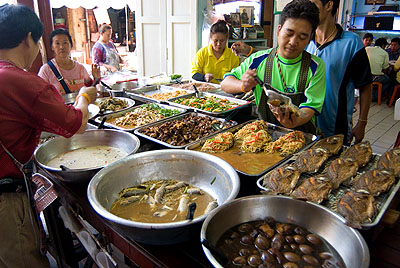
Today I had lunch with the Lonely Planet's Man in Japan, Chris Rowthorn. Chris trusts me enough to let me choose where we eat lunch, which, if you ask me, is the highest level of trust. Around noontime we found ourselves near the venerable Nang Loeng Market, and I decided to stop in at Ratana, a curry restaurant I had seen, but had yet to try. Like many of the places in the area, Ratana is simple, but oozes heaps of old-school Bangkok charm. The line of people out front is a sure-fire sign of good eats anywhere in Thailand. And as illustrated above, the amazing selection of curries, soups and fried dishes is a great introduction to Bangkok-style Thai cooking.

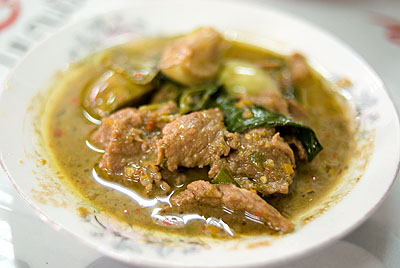
We began with green curry with beef:

_DSC8979.jpg

which was more like a stir-fry than the soupy curry you'll find in most places. It was also among the tastiest green curries I've ever sampled, the curry paste sporting a healthy dose of peppercorns. I was curious about this somewhat unusual flavour and asked the cook, who told me that the shop makes all of its own curry pastes, something quite uncommon nowadays.

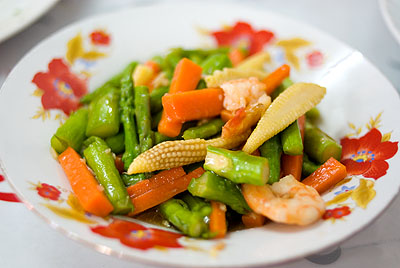
This was followed by a Chinese-style stir-fry of veggies and shrimp:

_DSC8986.jpg

a pretty common dish at Bangkok curry shops of this ilk, and a decent source of the green.

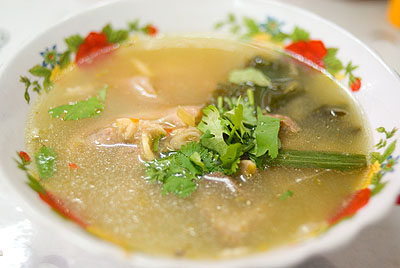
More interesting (but far less photogenic) was a bowl of tom yam with pork leg:

_DSC8976.jpg

Unlike most tom yam, which are generally seafood-based and clear in broth, this one was bordering on stew like, but still tasted light thanks to the copious lime juice. The soup supported several chunks of hearty pork leg, including bone, skin, and even, if I remember correctly, a bit of meat. A truly wonderful dish.

And finally Chris was curious to try khao khluk kapi:

_DSC8983.jpg

the dish of rice cooked in shrimp paste and served with a variety of toppings. Ratana's version was very, very good, and also unusual in that they topped the dish with an herb called cha om, the long green leaves seen in the pic, which have a slightly pungent flavour.

Ratana Curry Shop
Nang Loeng Market
Nakhorn Sawan Road
02 281 0237
Mon-Fri, 10am-2pm

How To Read and Pronounce a Thai Menu

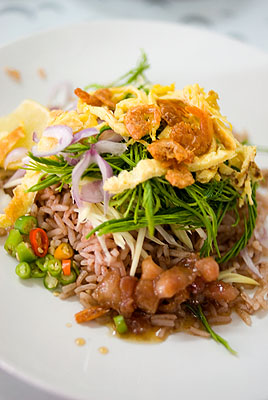
_DSC8162.jpg

Ever try to order food in a Thai restaurant only to be completely and utterly misunderstood, or even worse, ignored? Perhaps it's because you just came in from Khao San Road and are not wearing shoes and shirt. But in most cases it's probably because you're not pronouncing the names of Thai dishes correctly. Thai is a picky language, and a misdirected tone, a shortened vowel or improperly articulated consonant can mean the difference between a hot meal and yet another bag of "Thai Basil" chips at 7-11. And not only are Thai words hard to pronounce, but,there is no commonly accepted method of transliteration from Thai to English, so a dish you saw spelled one way on a menu last week, could very well be spelled differently in the next place. To help you understand and make yourself understood, I've put together a basic guide to Thai pronunciation and transliteration.

Som tam
I sometimes hear non-Thais pronounce the first consonant of the second word like our t in English (ie aspirated, with a puff of air). Generally, if you see something written with a t, it is probably referring to the unaspirated t sound (somewhere between a t and a d, and similar to the t in the English word "stand"). On the other hand, if you see a Thai word with th, it is never pronounced like the th in the English words "thin" or "this", but is rather the aspirated (accompanied by a puff of air) t sound. The same goes for k, kh, p and ph. Sometimes the unaspirated t is also written as dt, which personally I find confusing.

Phat thai or phad thai?
In Thai there is no difference between a final t or d sound (or ph, p or b for that matter). However do keep in mind that ph is the aspirated p sound, and is not equivalent to f.

Larb vs. larp vs. laab vs. laap vs. lahp
The length of the vowel sound is very important in Thai, and to convey a long vowel sound, English transliteration often sticks an r (or sometimes an h) into the mix. Myself, I prefer just to double the vowel, as the Thai long vowel sound is not exactly like the English r sound. Regarding the words above, there is no "correct" spelling--just remember to pronounce a long vowel sound when you say the name of the dish.

Some sounds simply don't exist in English
Obviously transliteration has its limits, particularly in the lack of tones (a whole other can of worms that I won't get into here) as well as the various sounds that are common in Thai, but that aren't found in English. A couple examples of this are the eu sound, found in the word for "one" (neung), which is made by smiling (as opposed to rounding the lips). Another sound that doesn't have a real equivalent, and tends to be written any number of ways is the aw (like in the English word "law") sound. Sometimes you'll see this transcribed as o or or.

l and r
The written Thai language distinguishes between r and l, but in everyday speech, the r is almost always pronounced like an l (in Laos they've done away with the r sound altogether). This is why the dish raad naa, when said by a cook on a street corner in Bangkok, is going to sound more like laad naa.

A few words and phrases to help you along when ordering:
mii ... mai? Do you have ...?
mai kin ... I don't eat ...

neua sat
meat
kai chicken
plaa fish
muu pork
neua beef
phak vegetables

phat
fried
thawt deep-fried
yaang grilled
tom boiled
neung steamed

arawy
delicious
khawp khun thanks
thao rai How much? (the easiest way of asking for the bill)

How To Make: Phat Kraphrao

_DSC8433.jpg

I reckon this dish--meat fried with a kind of basil leaf, garlic and chilies--is the closest equivalent to Thai "comfort" food. It's quick, nourishing and delicious, and is available just about everywhere. You can make it with virtually any meat or seafood, although I've decided to use the ubiquitous (and delicious) squid.

A couple things to keep in mind when making phat kraphrao at home are that you'll need bai kraphrao (holy basil, the dish's namesake), not bai horaphaa, Thai basil. Bai horaphaa, although more familiar to most people, is almost only eaten raw, or as a garnish. Bai kraphrao, on the other hand, is always cooked, and it's bitter-spicy flavour is a world apart from the sweet, anise-like taste of bai horaphaa.

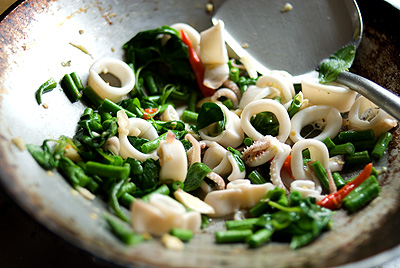
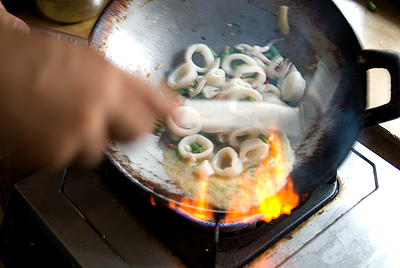
Also, ideally you'll want a hot, preferably gas or propane stove to make this dish. The idea with this dish is to cook it quickly and at a high heat to allow the ingredients to remain fresh and crispy. If you really know what you're doing, you can also tilt the wok and "ignite" the dish while cooking in order to impart a delicious smoky flavour (shown below). If an electric stove is all you've got, then by all means go ahead, but the relatively low heat means that the dish will inevitably be slightly soggy and overcooked.

And as always, I'm not going to tell you how much seasoning you need to put into the dish. I recommend adding fish sauce a teaspoon (or small glug) at a time, tasting after each addition to make sure you've added enough. For reference, phat kraphrao should be slightly salty and spicy, so feel free to indulge. And if after cooking you've found it's not spicy enough, you can always make a quick bowl of phrik naam plaa, sliced chilies and garlic in fish sauce, a typical accompaniment to this dish.

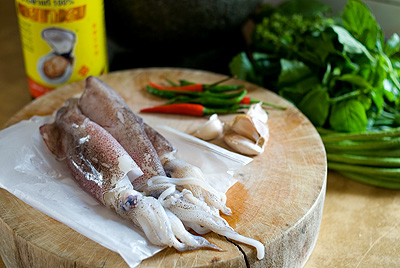
Here's what you'll need to make two dishes of phat kraphrao:
_DSC8408.jpg

Squid (or other meat or seafood), 4 medium
Bai kraphrao, (holy basil), two large handfuls
Long bean, 4-5 beans
Garlic, about 4-5 large cloves
Chilies, to taste
Cooking oil, 2 Tbsp
Fish sauce, to taste
Oyster sauce, about 1 Tbsp
Sugar (optional), to taste
Rice (not optional), two plates
Fried egg (optional)
Prik naam plaa (optional)

Begin by cleaning and preparing your squid (if you're not sure how this is done, go here). Slice into thick rings and set aside.

Wash bai kraphrao and remove the leaves:
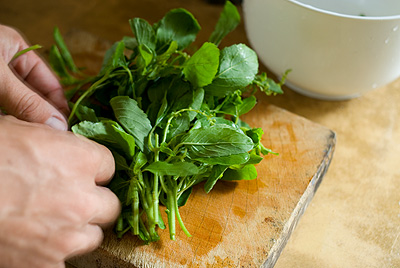
_DSC8416.jpg

Set aside. Wash long bean and cut into 1/2-inch pieces:
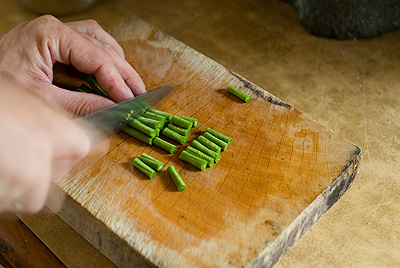
_DSC8415.jpg

Set aside. In a mortar and pestle, grind up your garlic and chilies into a coarse mash (not a fine paste):
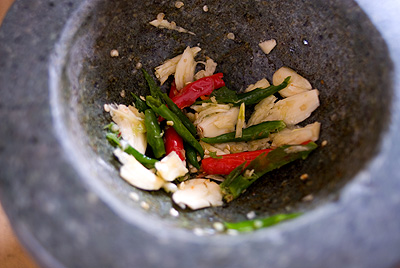
_DSC8422.jpg

Set aside.

Prepare your mise en place: within reaching distance of your wok, place a bottle of fish sauce, a bowl of sugar and a bottle of water. Have all your ingredients close at hand, open and ready to throw in the wok. The entire cooking time of this dish should be no more than a minute, so you won't have time to be hunting around for things once you've begun.

With the flame on med-high, heat 1 Tbsp of oil and add half of the mashed chilies and garlic. Saute about 10 seconds:
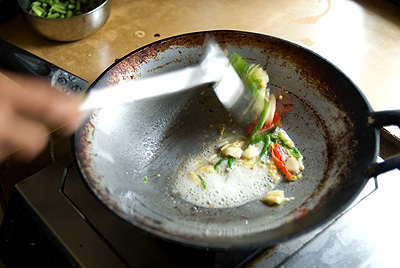
_DSC8427.jpg

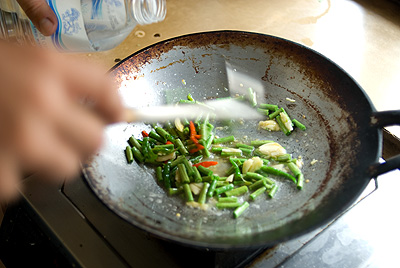
Increase heat to high and add half of the sliced long bean and a tablespoon or two of water. Fry until long bean is cooked but still crispy, about 20 seconds:
_DSC8428.jpg

Add half of the squid, followed by a splash of fish sauce, oyster sauce and sugar (if using). Stirring constantly at very high heat, fry until squid is just done, about 10 seconds:
_DSC8431.jpg

Add a tablespoon or two of water if mixture is beginning to dry out, and toss in a haldful basil (don't worry if this looks like too much; the basil shrinks considerably when cooked). Stir thoroughly to combine, taste and add more fish sauce or sugar if necessary. Fry until basil is just wilted but not limp, about 15 additional seconds.

Serve phat kraphrao steaming hot over hot rice with a fried egg on top, if desired. Repeat with remaining ingredients.
Oh My Cod!

_DSC8217.jpg

I love Thai food, but after eating it day in day out sometimes I want something different, something a bit more exotic, something like... fish and chips. The Brits in the audience will no doubt laugh, but as a teenager growing up in Oregon, fish and chips seemed pretty exotic to me. Upon moving to Bangkok I was delighted to discover that fish and chips were quite readily available, and my usual (and now former) fish and chips haunt became a characterless room adjacent to a bar near Soi Cowboy, which, according Wikipedia is "perhaps Bangkok's best known fish and chips shop". This may be true, but in retrospect, a visit to this place is an exercise in mediocre food in desperate surroundings. (For an excruciatingly detailed, and sometimes impassioned discussion on the fish and chips scene in Bangkok, check out this forum.)

Thus I was overjoyed to discover Oh My Cod!, a relatively new fish and chips joint and a card-carrying member of the British Federation of Fish Fryers. Today I finally made the long trip down to Banglamphoo, and was fortunate indulge in one of my favourite foods with Newley Purnell,

_DSC8220.jpg

fellow Oregonian, fish and chips aficionado, and the body and brains behind newley.com.

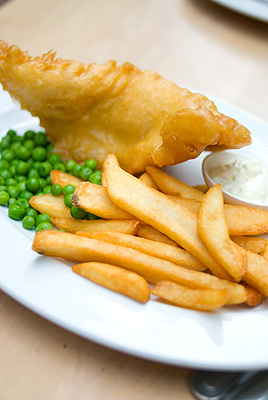
Apparently there are other food products for sale at Oh My Cod!, but Newley and I dove straight into the f & c. The restaurant offers a choice between red snapper or the more traditional cod, and being men of conscience we went for the not-yet-extinct snapper. As illustrated above, the dish takes the form of a mind-bogglingly puffy portion of fish accompanied by thick-cut chips ("French fries" for you American English speakers) and peas prepared either "garden" or "mushy" style. The fish batter was spot-on crispy and flaky, but the enclosed snapper was a tad soft and mushy.

The fish was followed by a right proper cuppa:

_DSC8225.jpg

of PG Tips no less. And being "fully licensed to sell drinks" the menu at Oh My Cod! also includes some imported English beers and ciders, as well as the elusive Beer Lao. The restaurant also sports a pleasant outdoor dining area:

_DSC8227.jpg

and what must be one of the most detailed websites in the history of fish and chip restaurant websites. The only bummer was our surly nose-ringed waitress, who refused to speak Thai with us, but who didn't seem able to speak English either. Not sure exactly how she expected to communicate, as my sign language skills are pretty rusty. Regardless, I will doubtlessly be returning.

Oh My Cod! British Cafe
5d Rambuttri Village Inn
Soi Rambuttri (near Khao San Road, see map)
02 282 6553
7:30am-10pm

Technorati technorati tags: , , ,

How To Eat Thai Food

_DSC8180.jpg

Not like this.

Eating Thai food with non-Thais always reminds me how different our eating habits are. Although you're probably not going to offend anybody by holding your spoon the wrong way or taking to much yam wun sen, understanding how Thai people eat will undoubtedly smooth your way and maybe even provide a greater understanding of the food and people. And chicks love it. So here are a few tips on how to eat like the Thais do:

1. Order a balance of dishes. I know you all want to eat phat thai, but it's actually a jaan diaow, a one-plate meal typically enjoyed by one person eating alone. When eating with others, try to order dishes that everybody can share (i.e. virtually everything except phat thai or any other noodle dish). Also, try to order a good balance of dishes. Ordering four coconut milk-based curries is a bad idea you'll almost certainly regret later. I always try to order one fried vegetable dish, one sour soup and one uncooked dish, perhaps a yam (Thai-style salad), or a naam phrik (chili dip). Throw in a grilled or deep-fried fish and you've got yourself a phat meal. This is very easy to do in most restaurants, and allows you to truly sample the variety of Thai cooking.

2. Always eat your food with rice. Growing up, I recall my family ordering Chinese food and how the rice would always end up unopened, in its white container, until, several months later, it solidified and went sour and was eventually thrown away. Needless to say, I don't do this any more. In fact, I can't even imagine eating a spicy kaeng som or a phat fai daeng without rice. In Thailand, rice is the "base" of the meal, much like bread elsewhere. And since the flavours of Thai cooking are so strong, you're going to want something to tone it down a bit anyway. There are many Thais who, in leaner times, have had little more to eat than a plate of rice and maybe a splash of fish sauce, but you'll find very few, if any, who have ever scarfed down a bowl of kaeng phet sans riz.

3. Dishes are shared. This is one concept that foreigners seem to have a particularly difficult time with. If you dine with Thais, they'll ask you to order one or two dishes that you fancy. However, when these dishes arrive, they are no longer "your" dishes to horde, rather they belong to everybody. On the same note, when serving yourself, you are expected to take one bite at a time, not one serving, from the central dish. Scraping a huge pile of food onto your rice can be seen as greedy here. And there are no "courses" per se in Thai food, so eat everything as it comes.

4. Use a fork and spoon. This is another big difference that has a couple dimensions. When dining informally, or with close friends, there often won't be any serving spoons. Thais use the same spoon they've just shoved into their mouth to pick food from the central dish. This seemed very, very odd to me at first, but is just the way things are done here. And for those who are unsure about the mechanics of the fork and spoon, here's how it's done: with your right hand, use your spoon (or the communal spoon, if one is provided) to take the equivalent of one bite of food from the central dish. Put this directly on top of some of the rice on your plate. Holding the fork in your left hand, use it to push the now food-drenched mound of rice back onto your spoon. Shove the spoon in your gob. Repeat.

5. Tipping is not necessary or even expected in Thailand, but it sure is nice. The people who serve you your food in Thailand probably work 12 hours a day, six days a week, and earn very little. When paying, Thai diners typically leave their coin change, not so much as a tip, but more to avoid looking cheap. I try to leave 20 baht or so to look wealthy. Chicks love it.

Soi Polo

_DSC8207.jpg

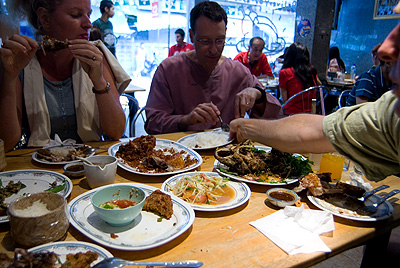
Food with friends always tastes better, especially if those friends happen to introduce you to really good restaurant you've never been to before. Such was the case when I was taken to the famous Soi Polo fried chicken joint by experienced diner and South China Morning Post editor Hal Lipper, and self-confessed "ace reporter" Ron Gluckman (check out his site for a plethora of wacky Asian reportage) and his wife Jolanda. These guys all live within a few minutes' walk of Soi Polo and had eaten there several times. For me getting to this part of town is something of a minor expedition and it was my very first time.

This restaurant has been popular among locals for ages (40 years, according to the sign), but particularly caught the attention of Bangkok's foreign community when it was featured in a New York Times article by RW Apple. On the day we visited the clientèle was overwhelmingly Thai (generally a good sign), and we began with som tam Thai:

_DSC8202.jpg

The dish arrived within seconds, which made me fear that it might have been pre-made, but a taste proved the dish to be freshly pounded and really quite exceptional; sour and salty with hearty chunks of crisp papaya and unlike just about everywhere else, good-quality dried shrimp.

Everybody is familiar with laap, but I suggested ordering laap plaa duk, made from the meat of grilled catfish--something new to this group:

_DSC8194.jpg

The catfish had a delicious smoky flavour that was accentuated, rather than overwhelmed, by the accompanying fish sauce, lime juice, powdered rice and chilies. And the dish wasn't "mushy" as it often is at lesser restaurants.

Continuing on the fish theme, Hal ordered plaa chorn naam tok, a deep-fried snakehead fish served with a hearty Isaan-influenced dressing:

_DSC8196.jpg

and Ron wanted us the try the restaurants thord man, fish cakes:

_DSC8197.jpg

which were almost certainly the largest I've ever seen.

But everything else aside, this place is really all about the deep-fried chicken:

_DSC8190.jpg

which was pretty amazing stuff, although, just to be picky, I found it a bit too meaty, myself preferring the scrawnier kai baan, free-range chicken. The chicken had been marinated in a dressing not unlike the famous deep-fried chicken from Hat Yai, and came with two good, but largely unnecessary dipping sauces. But I think everybody would agree with me that best bit was the copious crispy deep-fried garlic, which I'm sure I could eat by the handful, like popcorn.

Everything we ordered was great, and I was particularly impressed by the quality of the ingredients: big, flavourful mint leaves, tasty catfish, meaty shallots et al. This is a restaurant that really does seem to deserve all the praise shoveled upon it.

Kai Thort Jay Ki (Soi Polo)
137/1-2 Soi Polo (near Lumphini Park and the Suan Lum Night Bazaar)
7am-10pm
02 655 8489

Technorati technorati tags: , , , ,

How To Make Bird's Nest Soup

_DSC7050.jpg

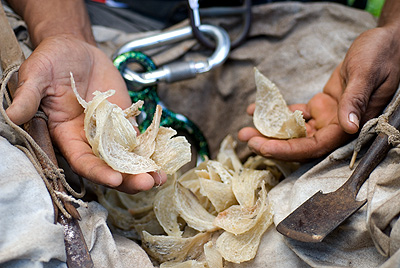
As mentioned previously, I recently worked as an assistant to Eric Valli, one of 55 photographers involved in the Thailand: 9 Days in the Kingdom book project. Back in 1990 Eric did a National Geographic article and film about the workers who gather swift nests in the caves of southern Thailand. The nests, pictured above, are made from the hardened saliva of the swifts, and are believed by the Chinese to have medicinal properties. The gathering of the nests, which are located deep inside island caves, is also very dangerous and they are thus extremely valuable. For the 9 Days project Eric wanted to go back to these caves to photograph a profession and world that very few outsiders have ever seen.

I'd love to post Eric's pics here, but reckon the publishing company wouldn't be too happy about that, so I'll have to rely on the images that I took, which is too bad, as Eric's images were simply amazing.

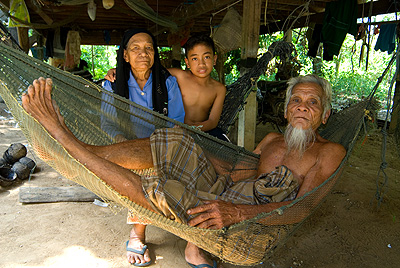
The man below is called Sahat and was the climber that Eric worked closely with nearly 20 years ago:

_DSC7105.jpg

Sahat retired from gathering bird's nests about 10 years ago, but is still very strong, and at 72, earns money by, among other things, climbing and cutting the tops off of coconut palms!

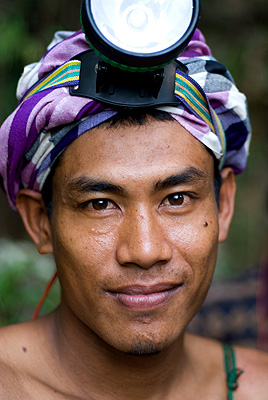
This time Eric worked closely with a young climber called Sun:

_DSC6683.jpg

a super guy, and one of most talented natural athletes I've ever seen.

It's hard to explain in words the work these guys do because even after seeing them do it myself, the reality is simply quite unbelievable. Basically the climbers rely on a complicated network of bamboo scaffolding to reach bird nests that are often found at the highest and most deepest corners of the caves. These towers of bamboo can sometimes be literally hundreds of feet high, and the climbers climb up them barefoot, jamming their toes in the knots like steps. In places where the use of bamboo is not practical, they rely on bunches of vines, and increasingly nowadays, rope, to pull themselves up. Although nowadays most of the climbers wear modern harnesses (introduced by Eric), the only time they use them is when they are stationary and lash themselves to something stable (typically bamboo) if they have to reach for a particularly far wall of nests. And the electric light that Sun is wearing in the pic above is also a relatively recent introduction; when Eric was here in the late '80s the climbers still relied on fiber torches that they gripped in their teeth!
As if this doesn't sound crazy enough, simply to reach the cave that we photographed involved an hour boat ride, a precarious climb up a sheer rock face, a long hike uphill and a 150 foot rappel, although the climbers simply chose to climb down the bamboo. Here is the cave seen from about halfway down:

_DSC6611.jpg

Besides being dangerous, it was also very hard and dirty work, as this picture of Eric after a particularly difficult climb shows:

_DSC6793.jpg

Here is Eric setting up a shot inside a relatively small cave on an island called Ko Li Pe:

_DSC6311.jpg

As many of the caves are almost completely dark, we were limited to photographing in caves that had some natural light. This particular cave had quite a bit, and with the help of a flash, I was able to do these portraits:

_DSC6535.jpg

_DSC6526.jpg

_DSC6519.jpg

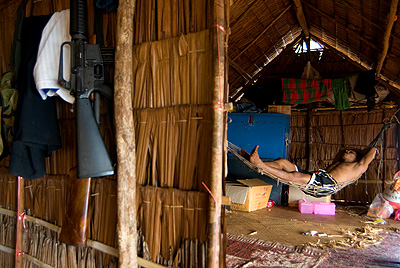
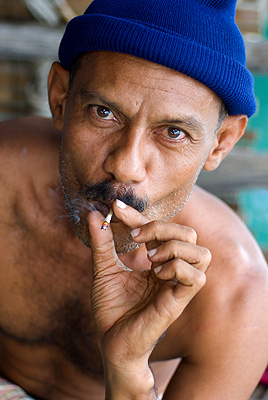
Because of the value of the nests, each cave is protected by armed guards:

_DSC6569.jpg

_DSC6862.jpg

Although everybody assured us that there was little theft nowadays because "the thieves are all dead."

Relaxing after a hard day's climb:

_DSC6602.jpg

and Eric and I on our way back to Ko Yao Noi, where we were based for the week:

_DSC6706.jpg

In all it was a difficult and sometimes scary, but amazing experience. Because of the high stakes and security, Eric reckons we are probably among the only outsiders, Thai or foreign, to have climbed in these caves with these people, which is quite an honor. And in case you're wondering how I feel about bird's nest soup, frankly I find the stuff--basically a sweet, tasteless broth with strands of noodle-like bird spit--rather disgusting. But don't tell the climbers I said that.