Damn Spicy

Khanom jeen and naam yaa plaa at a stall near Lamai Beach, Ko Samui After several days on Ko Samui, I officially have no more reason to bitch about the lack of local eats. While staying on Lamai beach I discovered a stall at nearby Talat Dao that sells a variety of khanom jeen, curries served over fresh rice noodles.  This is possibly the most common dish in southern Thailand, and is served at all times of day or night. Khanom jeen can also be got in other parts of Thailand, but what makes it different down here are the types of curries served and the toppings. Southern Thais like their chili heat, and the innocent looking, typically yellowish curries you'll see here are some of the spiciest in the country. The one pictured above is called naam yaa plaa (pictured above), and is a fish and coconut milk-based curry particular to the south. As with all types of khanom jeen, when you order you'll simply get a shallow bowl with a handful of noodles and a ladleful of curry. It's your job to top it with the fresh herbs and veggies held in vast trays on the tables. These herbs typically include a couple kinds of basil, young cashew nut leaves, phak chee lawm (an herb almost identical to flat leaf parsley, pictured above) cucumbers, long beans and a couple types of pickled veggies. It's all for free and you simply take what you like, rip it all up and mix it into your noodles.

Another very southern type of khanom jeen is kaeng tai plaa, literally 'fish kidney curry':

Kaeng tai plaa at Lamai Beach, Ko Samui

I think this curry, which also includes crispy bamboo, grilled fish, long beans, and a type of sweet potato-like local tuber, is about the spiciest thing humans were meant to consume. As if that wasn't enough, it's also extremely salty.  After eating it I was still feeling the burn a good 20 minutes later. Honestly though, it wasn't all that unpleasant. Have you ever eaten anything so spicy you actually felt a bit... well, high?
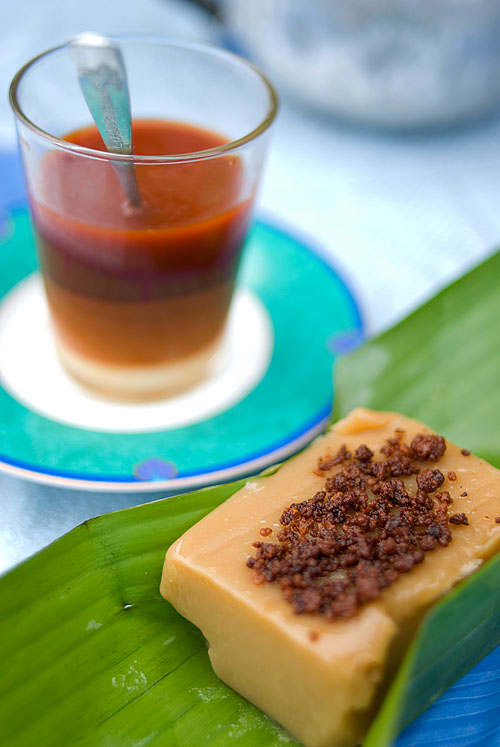
Breakfast on Ko Samui

Breakfast at Lamai's morning market, Ko Samui. I've been on Ko Samui for almost a week now, and although finding real Thai food is not impossible, it can be something of a struggle. While on Lamai Beach I had a handsome meal of bangers and mash, was tempted to order pizza ('Chef from Naples'), and one night ate dinner at, uh... a Swedish restaurant (falukorv med stekt potatis och äkta svensk senap!). These were all satisfying, but I was still longing for something... local. I finally found it the next morning at Lamai's morning market. There I had a breakfast of sweet Thai tea with a Thai sweet (pictured above--name forgotten). Sweet, yes, but Thai. More to follow...
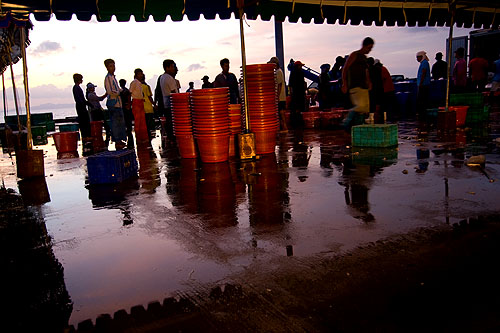
Na Thon

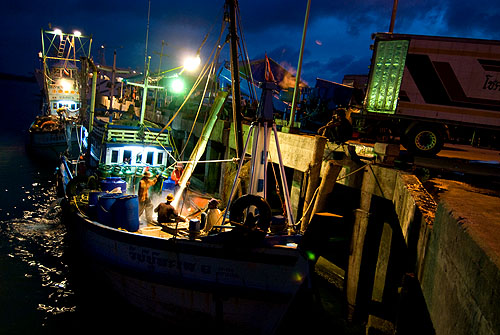
I'm on Ko Samui, doing the photos for Lonely Planet's upcoming Ko Samui Encounter guide. I have a big fat list of places I have to shoot, but the good thing about doing this job is when I come across something interesting I can usually just shoot away. This happened when I was taking photos of Na Thon, Samui's main port. It was sunset, and several ships had docked and were unloading fish: Unloading fish at Na Thon, Ko Samui's main pier.

A bit later, the remaining natural light mixed with the fluorescent and tungsten lights of the boats to create a pretty cool effect:

A fishing boat at Na Thon, Ko Samui's largest pier.

If you look closely, you can see that they are filling the boat with ice, which also added an interesting element to the pic.

TV

Recently the Dutch television programme The Taste of Life was in Bangkok. I took them around town for a day, and even feature in part of the show! Apparently the video can be seen here, but I'm on the road and have yet to find a connection fast enough to accommodate streaming video. If you're blessed with amble bandwith take a look and let me know how silly I look.

Dinner in paradise

Haad Yao fried rice I'm currently on Ko Pha-Ngan, a beautiful island in southern Thailand. At the moment, the water is clear, the weather sunny and I'm having a great time with old friends. There's only one downside: the food is bloody awful. Actually, that's a bit too strong. The food here isn't unsanitary, or rotten or even that badly prepared. It's just phenomenally bland. A boring, uninteresting approximation of Thai food for gastronomically timid foreigners. To make things even worse, every restaurant on Haad Yao seems to have the identical menu, and they staunchly refuse to vary from this. Among the more bizarre things that I've been served is something called Haad Yao fried rice (pictured above), rice fried with ketchup and chicken, and wrapped in a thin omelet. You can opt for the classic Thai dishes, but unless you're a fan of limp, salty 'kana with garlic', greasy phat thai, or milky tom khaa, you're screwed.
Our only saving grace at this point has been a streetside som tam and grilled chicken stall about three kilometres up the road.

Chicken grilling on Ko Pha-Ngan

The proprietor is from Buriram, and makes papaya salad just the way I like it: sour and spicy. If you go to the same area in the morning, you'll even find, believe it or not, authentic southern Thai food such as khanom jeen. Unfortunately a taxi ride there (actually a seat in the back of a truck) costs more than the meal, so what would be a dirt cheap meal anywhere else in the country becomes an exorbitant splurge here.

In a couple days I'll be crossing over to Ko Samui, home I'm sure to even more quasi-Thai food, but also the location of Bangpo Seafood, a beachfront restaurant serving authentic Ko Samui-style Thai food that, despite having eaten there only once, I still count as one of my most memorable eating experiences in Thailand. Can't wait.

Maps


View Larger Map A while back, I started showing the locations of the places I mention in Google Maps. As some of you pointed out, the maps were written in Thai--not a great deal of help to most of the people who come here. Fortunately, in glancing at my Google Map today, it appears that it now includes both Thai and English. So, please take a look, click on whatever looks good, and hope this tool helps you find it!

Welcome!

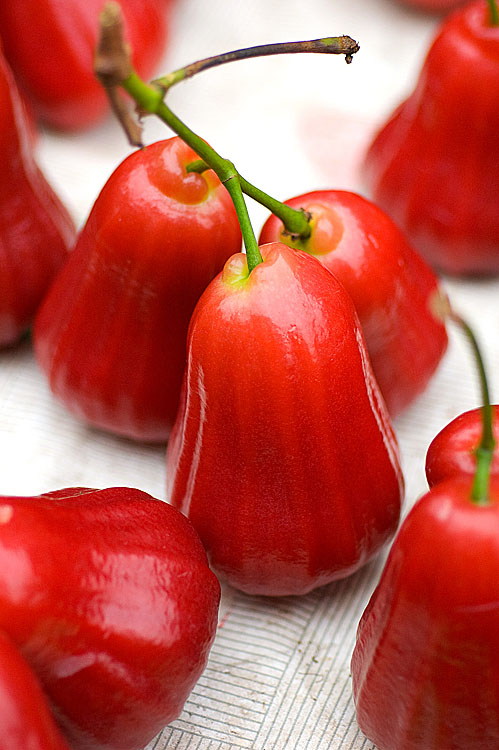
 Rose apples You've undoubtedly been re-directed here from RealThai, my former Thai food blog. Thai food fans don't despair just yet--all my previous entries have been moved here, and I'm still living in Thailand and the bulk of my entries will continue to emphasize Thai eats. However, I'm doing a lot more traveling these days and wanted a more general forum from which I can share my food discoveries. I also like the idea of a 'hub' of my own work, and if you've got the time to explore the site a bit, you'll also find a Photo Blog, my portfolio, as well as my Bio and a few examples of my published work.  Update your bookmarks and enjoy!

Welcome!

In Songkhla's old district. This is my first post at my newly-redesigned website. I'm still learning how to post and use some of the new functions, so it's something of work in progress. Once I get everything ironed out I'll start publishing RealThai here and you'll be able to check out all my blogs, as well as a portfolio of my work and samples of my published work, all at one convenient hub.
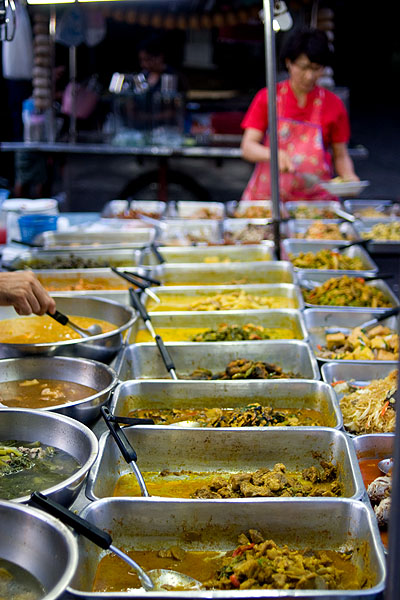
Until then, the pic above was taken in the old district of Songkhla, in southern Thailand. I'll be posting more from southern Thailand, as well as other places I've been lately, soon.

The deep south

_DSC6507 On my most recent trip I spent a week in three of Thailand's southernmost provinces: Songkhla, Pattani and Narathiwat. Due to a violent insurgency that's been brewing since 2004, there's not a lot of folks visiting these parts, but there's still a lot of interesting things to see...and eat.

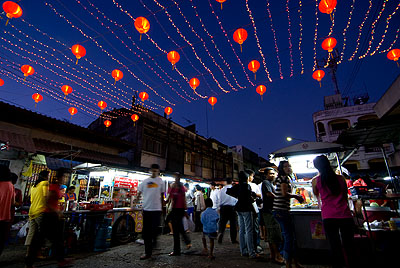
Every big city in the south has a night market. Hat Yai's:

_DSC6497

featured a few stalls selling curries, grilled seafood and khanom jeen (fresh rice noodles served with curry). There were also several stalls selling kai thawt hat hai, Hat Yai-style fried chicken. However where it concerns the local dish, the residents I talked to consider Kai Tod Daycha, with three branches around town, the best:

_DSC6478

Hat Yai-style fried chicken differs from elsewhere in its spice-laden marinade, and Daycha served the eponymous bird over fragrant yellow rice, or with a side of som tam (papaya salad).

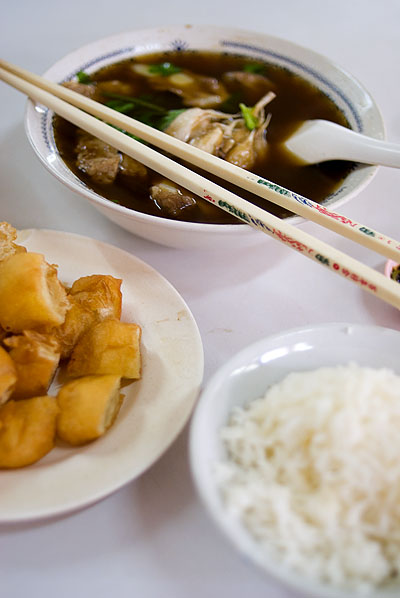
In addition to Muslim-style food, there are also lots of ethnic Chinese in the south, and at a cafe in Hat Yai I had a wonderful bowl of ba kut teh:

_DSC6455

pork ribs cooked in a herbal broth and served with sides of rice and deep-fried bits of dough. And yes, that's an entire head of garlic there in the broth.

Moving south, Pattani also has a much smaller, but still interesting night market serving a mix of Thai-Muslim and Chinese dishes:

_DSC6747

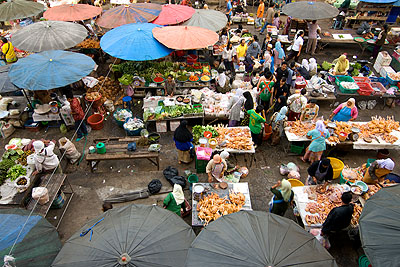
The city also has one of the most vibrant morning markets in the region:

_DSC6767

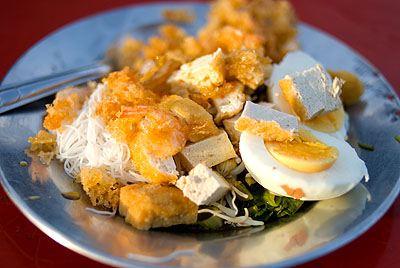
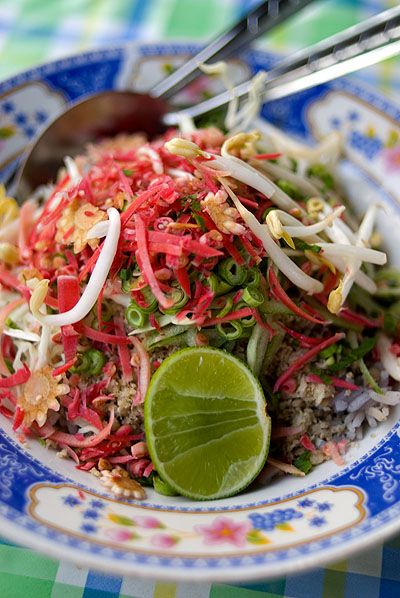
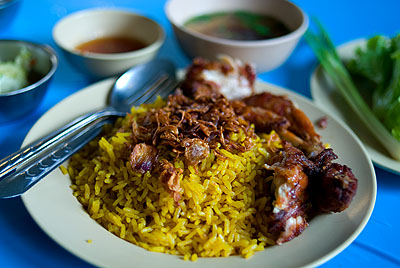
Most people in Pattani are ethnic Malays and there were more conversations in Yawi (a Malay dialect) than in Thai. In addition to language, breakfast is also very different in Thailand's deep south. Undoubtedly the most popular morning meal in these parts is khao yam (pictured at the top of this post), rice, often cooked with a type of purple flower, and topped with a bunch of finely-sliced herbs, roasted coconut, and a type of fish sauce called budu. The thin red strips are a kind of flower called dawk dala.

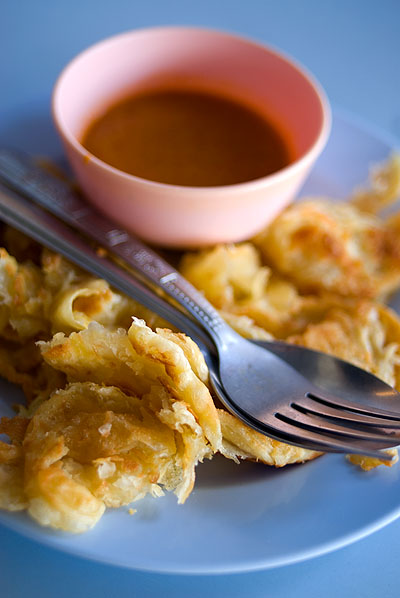
Another ubiquitous breakfast, especially in Muslim areas, is roti, a type of crispy pancake associated with Thai-Muslim cooking, and often served with a curry dip:

_DSC6557

Thai Muslims really love sweet food, and will often put a tablespoon of sugar or three into the dip. In fact, despite southern Thai food's reputation as the hottest regional cuisine in the country, I found that many dishes featured sweet as their leading flavour. In Songkhla they like a dish called tao khua:

_DSC6562

thin rice noodles and deep-fried crispy bits swimming in an insanely sweet sauce.

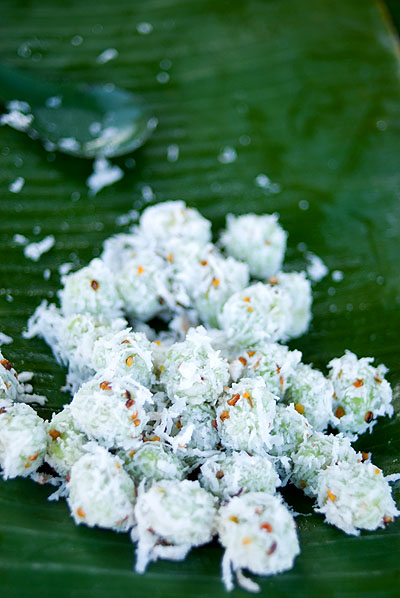
After a meal like that, I rarely felt a need for dessert, but really fell for khanom kho:

_DSC6644

These are soft balls of dough and coconut meat surrounding a tiny cube of raw sugar. The combination of the soft, fluffy outside and the crunchy inside was amazing.

Ayuthaya (again)

_DSC6135

I've been on the road quite a bit lately, the reason for not having posted in while. However I've recently become the owner of an intimidatingly black MacBook, so you can expect some mobile blogging in the near future.

My first trip took me once again visit Ayuthaya. I'm always happy to go there for fresh air and the chance to explore, but the excellent Thai food has also become a good enough excuse in its own right. I've already mentioned it here and here, so by now you know that if you visit Ayuthaya, you must eat at Baan Wacharachai. This time I wanted to try something different, and asked the locals about the best place to eat kuaytiaw ruea, 'boat noodles', a dish associated with the city. I was enthusiastically pointed in the direction of an open-air restaurant across from the ruins of Wat Ratburana called Lung Lek ('Uncle Lek'):

_DSC6125

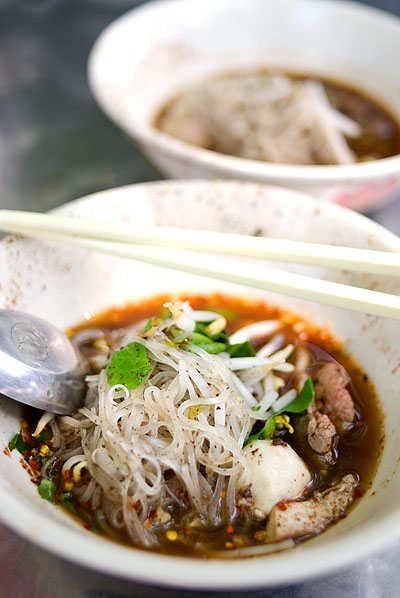
Lung Lek's noodles here must be among the most intense bowls I've ever consumed. There were the usual condiments on the table (fish sauce, dried chilies, sugar), but none was necessary--the noodles were already thoroughly spicy, sour and sweet. The beef variety (pictured above) contained a few slices of very tender stewed beef along with lots of unidentifiable bits, and the pork combined par-boiled pork and meatballs. Both contained a handful of par-boiled phak boong (sometimes known as 'morning glory', a green aquatic veggie), crispy rinds and a dose of blood. After a bowl of each (they're small and cost 15 baht) I cycled just up Thanon Chee Kun to Paa Lek ('Aunt Lek'), another recommended noodle joint. Paa Lek's noodles (pictured at the top of the post) were slightly more attractive, and judging by the crowd (and the wait) more popular, but I felt they lacked the intensity of the previous shop's. Sweet was the leading flavour here, and I'm not a big fan of bean sprouts.

I've previously mentioned roti sai mai, candy floss wrapped up in thin pancakes. On this trip I had my sights set on another Ayuthaya sweet fav, khanom babin:

_DSC6248

Tiny pancakes of sticky rice flour and coconut meat. When done right they're just a tiny bit crispy on the outside, and soft and sticky on the inside. And they're usually not too sweet either (a rare trait among Thai sweets). Khanom babin can be found in abundance at the market located directly behind Wat Phramongkhon Bophit.

Nittaya Curry Shop

_DSC4194

Many Thai dishes begin with a thick, pungent paste, typically combining chilies, garlic, shallots and sometimes dried spices. These pastes are known as phrik kaeng or khrueang kaeng, and in the past, were made at home, using a mortar and pestle. Nowadays, at least in Bangkok, most people skip this time-consuming step and buy pre-made pastes. There are lots of brands out there, but if you're lucky enough to live near Banglamphu, you can get yours at Nittaya.

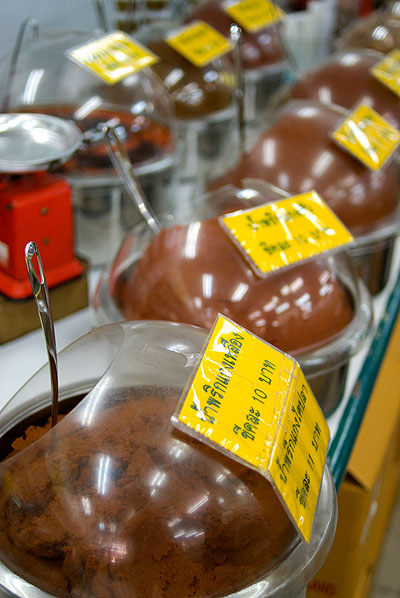
Having made curry pastes for several decades now, Nittaya has quite a reputation. They've got everything here, from ready-to-go matsaman paste, to an excellent nam phrik phao. The curry pastes are kept in covered containers:

_DSC4191

although this does little to mask the...delicious odour. They're sold by weight, and the staff can even put your choice into a leak-proof tube.

Nittaya also sells heaps of prepared curries and other dishes:

_DSC4205small
(To see a larger version of this pic, go here.)

Nittaya Curry Shop (Google Maps link)
136-40 Th Chakhraphong
02 282 8212
10am-7pm

Guilty pleasures

_DSC4883

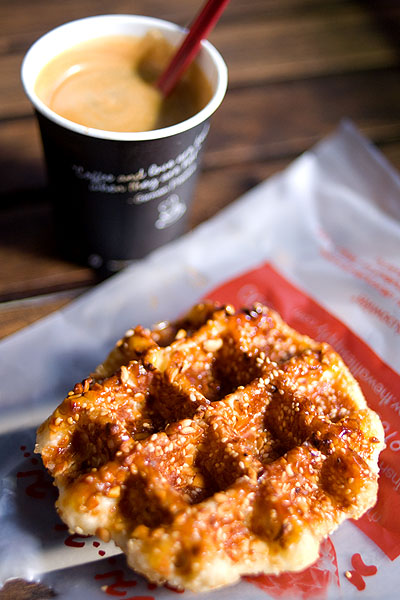
Lest you think it's all famous restaurants and ancient recipes for me here in Bangkok, I do enjoy (relatively) trashy food once in a while. This desire usually manifests itself early in the morning, when I'm on my way to Chinatown to take photos. Stopping by Hua Lamphong, the city's main train terminal, I beeline to the snacks shown above. The waffle-like pastry above is in fact, cleverly known as The Waffle (motto: "Enjoy your life enjoy your waffle"). Lately I've been opting for sesame-salt flavour, but I'm also an firm supporter of rum-raisin. A hunk of The Waffle is best enjoyed with a steaming paper cup of espresso from Black Canyon (motto: "A drink from paradise... available on Earth"), a bargain at 50 baht.

And if there was any additional need to justify my decision, here's the view at Hua Lamphong:

_DSC4899
(For a larger version of this pic, go here.)

Friend and fellow blogger Newley Purnell is also a big player on the Bangkok waffle scene. He has been known to down one or two The Waffles, but is probably most recognized for his promotion of that ancient Thai snack dish, the waffle-coated hot dog.

Choy Tii

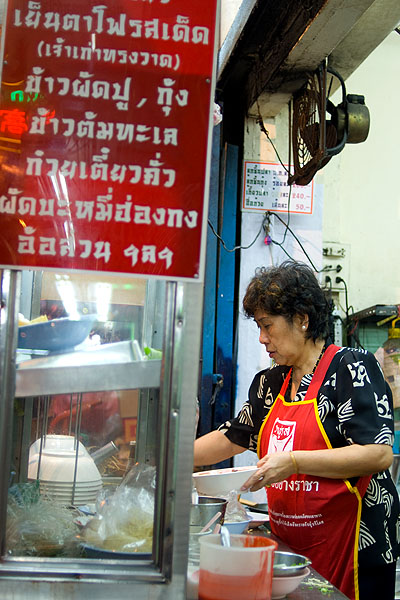
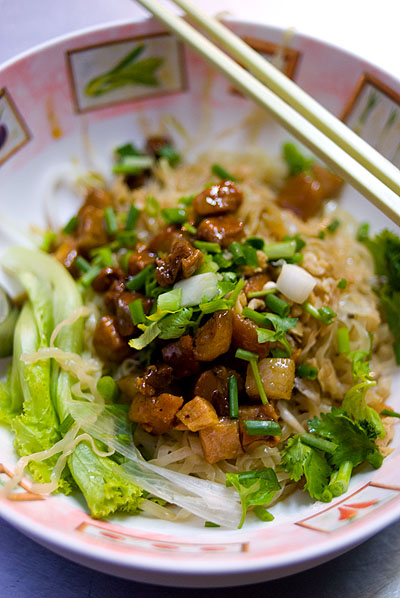
Ever find yourself in a rut? There's so much good stuff to eat in Bangkok's Chinatown, but somehow I always find myself going to the same places. Thus with the intention of trying something new, I stopped by Choy Tii, a shophouse noodle joint on Thanon Plaeng Naam in the heart of Bangkok's Chinatown. What initially drew me in was the shop's sign (above), which advertised phat mee hong kong, Hong Kong-style fried noodles. Unfortunately Choy Tii was out of the thin, pale wheat noodles used to make this dish and I was asked if I'd rather have mee haeng, 'dry noodles'. I agreed, reluctantly, and received this:

The noodles, the flat kind known as bamii, were par-boiled along with a few leaves of lettuce, and the whole lot was topped with cubes of fatty muu waan, 'sweet pork', and generous lashings of thick dark Chinese-style vinegar. The dish was meaty, oily and sour, and I thought it was one of the best bowls of noodles I've had in a long while. I ate every last bit.

Looking at the sign again it appeared that yen taa fo was Choy Tii's signature dish, so I decided to try a bowl. I was highly disappointed: the soggy noodles, tasteless factory-like fishballs and weak broth were particularly disappointing, especially after the wonderful yet simple bowl I had just eaten. It was almost enough to make me order another mee haeng.

Choy Tii (Google Maps link)
59 Th Plaeng Naam
02 222 6087
Lunch & dinner

Poj Spa Kar

_DSC9452

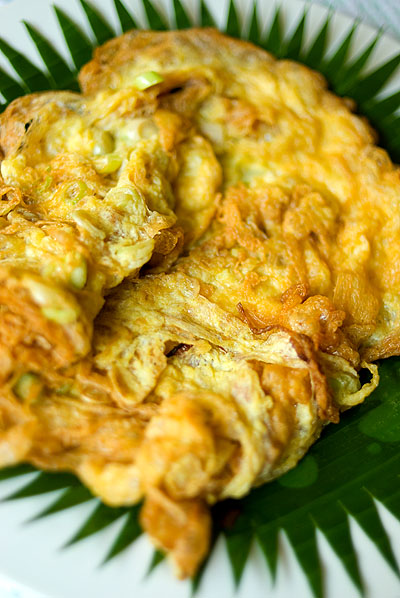
This restaurant, pronounced phot saphaa khaan, is famous for its cook, who is the relative of a former cook in the royal palace. The restaurant, which has been located in the same place since 1925, claims to follow these royal recipes, and serves excellent old-school faves such as mee krawp (sweet/sour crispy noodles) and kaeng liang (a thick soup combining shrimp and vegetables). I particularly like the more unusual dishes such as a delicious salad of fresh herbs and grilled pork, and the deceptively simple but delicious omelet with lemongrass (pictured above).

Poj Spa Kar (Google Maps link)
443 Th Tanao
02 222 2686
10:30am-2:30pm, 5:30-9pm Mon-Fri; 11am-9:30pm Sat-Sun

Media roundup

Untitled-1

It's been a busy holiday season:

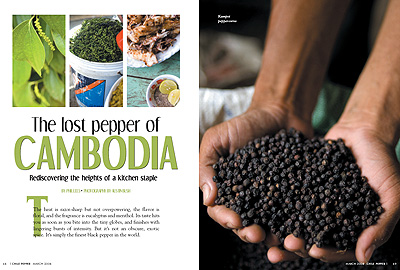
Phil, of The Last Appetite, and I did a piece about Cambodia's pepper (above) that is in the current issue of Chile Pepper.

I took the photos for a piece about dining in Bangkok in last month's Olive.

I believe I have a piece about phat thai in the current issue of Intermezzo.

Here's an interview (in French), with friend and photographer Eric Valli about our experience photographing bird nest gatherers in southern Thailand one year ago. His photos, including one that I took, were in a recent Paris Match.

And lastly, RealThai was mentioned in a recent New York Times piece on food in Bangkok.

Sor Raad Naa

_DSC3470

You'd think you could get fried rice just about anywhere in Bangkok. But Cherry insisted we needed to go to Thanon Thaa Din Daeng, across the river in Thonburi. Cherry has taken me to some good places on this street before, so I had no reason to object.

What makes Sor Raad Naa's fried rice worth the journey is that owner fries the rice old-school style in a wide flat wok over very, very hot coals. Occasionally he tilts the wok to impart everything with a smoky flavour:

_DSC3449

If the coals aren't hot enough, he flips a switch that turns on a high powered fan. He does two types of fried rice, one with tomato (pictured above) and another with Chinese kale:

_DSC3481

The tomato version was slightly sour, and I imagine that the kale version would taste slightly bitter from the greens. Both are topped with pork that has been marinated and cooked ahead of time.

As the name suggests, the shop was originally known for its raad naa, noodles fried in a thick gravy. They also do the fried noodle dish, phat sii iw, but it seemed that most people, like us, came for the fried rice.

Other places on the same street that Cherry has taken me to include the famous satay place and Chua Jiab Nugan.

Sor Laad Naa (Google Maps link)
Soi 13, Th Thaa Din Daeng
Lunch & dinner

Sanguan Sri

_DSC9769

This restaurant (pronounced sa ngoo an see), resembling a concrete bunker filled with office furniture circa 1973, has been a longtime favourite of the the lower Sukhumvit professional set. The kitchen specializes in central and southern Thai fare, with an emphasis on sweet-savoury dishes and curries.

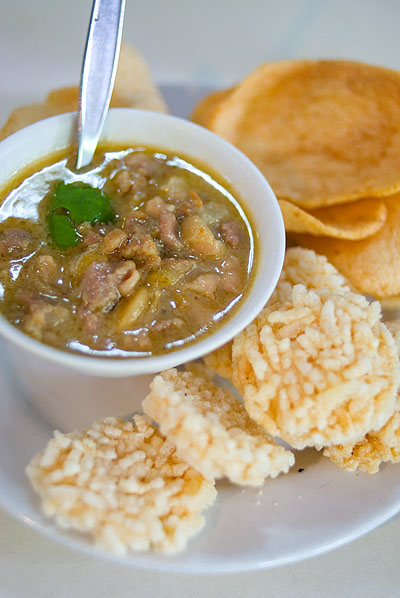
On a recent visit, friends Liz and Dan and I ordered khaao tang naa tang (pictured above), crispy rice cakes served with a sweet-savoury coconut milk, herb and ground pork topping. On previous visits I have had a good kaeng phet pet yaang, red curry with grilled duck breast served over khanom jeen noodles, and an interesting salad containing dried fish:

_DSC9784

I've eaten here quite a few times recently, and have enjoyed each meal. This is in contrast to David Thompson, who told me he didn't enjoy his latest visit. I urge those of you in Bangkok to stop by and let us know what you thought.

To find Sanguan Sri, enter Thanon Withayu and look for a gray, featureless building that you'll inevitably walk past without noticing.

Sanguan Sri (Google Maps link)
59/1 Th Withayu
02 252 7637
Mon-Sat, 10am-2pm

Maan Mueng/Yaa Maeng Wai

_DSC2541

I've mentioned this northern Thai restaurant suburban Bangkok previously, but after a recent meal, and now that I'm mapping restaurants, feel compelled to mention it again.

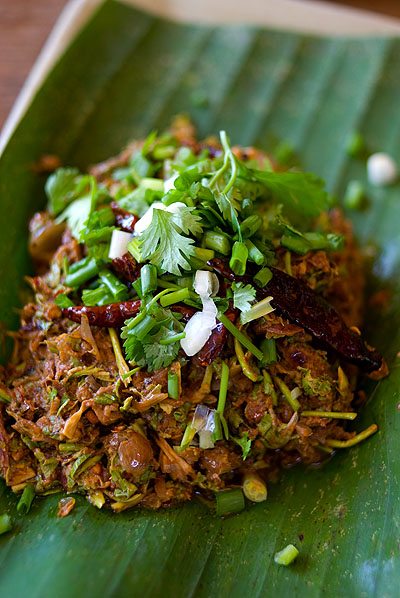
Perhaps I wasn't so decisive about this before, but after my third visit, I'd say that this place serves the best northern Thai food I've eaten outside of the region. In fact, I'd wager that Maan Mueng puts out better northern Thai nosh than many restaurants in Chiang Mai! If you come during the day, the selection if huge, and you can just point to whatever looks good from the pots out front. It's probably one of the only places in Bangkok where you can get seasonal dishes, such as the dish pictured above. It's called yam phak hueat, and is made from sour-tasting leaf (phak hueat) that is minced and par-boiled before being mixed with a curry paste and some other herbs and seasonings. It may not look (or sound?) that pleasant, but was delicious.

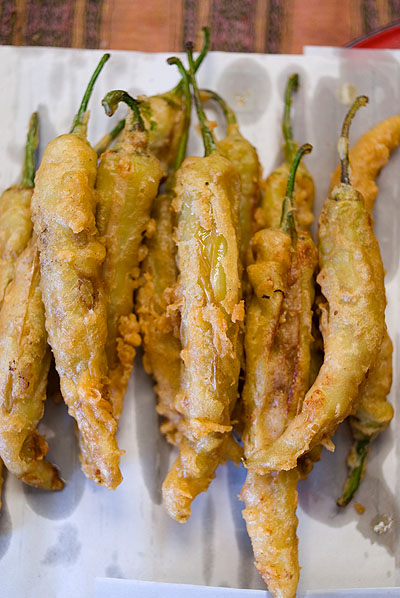
Another fun dish was something of a northern Thai tempura; big green chilies stuffed with a delicious minced pork mixture, then battered and deep-fried:

_DSC2549

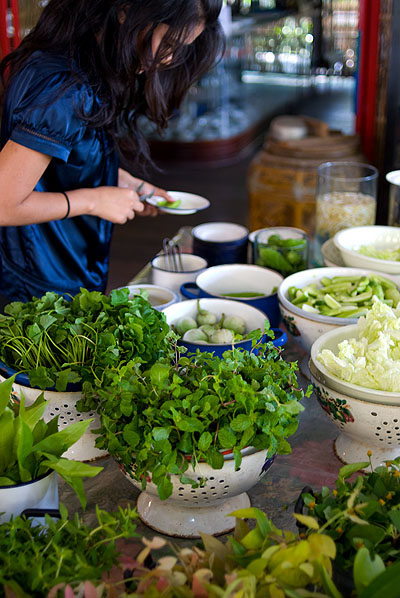
But perhaps the coolest thing about Maan Mueng is the greens; there's a vast table topped with bowls containing different veggies, leaves and herbs, many of which most Bangkok Thais wouldn't even recognize:

_DSC2525

A waitress warned me that one herb I chose would make my mouth numb. She was right.

Maan Mueng, which is also known as Yaa Maeng Wai, and which is now open evenings, recently moved a bit further up Ramkhamhaeng, and is now truly outside of the city, but is definitely worth a visit.

Maan Mueng/Yaa Maeng Wai (Google Maps link)
Ramkhamhaeng 162
8am-10pm (closed Tuesday)
081 913 3413/081 771 1708

Samut Songkhram's morning market

_DSC2246

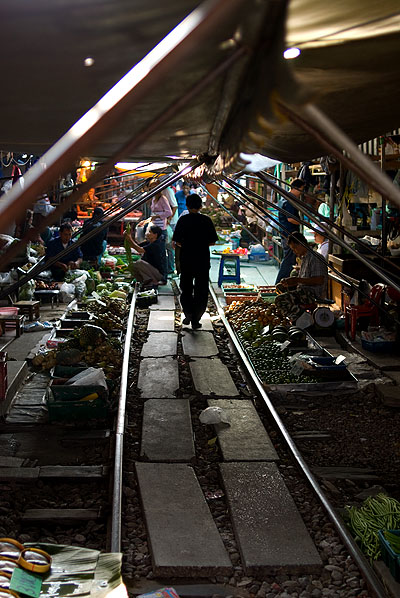
Samut Songkhram, a small town south of Bangkok, has one of the most interesting fresh markets in the country. As illustrated above, a significant part of the market is located directly on the city's railroad tracks. When the train runs through, as it does several times each day, everybody picks up and moves to allow it to pass, then immediately gets back down to important task of vending. The aesthetics of the situation, not to mention the excellent food, led to some interesting images, some of which can be seen here.

Update: Reader cranrob sent a link to a hilarious YouTube video (not mine) of the train running through the market: