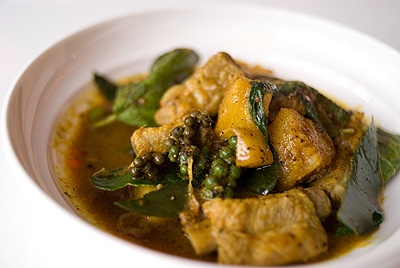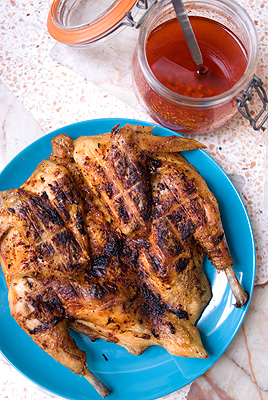
Muslim Restaurant

_DSC3811.jpg

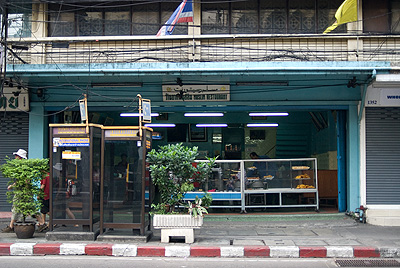
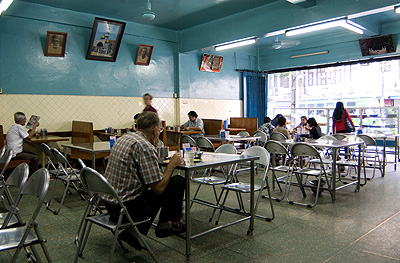
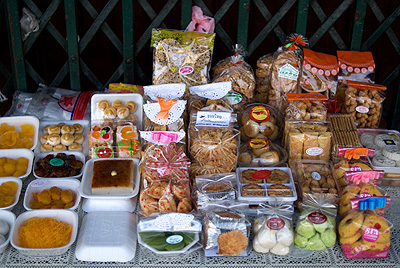
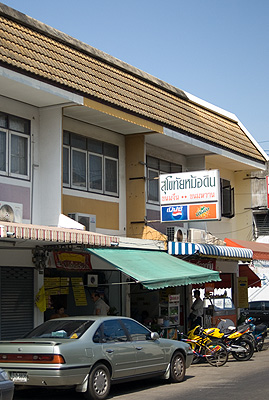
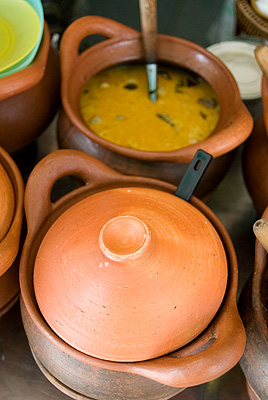
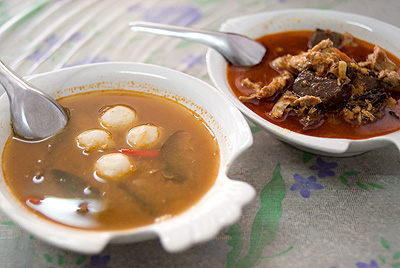
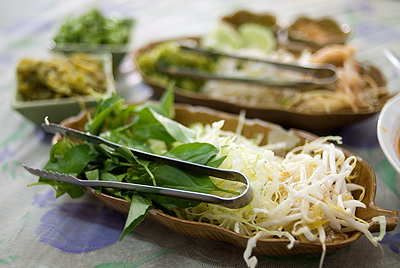
This is the creative name of a very longstanding restaurant in the Silom area. Apparently they've been making briyani and other Muslim dishes in this same location for 60 or 70 years, and was among the first restaurant of its kind in Bangkok. The thing I like about it (other than the food, which I'll get to in a moment) is that it appears that very little has changed about the restaurant throughout this time:

_DSC3823.jpg

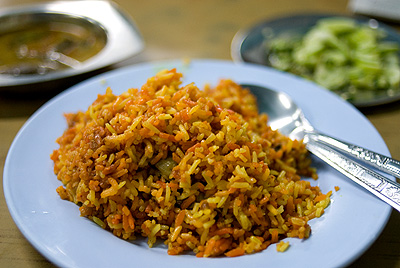
In particular, the wooden booths are a feature that one sees only amongst the elite few of Bangkok's crustiest restaurants. However most people come here to eat, not critique the interior design, and most of them come to eat the khao mok, biryani. They do several kinds here, which is a great chance to avoid the ubiquitous chicken. I choose khao mok phae, goat biryani:

_DSC3819.jpg

As the orange colour illustrates, it's really quite unlike any other khao mok you'll get in Bangkok. I find it similar to biryanis I have eaten in Yangon, Myanmar, and imagine it's similar to what you would get in India. The goat was in the from of a huge joint that offered little meat, but was tender and tasty. Personally, I could go without the meat and simply eat the delicious rice with the complimentary sides of sour eggplant curry, and ajaat, a sweet/sour cucumber, syrup and chili sauce.

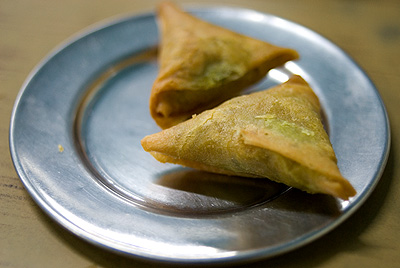
Feeling only 84% full, I ordered two samosas:

_DSC3820.jpg

Greasy, but tasty, and will leave the taste of cumin in your mouth for a good half hour. The glass case where these came from also holds various curries and Indian-style sweets:

_DSC3826.jpg

I've eaten other dishes here, including the shrimp biryani and the oxtail soup, and can vouch for their goodness. Here's what the Nation has to say about the restaurant. I say it's definitely worth a visit, both for the fun old-world atmosphere and the good eats.

Muslim Restaurant
1354-56 Charoen Krung
(near corner of Silom Road)
02 234 1876

A fun food day

_DSC3791.jpg

It's been just on a year since I started RealThai. I'm spending more time on it than ever, it finally more or less looks the way I want it to, my photo editing skills are improving (just take a look at some of the early images!), and as a result, more and more people are reading it. Occasionally I'll even get an email from a reader who happens to be passing through Bangkok, asking to meet up. Such was the case with Maia, a food addict living in Paris. She had asked if I was willing to meet, and deliberately playing on my weaknesses, had promised a grab bag of food-related goodies from Paris. How could I say no?

We at Hua Lamphong and began our day with a bowl of kuaytiaow khae consumed in the medieval-like bowels of Chinatown's talaat mai:

_DSC3793.jpg

After a bit more wandering, Maia bought three bags of tofu skin, as one does in Chinatown, and we proceeded to Thanon Tanao. Stopping in at a cafe we met this monk, who wished us lives of 130 years, and who was exceedingly proud of the Japanese clock he purchased for 300 baht:

_DSC3795.jpg

Maia, a self-confessed "weirdo magnet", was loving it. The monk, who originally came from Lopburi, had been a monk at nearby Wat Bowonniwet for an astounding 49 years!

At lunchtime I had an appointment with with another fellow blogger and RealThai fan, Göran Lager. Göran, a food historian, is the author of several books in his native Sweden, and also does stories for a food program on Swedish radio called Meny ("Menu"). Upon discovering my blog a few weeks ago he was surprised to find that I used to live in his hometown, Sollentuna, and decided to interview me about Thai food:

_DSC3800.jpg

In flipping through RealThai, Göran and his wife (who is Thai) noticed my obsession with som tam, and we knocked back a couple while he asked me, in Swedish, about the dish. Now, I'll admit that I used to speak Swedish somewhat well, but that was back in 1998. In the decade since then I've spoken a total of about 14 words of Swedish, and the "interview" that resulted that day was a garbled mash of substandard svenska, equally bizarre English and, oddly enough, somewhat accurate Thai. Thankfully, Göran appears to be a professional and can edit out the bad bits, although I imagine he's unable to do anything about my American accent. In an effort to capture the entire som tam "experience" he even recorded the sounds of the som tam being made:

_DSC3804.jpg

My guess is that this sound was somewhat more interesting than my interview.

So, if you're a fan of RealThai and happen to conduct a food-related program on your country's national radio, or are willing to bring gifts of exotic treats, by all means, do drop us a line.

Pak Tai 41

DSC_9240.jpg

Welcome to southern Thai food heaven. As the image above was meant to suggest, this restaurant in northern Bangkok is serious about southern curries. Walk in any day before lunch and you can choose from at least 30 different curries, fried dishes and soups. And most of them are pretty good. I think it's a "famous" restaurant, as I've seen it mentioned in a magazine. But the most important thing is that it's close to my house, so I've eaten here many, many times. We've always got to order kaeng lueang:

_DSC3775.jpg

This is the southern version of kaeng som, and is bright yellow with turmeric and shockingly spicy. This one was loaded with or, the pithy interior of the taro stalk, as well as huge chunks of fish. I harbour suspicions that they might season this dish to please Bangkok eaters, as it's usually pretty sweet. Scandalous.

One of my favourite things about this place is that, in true southern style, you get a vast tray of fresh herbs and veggies regardless of what you order:

_DSC3780.jpg

And there's also herbs in the curries, such as the kaeng hoy sai bai chaphluu, a coconut milk curry with shellfish and wild tea leaf:

_DSC3777.jpg

This being southern food the seafood didn't stop there. There was an excellent plaa thod khamin, fish deep-fried in turmeric:

_DSC3782.jpg

(a dish for which I have previously described the recipe here), and a yummy hor mok plaa:

_DSC3783.jpg

This is a lunchtime joint; if you are unfortunate enough to arrive in the evening the selection of curries is none too impressive.

Pak Tai 41
Lad Phrao Soi 41
(near the Wat Lad Phrao intersection)
02 931 7887

Technorati technorati tags: , , ,

Paa Uap

_DSC3702.jpg

What a great find. This month-old restaurant, located just a few kilos from my house, specializes in fish from the Mekong River and other specialties of Nong Khai province in northeast Thailand. There are actually a few restaurants around here that do this sort of food, but I was really blown away by Paa Uap. For starters, the proprietors are natives of Nong Khai, and import their fish directly from the province, packed in ice and on the overnight bus:

_DSC3687.jpg

The big yellow fish on the top is plaa khae, so called, I was told, because it resembles a crocodile (khae is apparently the Nong Khai dialect word for charakhe, crocodile). The ones below are called plaa phoh, and are apparently quite hard to catch and are thus quite expensive. These, and any other fish they might have, can be grilled, made into tom yam, deep-fried, or just about anything you'd like. If you're not sure what to order, and can read Thai, the restaurant's menu even contains detailed information about the various fish they have:

_DSC3689.jpg

including when they're available, how they taste and where they're found. Other than Mekong River fish they also serve naem nueang, the Vietnamese do-it-yourself dish often associated with Nong Khai, as well as several dishes featuring "jungle" animals such as deer.

However, this being isaan food, we started with the ubiquitous som tam plaa raa, Lao-style papaya salad (pictured at the beginning of this post). I think this has got to be one of the best I've had in Bangkok. The dish was exceedingly sour and garlicky, and featured a strong but not overwhelming essence of plaa raa as well as hearty chunks of slightly bruised papaya. In short, very Lao. We ended up eating two dishes.

This was followed by laap plaa jok:

_DSC3696.jpg

Plaa jok being another kind of Mekong River fish. Unfortunately this laap was so strong on the lime that there was really no chance to see what the fish tasted like. It was still very yummy though.

And finally there was hor mok plaa ling:

_DSC3711.jpg

In Thai Food David Thompson likens hor mok to a steamed curry, which is accurate when describing Thai food, but northeast Thai/Lao-style hor mok is a bit different. Less (or no) coconut cream is used here, and the flavours here are really subtle, in this case a combination of dill, a tiny bit of chilies, tender greens and bai yaanang, a bitter leaf often used in hor mok. The fish was very fresh, and took the form of meaty strips, as well as part of the head. The taste and smell was so authentic that I nearly had to remind myself that I wasn't sitting by the side of the Mekong in Nong Khai (or Vientiane, Laos, for that matter!).

All this was taken with freshly steamed sticky rice. Have you ever eaten freshly steamed sticky rice? If you have, then you'll know why I put it in italics!

If you're thinking of visiting, I'd recommend coming in the evening, as when we were there for lunch we were the only diners and the staff weren't quite ready.

Paa Uap
Sukhonthasawat Road
02 907 9228

Technorati technorati tags: , , , , ,

Culinary Concepts

DSC_4295 copy.jpg

The article below was written by friend and journalist Hal Lipper, and ran in last Sunday's The Nation. I was along with Hal, David and Phi Tong and took the pics that accompanied the article.

This is how David Thompson does it. The world's only Michelin-star chef specialising in Thai cuisine spends days with grey-haired grannies in the kitchen, watching them pound pastes and stir curries.

He takes copious notes while they cook and when sampling their food, and then later recreates and enhances their traditional dishes in Nahm, his restaurant in the Halkin Hotel in London.

Thompson, who currently is in Thailand to supervise photography for his book on Thai street food, took The Nation on a road trip to Sing Buri to search for some of the region’s best fare.

In 36 hours, we ate nearly two dozen Central Plains dishes – ranging from curries to grilled snakehead fish to stir-fried frog, wild boar and cobra – and made a 4am foray to Sing Buri’s sprawling wholesale market.

DSC_4489 copy.jpg
Singburi's morning market.

“The food in the central plains is more rustic, more fully flavoured and sweeter than Bangkok,” noted Thompson, whose first cookbook “Thai Food” culled forgotten recipes from funerary texts that had been written to commemorate exemplary chefs.

We sampled the cobra, wild boar and frog at the Look Thung restaurant – which shares its name with the country-music style. It’s an open-air affair on a dusty road just outside the provincial capital of Ang Thong. It had been recommended by a friend of chef Tanongsak “Dtong” Yordwai, Thompson’s partner of two decades. The reptiles and amphibians are chopped and dried before being stir-fried with a chilli paste, and are primarily drinking foods – good with beer or rice whisky, but not worth the three-hour drive from Bangkok.

DSC_4533 copy.jpg
A stir fry of cobra, Look Thung Restaurant, Ang Thong.

Sing Buri is known for its snakehead fish, which Thompson feels is the finest in Thailand. Among the best restaurants to sample this huge, primal-looking fish is Mae Laa Paa Pao (Mae La Grilled Snakefish) just outside Sing Buri on Route 1.

The snakeheads here are grilled over coconut husks until their skin is black and crispy and can be peeled off to reveal the toothsome, naturally oily flesh. The smoky aroma and delicate flavour are astounding.

DSC_4319 copy.jpg
Poo lon, a dish of crab and pork simmered in coconut cream and herbs, Sum Phai Restaurant, Singburi.

We sampled a half dozen other dishes, but none compared with the grilled snakehead.

The highlight of the trip was Sum Phai (Bamboo Grove) Restaurant, a rustic, al fresco eatery set at the end of an irrigation canal about 10 kilometres past Ampur Muang in Sing Buri’s Hua Paa district. (The restaurant, closed by the recent floods, will reopen after January 1.)

Sum Phai was a remarkable find. Its chefs – three related by blood, the fourth related by marriage – together have nearly two centuries’ culinary experience. The eldest chef’s mother and grandmother were cooks, and their recipes are from the days of King Rama V, who used to visit Sing Buri, celebrated for its superb produce, fish and local cuisine.

DSC_4362 copy.jpg
Deep frying semi-dried snakehead fish, Sum Phai restaurant, Singburi.

All dishes at Sum Phai are cooked using local ingredients, including herbs and chillies plucked from a garden that grows beside the kitchen. The women here pride themselves on their frog salad and frog jungle curry. But amphibians were in short order that day, so they instead made plaa raa sap, fermented fish minced with fresh herbs.

Also on the menu: kaeng bon, a thick curry made from grilled fish, coconut milk and tamarind, kaeng khee lek, a coconut cream-based curry made with fish, a lemongrass salad with cashews, deep-fried snakehead fish, poo lon, a dish of crab and pork simmered in coconut cream, a stir-fry of morning glory and shrimp, and luk tan, the fruit of the palm-sugar tree, for dessert.

Thompson positioned himself on a stool in the corner of the kitchen and took copious notes. Dtong helped the chefs prepare collect the ingredients.

DSC_4263 copy.jpg
David Thompson grinding a curry paste, Sum Phai Restaurant, Singburi.

The people of the central plains generally use fresh, indigenous ingredients rather than frozen foods from other provinces. “Food here is prepared and cooked in context with local society. It’s cooked with great care,” Thompson noted.

Two hours later, just before plating, Thompson and Dtong were shooed to the dining area, which is shaded with palm fronds and flowering vines.

DSC_4407 copy.jpg
Tanongsak “Dtong” Yordwai, David Thompson and Hal Lipper enjoy a meal at Sum Phai Restaurant, Singburi.

The dishes rolled from the kitchen. The kaeng bon was rich with taro and the bitter-sour leaves in the kaeng kee lek were a nice counterpoint to the sweet coconut cream, tamarind and savoury grilled beef.

Thompson was ecstatic. “You rarely get raw fish dips or taro shoot dishes in Bangkok,” he noted.

The lemongrass salad was made with fresh shrimp rather than dried prawns. Thompson liked it so much that he said he would cook a variation with squid and roasted coconut for William Paterson, Australia’s ambassador to Thailand, at a dinner for 30 the next week.

DSC_4399 copy.jpg
A "yam" or salad of thinly-sliced lemongrass and deep-fried dried prawns, Sum Phai restaurant, Singburi.

“In the countryside, you find better, fresher ingredients, and more authentic flavour,” Thompson noted. “The techniques may not be as refined as in Bangkok, but the results are often superior.”

Hal Lipper

The Nation

Technorati technorati tags: , , , ,

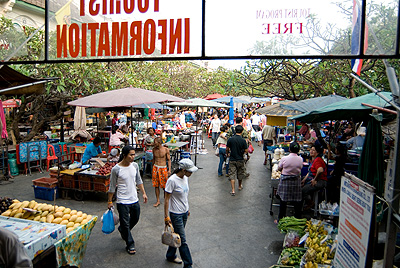
Tha Chang Market

_DSC3571.jpg

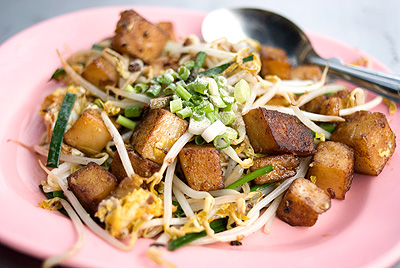
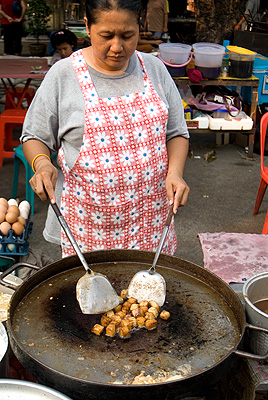
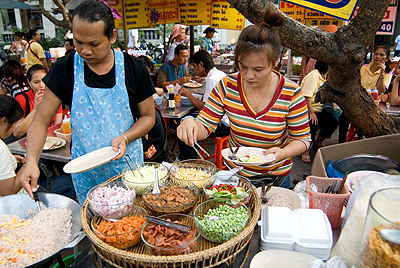
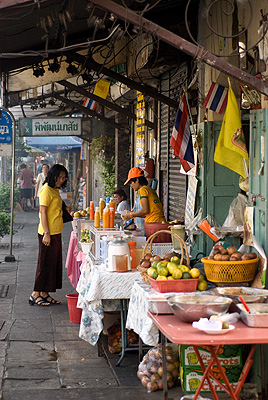
Every evening at about 5, a small market unfolds at Tha Chaang, the boat pier just across from Wat Phra Kaew. I happened to be in the area, and just happened to be hungry, and so began with a dish called, if I remember correctly, khanom phak kaat:

_DSC3584.jpg

This translates as "cabbage snack", and since this dish has no cabbage, leads me to believe I might have misunderstood the name! It's basically fried cubes of dough (probably from rice or tapioca flour):

_DSC3580.jpg

and is very similar, athough not as good a dish I had in Penang called char kway kak. That dish had a wonderfully smoky wok hei; this was more like well, fried bits of bland dough.

It's not a huge market, but you'll find all kind of prepared food such as noodles:

_DSC3578.jpg

fruit:

_DSC3594.jpg

khanom jeen:

_DSC3592.jpg

as well as raw ingredients, such as overpriced fruit:

_DSC3573.jpg

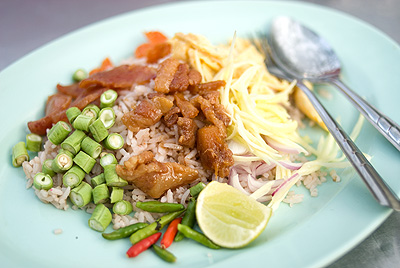
Seeing all this made me hungry so I had a plate of khao khluk kapi:

_DSC3590.jpg

This is rice that has been cooked with kapi, shrimp paste, which is then supplemented with several different toppings:

_DSC3575.jpg

including sliced shallots, sliced green beans, shredded green mango, sliced omelet, Chinese sausage, "sweet" pork and fresh chilies. Squeeze a lime over it and you have one of Thailand's best dishes.

Technorati technorati tags: , , , , ,

Thip Pramong

_DSC3552.jpg

Thip pramong means something like "heavenly fishing" and is the name one of several seafood restaurants in the Khao Saam Muk area of Chonburi, about an hour east of Bangkok. Friends of ours, Nat and Pao:

_DSC3527.jpg

had been there recently and liked it. So they invited us to go back on Friday.

We began with clams stir-fried with bai horaphaa, Thai basil:

_DSC3537.jpg

Mighty good, and some mighty meaty clams. This was followed by plaa meuk neung manao, squid "steamed" with lime:

_DSC3532.jpg

which, as you can see is not really "steamed" but simmered in a sour, sweet and spicy broth.

When eating Thai seafood, you must order khao phat puu, fried rice with crab:

_DSC3538.jpg

Despite being such a boring dish, I really love this one and have to have it every time. They did a good one here, with huge chunks of crab and egg. A squeeze of lime and some phrik naam plaa (sliced chilies in fish sauce), and I'm happy.

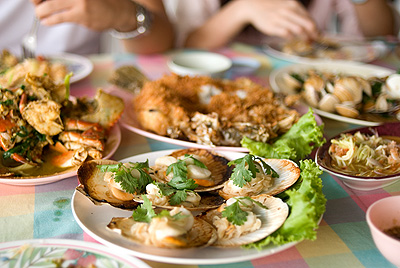
There were also grilled scallops:

_DSC3550.jpg

which were VERY well done, but it didn't really matter, as the extremely spicy/sour dipping sauce they came with masked any scallop flavour. Made with a bit more care was deep-fried grouper with a mango-based sour dressing:

_DSC3543.jpg

It's a bit hard to tell by the pic, but the entire fish has been butterfly-cut, splayed open, battered and deep-fried. The mango dressing is served on the side.

However the Dish of the Day, at least for me and Nat, was puu phat phong karii, crab fried in curry powder:

_DSC3545.jpg

Two fat, meaty crabs fried with onions, scallions and a rich sauce made from curry powder. Here's Nat enjoying:

_DSC3551.jpg

During dinner Pao asked me if this kind of food was expensive in the US. I told her it was, and that very few people could afford to eat like this, but couldn't really give her an accurate estimate. Any ideas? Our meal came to just short of 2,000 baht (about $50), which is rather expensive by Thai standards. Regardless, everything was good, and the seafood was truly fresh, as evidenced by the nearby pier where it was unloaded from boats and taken directly to the restaurants:

_DSC3557.jpg

While we were eating a boat arrived and some truly frightening looking horseshoe crabs and several buckets of fish were brought it.

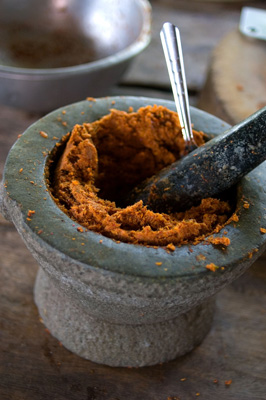
As an added bonus, along the way back from Khao Saam Muk there are several roadside shops selling granite mortar and pestle sets. After some careful inspection, Nat and Pao picked one up for their new house:

_DSC3564.jpg

Thip Pramong
Khao Saam Muk, Chonburi

Technorati technorati tags: , , ,

Ratchawat Market

_DSC3469.jpg

Ratchawat Market is located in a secluded corner of the Dusit area of Bangkok, not far from the royal palace. I had read about it in The Nation, which described it as a good food destination, and I decided to pay a visit. The market itself is rather dark and unattractive:

_DSC3449.jpg

although there were some friendly ladies selling sweets by the entrance:

_DSC3514.jpg

Much more interesting things can be found along Thanon Nakhorn Chaisii, the main road leading to the market. Here you'll find heaps of vendors selling fresh produce, such as these bitter gourds:

_DSC3504.jpg

and jackfruit:

_DSC3500.jpg

as well as prepared foods, such as grilled meat:

_DSC3509.jpg

curries to be eaten with khanom jeen, fermented rice noodles:

_DSC3519.jpg

muu khua kling, a southern Thai dish of pork "dry" fried with curry paste, served here with mad amounts of green peppercorns and kaffir lime leaf:

_DSC3445.jpg

chao kuay, "grass jelly", a kind of dessert:

_DSC3471.jpg

grilled and deep-fried fish:

_DSC3516.jpg

including plaa som:

_DSC3517.jpg

This is fish that has been stuffed with rice and basically left to rot. After a few days the fish obtains a wonderful sour taste. It is then typically deep-fried and served with sliced shallots, chilies and a squeeze of lime. Delish.

Ratchawat Market is near the imposing Excise Department, which means lots of hungry people at lunch time. The numerous small restaurants serving these people turned out to be the strength of this particular market area, and there were some interesting options. I started with a dish of phat thai at one of those hole-in-the-wall restaurants that look like they've been serving the same thing for fifty years. Unfortunately I came at a bad time, and they were in the middle of frying up a massive take-away order of phat thai:

_DSC3480.jpg

I waited patiently, and finally got my dish from somewhere in the belly of that beastly pile of noodles:

_DSC3487.jpg

Not surprisingly, it was mediocre. Much better was kwaytiao lawt from this streetside stall:

_DSC3522.jpg

Kwaytiao lawt refers to the wide rice noodles used in this dish, which are topped with, among other things, Chinese pork sausage, tofu, barbecued pork and a sweetish soy sauce:

_DSC3523.jpg

Really, really good. And continuing on the noodle theme I finished with yen ta fo, the one noodle dish that people in Bangkok can't seem to get enough of:

_DSC3494.jpg

Those familiar with this ubiquitous dish might notice that something looks a bit different here. I think this was more of an old-school yen ta fo, and went light on the various fishballs and heavy on the more unusual pickled squid (!) and pickled jellyfish (!!). The broth was great, but there were a lot of strange bits and bobs left in my bowl...

So, I encourage a visit here, but don't feel bad if you give the actual market a miss. Come just before lunchtime, when the nosh is ready, but the hordes of hungry government employees have yet to arrive, and try something new.

Technorati technorati tags: , , , ,

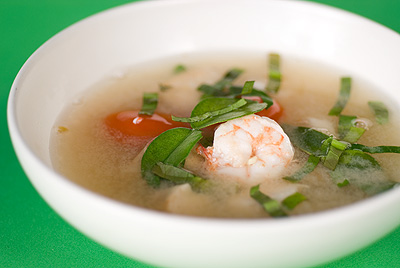
How To Make: Tom Yam Kung

_DSC3425.jpg

Tami over at running with tweezers has initiated the first annual Souper Challenge Blog Event, a thinly-veiled threat for all of us foodbloggers to make soup. I don't really need an excuse to do this, as we eat soup nearly every day in Thailand, and I've decided to take part by doing tom yam, the famous sour-spicy soup.

Now, I know what you're thinking: Austin, there are about 80 million recipes for tom yam on the Internet [actually there are 179,000], why do we need another one? It's true, but if you ask me, I don't think any of them come close to describing the best way to make this dish. Most tom yam recipes demand that you follow their instructions regarding the specific amounts of the flavouring ingredients to add. In reality, Thai people make tom yam by feel, adding ingredients and tasting continuously until they reach a flavour they like. You'll probably never see a measuring spoon in a Thai kitchen, but you will see lots of spoons for tasting the broth!

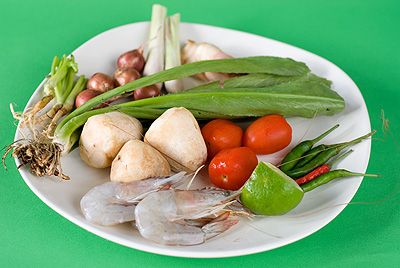
Today we're going to make make tom yam kung, tom yam with shrimp. I'm choosing this kind because it's probably the most famous kind of tom yam, and I want to share the method of making a really nice broth. To make tom yam for two people, here's what you'll need:

_DSC3391.jpg

Fresh shrimp (shells and all, not just shrimp meat) 10 or so depending on size
Water, approximately 4 cups
Galangal, a thumb-sized piece, peeled and chopped into big disks
Lemongrass, 3-4 stalks, outer layer removed and bruised
Shallots, 6, peeled
Coriander (cilantro) roots, 4, cleaned well
Fish sauce, to taste
Sugar (if desired), to taste
Straw mushrooms (het faang), 6
Cherry tomatoes, 4
Sawtooth coriander (phak chee farang), 6 leaves
Chilies, to taste
Limes, 2-3, depending on how sour you like your food
Kaffir lime leaves, three, halved

Wash the shrimp well and behead and peel them, reserving the shells and heads. Devein shrimp, butterfly (if desired) and set aside in the fridge. Bring water to a boil in a medium saucepan and add shrimp shells and heads. When water reaches a boil again, stir and push on the shrimp shells to extract as much shrimpy goodness as possible.

_DSC3398.jpg

Reduce heat slightly and let simmer for about five minutes. Strain and discard shrimp shells, reserving water.

In the same saucepan, bring shrimp broth to the boil again and add galangal, lemongrass, shallots and coriander roots. Allow to reach a slight boil and reduce heat to a simmer. Add a few drops of good-quality Thai fish sauce and taste. Add more fish sauce until the broth tastes just slightly salty, no more. If you like sugar (as many Thais d0) do the same thing with your sugar at this point, and taste.

While the broth is simmering, prepare your mise en place. Halve your cherry tomatoes, slice your limes, thinly slice your sawtooth coriander:

_DSC3405.jpg

quarter your mushrooms:

_DSC3406.jpg

and roughly chop your chilies, grinding and smashing them with the side of a knife when done:

_DSC3407.jpg

After about 3-4 minutes, when your broth is fragrant, add prawns, mushrooms and tomatoes:

_DSC3416.jpg

After another 2-3 minutes, when mushrooms are slightly soft and prawns done, squeeze in your lime juice and add your lime leaves:

_DSC3419.jpg

Again, taste to see how sour it is (this soup should be sour followed by salty, but go for a taste that you like). Add more fish sauce (or sugar) if necessary, tasting all the while, and add your chilies and sawtooth coriander. Stir to combine and remove from heat. You're done.

Technorati technorati tags: , , ,

Baan Chok Man

_DSC3360.jpg

Been meaning to do this one for ages. Baan Chok Man is just about the closest restaurant to my house here in northern Bangkok. Coincidentally enough, it also happens to be one of my favourite restaurants in Bangkok. Before you get too excited, let me make it clear that the food at Baan Chok Man is not particularly exciting. Nor is it innovative or clever. It's simply good, solid, consistent Thai grub. Very consistent in fact. I've been eating here for more than five years, and throughout that time the dishes are churned out exactly the same each time. I'm starting to think they might have robot in the kitchen or something. This is the first place I take my friends and relatives when they visit Thailand, and they invariably love it.

Baan Chok Man is a garden restaurant:

_DSC3379.jpg

and part of the pleasure here lies in sitting under the trees on a cool evening. Unfortunately we arrived a bit early and to avoid the laser-like rays of sun, were forced to sit indoors. Our first dish was tom khrong plaa krob (pictured above). This is more or less a thicker, spicier tom yam. Plaa krob means crispy fish, and refers to the crunchy dried fish that serves as the protein in this dish.

This was followed by sator phat kung, "stinkbeans" fried with shrimp:

_DSC3366.jpg

Somewhat unusually here they mince the shrimp, which actually makes it easier to eat, although slightly less impressive looking.

This was followed by yam kaan kaew, a "salad" of crispy kai lan stalks:

_DSC3365.jpg

The kai lan is mixed with minced shrimp, pork and squid that have been carefully blended with sliced shallots, chilies, fish sauce, lime juice and sugar--a combination that finds its way into many of the restaurant's dishes.

However my favourite dish, and something we have to order every freaking time we eat here, is plaa samlee op samunphrai, "black banded trevally (a kind of fish--trust me here; I saw the English name at Tesco's) baked with herbs":

_DSC3370.jpg

Contrary to the name, there's not a lot of baking (at least in the Western sense) going on here. Honestly, I always wondered how this dish was made, and I think I finally figured it out tonight. First, they take a medium-sized black banded trevally and deep-fry it. While this is bubbling away, they do a quick stir fry that includes minced pork, thinly sliced lemongrass, kaffir lime leaves, garlic, green peppercorns and chilies (the "herbs" in the name of the dish). The fish and stir fry ingredients are combined on a sheet of foil, topped with crispy fried shallots and fresh kraphrao (a kind of Thai basil), wrapped up and "baked" (most probably grilled) until steaming inside. Pure genius.

If you're ever in the Kaset area of northern Bangkok, do stop by.

Baan Chok Man
74/29 Soi Sena 1
02 578 0033

Technorati technorati tags: , , , ,

Nang Loeng Market

_DSC3008.jpg

Nang Loeng Market is located just off of Thanon Nakhorn Sawan in Rattanakosin, old Bangkok. It first opened in 1899, and was in use until several years ago when it was destroyed by a fire. After a few years of construction, the market was recently rebuilt, and probably looks better than ever, but doesn't really seem to have recovered. On the day I visited only about a quarter of the stalls were in use and I wouldn't describe the atmosphere as particularly vibrant. Maybe I came on a bad day? Despite this, there's still some interesting stuff to see (and eat), in particular the old-school snacks and treats that this market is known for.

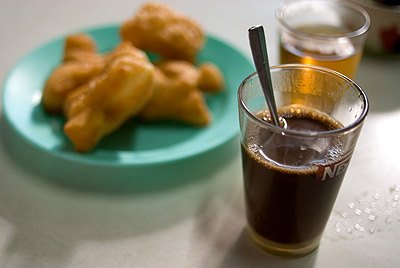
My day began with Thai-style coffee and paa thong ko, Chinese-style doughnuts:

_DSC2980.jpg

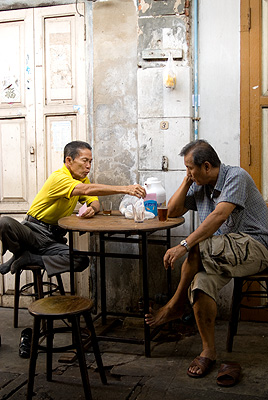
Like other areas in Old Bangkok, Nang Loeng is where you'll find lots of old dudes drinking coffee and chilling:

_DSC2982.jpg

I wandered around the market, passing by grilled sticky rice:

_DSC2962.jpg

a lady making rice porridge:

_DSC2990.jpg

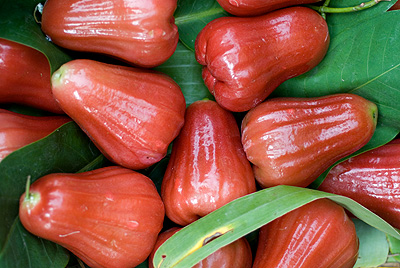
rose apples:

_DSC3005.jpg

a kind of freshly-steamed rice noodle called khanom paak mor:

_DSC2999.jpg

and sugarcane:

_DSC3017.jpg

before happening upon a small alley:

_DSC2943.jpg

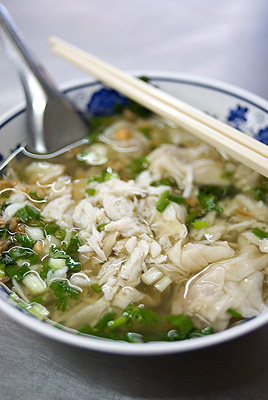
This whole alley is part of a famous noodle shop called Rung Reuang. I ordered a bowl of kiaow naam, wonton soup:

_DSC2995.jpg

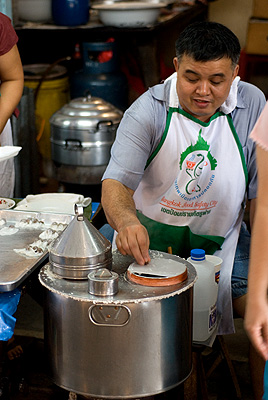
My noodles were made by a shirtless guy of Chinese origin who, according to the literature on the walls, still makes his own noodles. The kiaow were pretty good, mostly because they contained an astonishing amount of crab meat, an ingredient lesser noodle stalls skimp on.

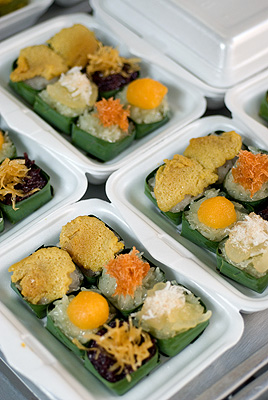
Nang Loeng Market is particularly known for its sweets, such as these sticky rice snacks:

_DSC3004.jpg

a bunch of khanom:

_DSC2988.jpg

and my new favourite, khanom bueang:

_DSC3022.jpg

While I ate my khanom beuang, I sat down to talk to the maker-man:

_DSC3025.jpg

He told me how he is one of the few people making these snacks the old way,

_DSC3028.jpg

employing a batter that comes from thua thong ('golden beans', not sure what they're called in English) and rice, which he makes himself from scratch. The sweet ones (above) are filled with foy thong, sweetened egg yolk, and shredded coconut meat, while the savoury ones (shown in the first pic) are filled with a combination of shrimp, coconut meat, coriander roots and black pepper, all mashed up with a mortar and pestle.

This guy was born and raised in the Nang Loeng area, and told me stories about what it was like growing up there. He also told me where to find a movie theatre that was built in 1918! The theatre, called Chalerm Thani, was among Bangkok's first, and was used up until the 1990's, but today is used as a warehouse.

I thought this was a cool little corner of Bangkok with lots of potential. If more was done to revitalize the area, including perhaps inviting more vendors and touching up the 150 year-old row houses that surround the market, I think this could be a busy, vibrant market.

Technorati technorati tags: , , , , , ,

Tam Som Thai Fire Power

_DSC2914.jpg

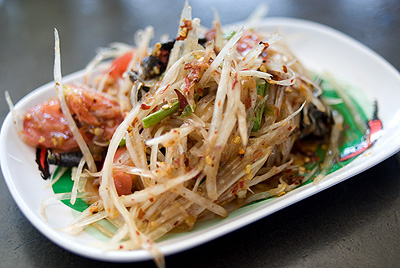
This is the English name of a restaurant chain we ate lunch at recently. The name is a reference to the spiciness of Thai papaya salad (called tam som in some dialects). Obviously you can't go to a place like this and not order som tam (as it's called in the central dialect):

_DSC2920.jpg

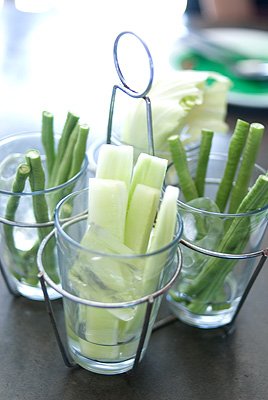
They do a decent one here, although I reckon those with a low tolerance for obscenely spicy food might have a tough time. The som tam was served with the traditional accompaniments of crispy cucumber, lettuce and long beans, but here they put them in on the the containers normally used for noodle condiments:

_DSC2917.jpg

Cute.

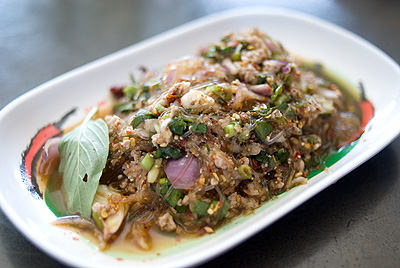
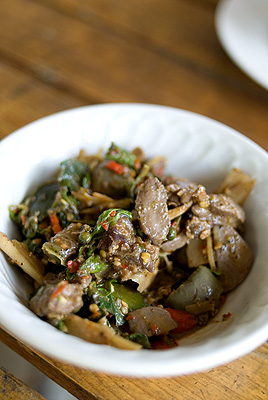
We ordered laap wun sen:

_DSC2919.jpg

which was basically pork laap with the addition of wun sen, glass noodles.

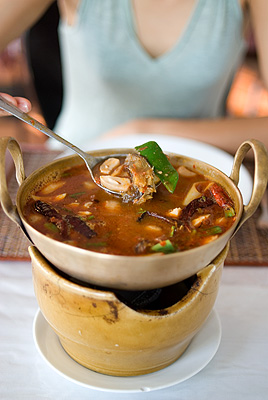
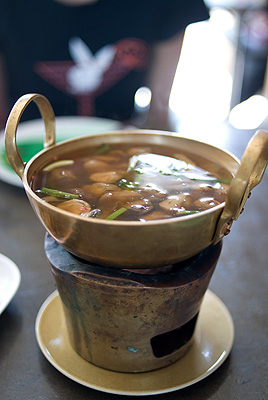
There was tom saep het faang:

_DSC2928.jpg

Tom saep is an isaan version of tom yam, and is usually made with pork ribs. This version probably used the same broth, but had no meat, and instead included het faang, straw mushrooms. Het faang go from good to slimy in a matter of hours, and unfortunately they decided to use the squishy old ones in this soup. Yuck. But that sure is a cute little stove.

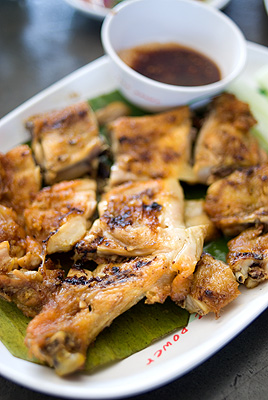
My favourite dish was their kai yaang khamin, grilled chicken with turmeric:

_DSC2930.jpg

This tasted excellent, but the texture was a bit unusual. I have a feeling they deep-fried it, then grilled it, or vice-versa. Oddly enough, "grilled chicken" is sometimes deep-fried in Thailand.

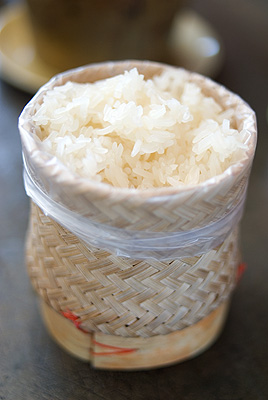
And there was, of course, sticky rice:

_DSC2931.jpg

Cute container, no?

Tam Som Thai Fire Power
Kaset-Navamin Highway (very close to the Ram Inthra Expressway)

Technorati technorati tags: , , , , ,

Baan Chan

I finally made it back. Baan Chan, the subject of today's post, is a restaurant specializing in the cuisine of Chanthaburi, a province in eastern Thailand. I had been to Chanthaburi several years ago, but other than some nice seafood, didn't really notice anything in particular about the food there. Since then I've learned that Chanthaburi is famous for its fruits, is home to Thailand's most famous rice noodles ('sen chan'), and is also known for the famous black pepper that grows in the area as well as over the border in Cambodia. The border area is quite undeveloped, and the province is also known for dishes that include various types of game, such as wild deer, boar and birds. I like Thai boar (which is usually raised), but don't really want to consume wild animals, so on my visit to Baan Chan I stuck with duck. This included kaeng paa pet, 'jungle' curry with duck:

_DSC2899.jpg

If you order kaeng paa elsewhere in Thailand, you'll get a soup. But apparently in Chanthaburi the dish takes the form of something like a thick stir-fry, with crunchy bamboo, heaps of herbs (lemongrass, kaffir lime leaves, basil, chili, peppercorn and a hint of nutmeg), bizarre bits of duck, and unusually, chunks of unripe banana (the unattractive grayish bits you see there). This is the restaurant's signature dish, and a good example of really freaking spicy Thai food done well, meaning that there was actually a variety of spicy flavours present (black pepper, ginger), rather than just the burn of chilies.

I also had khua kling pet:

_DSC2897.jpg

Until this meal, the only khua kling I was familiar with was a southern Thai dish that is typically pork or beef braised in a a curry paste until 'dry'. This dish was actually more or less a lot like a drier, spicers kaeng paa without the veggies. Excellent.

After these two, the green curry with homemade fish balls:

_DSC2903.jpg

seemed like a mild palate cleanser! I thought this was a perfect example of 'real' Thai green curry, which unlike the stuff you'll get in touristy restaurants, tends to be slightly yellow in color, has a hefty layer of oil floating on top, mushy eggplants, and is more watery than most people think a 'curry' should be. I do remember seeing this curry in quite often in Chanthaburi, and recall that is often contained fish, which is somewhat unusual elsewhere in Thailand.

Although I don't think it's particularly associated with Chanthaburi, we can never say no to a good naam phrik kapi:

_DSC2904.jpg

i.e. shrimp paste dip, served with fresh and battered-and-deep-fried veggies.

The last dish was kao lao:

_DSC2905.jpg

It's basically a bowl of noodles--without the noodles. Kind of a pointless dish, if you ask me. The broth was sweet, as is usually the case, and was heavy with ground peanuts. Yuck.

I'll definitely be coming back, as I still haven't tried the sen chan phat puu, rice noodles fried with crab, or the kaeng nuea sai krawaan, beef curry with nutmeg.

Technorati technorati tags: , , ,

Where to eat in BKK

I get quite a few emails from people planning to visit Bangkok asking me to recommend "the best places to eat" or where "the best Thai food" is. I'm honored that people would trust my opinion regarding an issue so profound, and thought the best way to approach this would be in a blog entry.

First of all, it's important to understand that with Thai food it's generally pretty hard to find a great all-around restaurant (although certainly some do exist); you're much more likely to find a place serving a few great dishes. As I've mentioned previously, the most rewarding Thai restaurants specialize in one style of cooking, or perhaps food from one particular region of Thailand. Keeping this in mind, it would be an immense undertaking to recommend individual restaurants. Instead, I'm going to mention the types of dining I think one should take part in when in Bangkok, and a few areas where small restaurants, street stalls and/or vendors are of a higher caliber than elsewhere.

For Thai newbies, I would strongly recommend beginning with a visit to a mall food court. They are clean and cheap, the menus are written in English, you have a wide range of choices, and actually, the food can be pretty good. My favorite food court is probably the one on the sixth floor of Mah Boon Khrong (also known as MBK). You'll find a huge variety of Thai food, everything from noodles to isaan--they even have a stall selling Thai-Muslim food such as khao mok kai. One of my favourite stalls is the one selling vegetarian food. There's generally a foodcourt at every mall, and in particular, upscale foodcourts seem to be springing up everywhere these days (such as the food court at Siam Paragon) but they're generally quite overpriced (by Thai standards) and mostly Chinese (I'm assuming you're looking for Thai food here). One peculiarity about Thai food courts: they don't accept cash. You'll need to find the cleverly hidden counter, where you'll have to stand in line to exchange your cash for coupons, or more recently, a swipe card. Then after you're done eating, you'll forget the coupons or swipe card with the remaining money in your pocket, and won't realize this until you get home. It's all part of the Thai food court experience.

At this point maybe you've found a dish or two that you like, and are somewhat more familiar with the flavours of Thai food. Now you are ready to eat somewhere "nice". Thus, I feel the natural next step is to eat at an upscale Thai restaurant. Be forewarned: upscale Thai restaurants are mostly mediocre, almost exclusively patronized by foreigners, and are going to be much more expensive than all other forms of Thai food put together. But they can also be very atmospheric and fun, and as most people try to include at least one on their trip anyway, I thought I would recommend the few I'm familiar with. My favourite upscale Thai place is probably La Na Thai, one of the restaurants in the lovely Face complex. I've eaten here twice, and both my Thai companions and I have enjoyed excellent Thai food each time. Other good upscale Thai include the tourist-ridden but good (as long as you avoid the buffet) Bussaracum and Flava. Lastly, if $ is not an issue, and you'd also like a view with your tom yam then I'd recommend the atmospheric riverside restaurants at the Oriental or the Peninsula.

Once you've downed a few plates of food court nosh and have consumed the requisite nice Thai meal, I reckon you're ready for the next step in Thai dining: a good food neighborhood. In my opinion, this is the highest level of Thai dining (you'll instantly realize just how average upscale Thai tends to be!). In good food neighborhoods there might be a few standout restaurants, but generally it's possible just to pick and choose. The restaurants are going to be simple, but the flavours strong. In this regard, I would recommend the area on and around Thanon Tanao in Ko Rattanakosin, one of Bangkok's oldest districts, and a place teeming with legendary Thai eats. Other good food neighborhoods include Tha Phra Chan (in particular the area around Tha Chaang in the evenings) and Thanon Phra Athit, both more or less located in the same area of Bangkok. I've also got a feeling that the Siam Square area might have some good eats, although on the surface it appears to be dominated by KFC and other chains. Investigation will ensue...

At this point, if you have followed my directions, you will have sampled a true cross section of Thai cuisine. It is only now that you are ready for the final step: Thai night market/street food. These affairs are only open at night, are not the cleanest restaurants you'll ever see, and they're in weird parts of town. But the food is often pretty good--almost equal to the experience. In this regard, I wholeheartedly endorse Chinatown at night. Simply walk down Thanon Yaowarat, try to avoid the annoying touts at touristy seafood restaurants, and pay attention as you reach the intersection Charoen Krung Soi 16. There you will find virtually every form of Chinese-influenced Thai street food. Another strong option is Sukhumvit Soi 38, where Chinese-ish food again dominates, but is a bit wider in scope, despite being a much smaller market.

There. That's my 2 bits. Anybody got anything else to add?

Technorati technorati tags: , , ,

Sukhothai Mor Din

_DSC2824.jpg

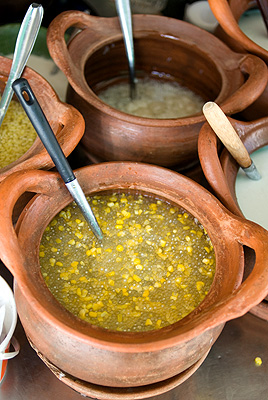
Although many visitors to Thailand rave about the street food, frankly, much of it is pretty mediocre. Much better, in my opinion, are the small mom and pop restaurants that specialize in one kind of dish, or perhaps a style of regional Thai cooking. They tend to be dark, difficult to find, and the owners can often be surly, but the food, man, the food... The above restaurant is a perfect example of this genre of restaurant. It's called Sukhothai Mor Din, literally "Sukhothai Clay Pots", so-called because their curries are served in the red pottery made just outside this northern city:

_DSC2801.jpg

These aren't just run-of-the-mill curries either. These curries are meant to be ladled over khanom jeen, fermented rice noodles. They had about eight different curries to choose from, and we ordered naam yaa paa, a watery fish-based curry, and naam ngiaow, a thicker northern-style curry made from pork ribs, tomatoes and chunks of blood:

_DSC2806.jpg

An order of any type of curry and khanom jeen is always accompanied by lots of fresh and par-boiled veggies and herbs:

_DSC2810.jpg

The green leaves in the foreground are called bai menglak (hairy basil?) and along with par-boiled morning glory, thinly sliced green beans and bean sprouts, are taken with the naam yaa paa. The naam ngiaow is normally eaten with pickled mustard cabbage, crispy fried garlic, shredded cabbage and squeeze of lime.

Other than curries, the clay pots also hold sweets:

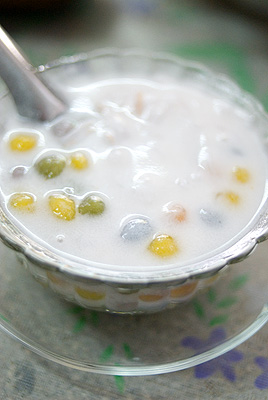
_DSC2818.jpg

I believe the above is sago with corn. I ordered sweetened sticky rice with lamyai, an indigenous fruit. Khuat ordered bua loy maphrao on, small, sweet balls with young coconut:

_DSC2821.jpg

Those not familiar with Thai sweets will be surprised to learn that the Thais actually prefer these kind of coconut milk-based sweets to also taste salty. I was aware of this, but was surprised at just how salty this shop's sweets were.

On my next visit I'm going to try the delicious-looking green curry with fish balls. Stay tuned...

Technorati technorati tags: , , , ,

Pot Thai

Several months ago I received an email from a writer who was working on a piece about Thai kitchen gadgets for the New York Times Style Magazine. To help her out, I did a blog entry describing some of the most emblematic tools in the Thai kitchen. Her article has just come out, take a look. (Incidentally, in the same issue there's also a cool "Style Map" of Hanoi (scroll to bottom of the page) courtesy of the Monsieur noodlepie himself, Graham Holliday, as well as an article about fancy French potatoes by Clotilde of Chocolate and Zucchini. Kinda makes you wonder what happened to all the real journalists, doesn't it?)

A bit of Portugal in Thailand

_DSC2648.jpg

Before you think I'm going out on a limb here, take a look at the above and tell me it doesn't look like a perfectly ordinary Thai meal!

There's actually quite a bit in common between Portuguese and Thai cooking. It was actually the Portuguese who introduced chilies (and many other ingredients) to Thailand in the 16th century. And although they didn't take to searingly hot food as much as the Thais did, both countries share a deep love for seafood, chicken, grilled foods and sweets, as you'll see below. Now if only they'd introduced vinho verde, good cheese and olive oil...

Regardless, I've been thinking a lot about Portuguese food lately. I like the emphasis on seafood and bread, and had recently gotten hold of a nice bottle of Portuguese olive oil that I wanted to put to good use. I had also come across several interesting-looking Portuguese recipes as of late, so I decided to put together a Portuguese meal using ingredients I could easily get here in Bangkok. Two dishes that immediately came to mind were frango no churrasco, Portuguese-style grilled chicken, and piri piri, the ubiquitous chili-based dipping sauce.

The two recipes below were taken and adapted from the Portugal volume of Lonely Planet's excellent World Food series. I have several of their World Food books, and find them an excellent introduction to the food of several different countries.

Frango no Churrasco (Char-grilled Chicken)

_DSC2655.jpg

2 large cloves garlic
1/2 tsp dried hot chili flakes
1/2 salt
2 Tbsp olive oil
1 medium free range chicken

1. Crush the garlic and mix with the chili, salt and oil. Set aside.

2. Remove and discard the chicken's neck and giblets. Wash the chicken in cold water and pat dry with a paper towel. Place the chicken breast-side-up on a chopping board and, using a large sharp knife, cut down the middle riht through to the board and all the way up to the neck. Open the chicken out and press it flat. Rub the flavoured oil all over both sides of the chicken. Cover and refrigerate to marinate overnight (or at least for a few hours) to allow the flavours the develop.

3. Prepare a moderately hot charcoal fire with a grill rack about 15cm above the coals. When the coals are white, lay the chicken on the grill with the skin side up and cook for 12 to 15 minutes, then turn the chicken over and grill the other side for a further 12 minutes or so, or until the chicken is browned. Remove and 'rest' the chicken in a warm spot, uncovered, for 10 minutes -- resting ensures the juices stay in the mean when it is cut.

Piri Piri (Red Hot Chili Pepper Sauce)

1/2 cup small dried chilies
3 cloves of garlic, chopped
1 tsp sea salt
1/4 cup white wine vinegar
1 cup olive oil

Put all the ingredients in a blender or food processor and process until combined. Put in a jar with a tight lid and leave in the fridge for a week.

The natural accompaniment to frango no churrasco and piri piri is batatas fritas, deep-fried potatoes. Despite this, I've always been intimidated by boiling oil, and my previous attempts at deep-frying were pretty abysmal. However I recently became interested in giving this style of cooking a second chance after reading the chapter called "Fries" in Jeffrey Steingarten's excellent book, The Man Who Ate Everything. In this book he gives a recipe (attributed to French master chef, Joel Robuchon) for frites that is so simple, it almost seems like he's playing a joke on us. I've adapted the recipe slightly, as I use a cold-pressed sunflower oil that's excellent for deep-frying (Steingarten suggests peanut oil--something unavailable in Thailand), and unless you're cooking for many people, I feel that measurements are superfluous.

Easy Frites

_DSC2653.jpg

potatoes
sunflower oil, at room temperature
salt

1. Wash and peel the potatoes (if desired), and cut them into the shape of your choice, keeping in mind that they will shrink when fried. Wash them briefly under cold water and dry with a cloth. Put them into a pan about 10 inches in diameter with sides at least 4 inches high. Just cover the potatoes with the oil.

2. Place the pan over the highest heat. The oil will begin to bubble, first softly and then furiously. Using long tongs, stir the potatoes to ensure that they cook evenly and that they don't stick to the bottom of the pan. By the time the oil reaches 350 degrees F., about 15 minutes, the potatoes will be a deep golden brown and should be ready to eat (Make sure that the oil temperature never exceeds 370 degrees F.).

3. Taste one or two. Drain and blot with paper towels. Salt the frites just before serving.

At this point, I already had some bubbling oil, and also happened to have a small bag of green beans, so I decided to try a recipe I'd come across in the fun section of Portuguese recipes at the excellent Leite's Culinaria. The dish below is called peixinhos da horta, which according to Leite's, is Portuguese for "little fish from the garden", as the dish resembles deep-fried fish that are popular in Portugal.

Peixinhos da Horta (Deep-Fried Green Beans)

_DSC2645.jpg

1/2 pound green beans
oil for frying
1/4 cup all-purpose flour
1/4 cup water
1 egg
1/2 tsp baking powder
3/4 tsp salt
1/4 tsp pepper

1. Cook the beans in a large pot of boiling salted water until crisp-tender, about 2 minutes. Drain, cool in a bowl of ice water, and drain again.

2. Heat the oil in a deep fryer or a large saucepan over medium-high heat to 350°F (175°C). Combine the flour, water, eggs, baking powder, salt and pepper in a large bowl; whisk until a smooth batter forms.

3. Dip six beans at a time into the batter, shaking off any excess. Add the beans to the hot oil and fry until golden brown, about 4 minutes per batch. Using tongs, transfer the beans to paper towels to drain. Sprinkle with more salt and serve hot.

Although I've heard that the Portuguese aren't too big on fresh greens, I also included a salad:

_DSC2644.jpg

The dressing for this (as well as the marinade for the chicken) was made with an excellent Portuguese olive oil I was able to find here in Bangkok, Herdade do Esporão Virgem Extra D.O.P. This is significantly cheaper than the high-end Italian oils available here in Bangkok, but was still very nice, with a slightly spicy flavour, perfect for my:

Portuguese-Style Vinaigrette

3 Tbsp apple cider vinegar
2 pinches salt
good quality Portuguese extra virgin olive oil
1 large clove of garlic

Put the apple cider vinegar in a deep heavy plastic or ceramic bowl. Add salt and using a whisk, mix until salt is dissolved. Add olive oil in a thin stream, whisking constantly. After having added about 3 Tbsps of olive oil, taste the dressing. Stop here if it tastes good to you, or continue adding more olive oil until you reach a taste that you like. Split the garlic clove and add to the dressing. Let the vinaigrette "season" at room temperature for at least an hour.

And finally, there was dessert:

_DSC2667.jpg

The treats above were brought at Or Tor Kor Market in Bangkok, and are the kind of traditional Thai desserts that one could find almost anywhere in the country--a seemingly un-Portuguese end to our meal. Actually though, the practice of making desserts out of egg yolks and sugar was originally introduced to the Thais by--you guessed it--the Portuguese. In the foreground are foy thong, "golden threads" (fios de ovos in Portuguese) and behind these, thong yip, "pinched gold", named for their colour and the way they're formed. For more on the Portuguese influence on Thai food, check out this piece I wrote for ThaiDay several months ago.

Technorati technorati tags: , , , ,

Ram-Saep

I had been entertaining big plans to go back to Baan Chan, a promising restaurant serving the food of Chanthaburi province that I have previously mentioned in this very forum. Well, this morning I finally found the time to go there, only to arrive and find that they're closed on Sundays... In a fit of desparate hunger, we scrambled to what was virtually the nearest restaurant, an outdoor joint called Ram-Saep. Ram is the northern Thai dialect word for delicious, and saep the isaan or northeastern equivalent (central Thais say aroy), so called because this restaurant serves both northern and northeastern Thai food.

This being northern Thai, I couldn't resist ordering laap khua:

_DSC2621.jpg

Regular readers might have noticed that I'm pretty obsessive about my laap khua. Ram-Saep's was good effort, with more or less the requisite flavours and textures, but nothing compared to the work of a laap khua master like the good people at Laap Khom Huay Puu (scroll down a bit).

Next was nam phrik nam puu:

_DSC2613.jpg

This is a 'dip' made from the small black crabs that are found in the rice fields of SE Asia. The crabs are crushed and boiled down into a thick black sludge that more or less tastes like you imagine boiled crab sludge would. Bitter is the main flavour here, and if you're not a fan of this taste you probably won't be writing the people at home abou the nam phrik naam puu. The dip was served with sides of cripy veggies and deep-fried pork for dipping.
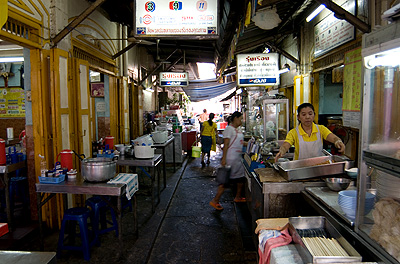
There was jor phak kaat, a soup of a leafy green veggie popular in northern Thailand:

_DSC2617.jpg

This was my personal favorite dish of the day. The broth was sour with healthy chunks of garlic and the vegetable was just undercooked and pleasantly crunchy.

Moving to issan food, we ordered kai yaang, grilled chicken:

_DSC2607.jpg

and a mighty good one at that. The dish featured a reasonably scrawny chicken (this is a good thing) with fatty skin that was rubbed with crushed garlic, coriander roots and black pepper, rendering the dipping sauce unecessary. Delish.

And finally, a som tam, green papaya salad:

_DSC2611.jpg

which was served in a cute mini mortar. This dish was mediocre, being a bit too sweet for my taste, and bordering on the souplike.

Ram-Saep is of the outdoor 'garden' restaurant variety, which means rustic bamboo furniture, loud live music and stray dogs begging for your scraps. This sort of atmosphere is best appreciated at night, when it's cooler and you have some time to throw down a few cold beers with your meal.

Ram-Saep
02 909 2850

Jay

_DSC2539.jpg

Every year at October, many Thais of Chinese origin choose to wear white, abstain from eating meat (and garlic and alcohol), and spend lots of time at the temple. Apparently there are significant historical and religious reasons behind all this, but we're really only interested in the food, aren't we?

And there's much to be had at this week-long festival. Many restaurants choose to serve only vegetarian food (known in Thai as ahaan jay), advertising their choice by flying the yellow flag seen above. Not all of the food is very good, but it's a fun time to try new things that aren't normally available. I happened to be in Yaowarat, Bangkok's Chinatown, the center of much of this meat-free madness, and did some exploring. I started the day with a tasty dish of kwaytiaow lord:

_DSC2533.jpg

hearty rice noodles topped with a few different kinds of tofu and bean sprouts. This was accompanied by a to-go bag of delicious deep-fried spring rolls:

_DSC2531.jpg

These two dishes more or less set the tone of the day, as despite this being a vegetarian festival, there are surprisingly few vegetables to be seen. Starchy stuff such as noodles:

_DSC2506.jpg

and steamed buns:

_DSC2522.jpg

make up the bulk of this "vegetarian" cuisine. Apparently the Chinese have a difficult time parting with their beloved flesh, making their vegetarian food as similar to meat possible, as illustrated in the astonishingly lifelike "duck" meat below:

_DSC2579.jpg

as well as the wide variety of amazingly realistic vegetarian "meats" for sale at talaat mai, Chinatown's main market:

_DSC2544.jpg

It's hard to see, but above are veggie "shrimp", veggie "salted fish", and believe it or not, vegetarian pork intestines!

Continuing along Thanon Yaowarat, Chinatown's main street, there was lots to see, including people making deliciously crispy peanut snacks:

_DSC2520.jpg

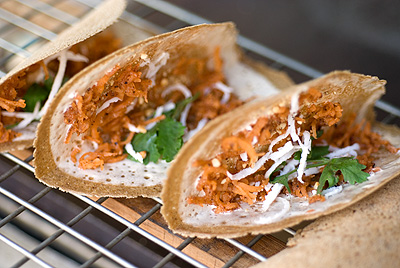
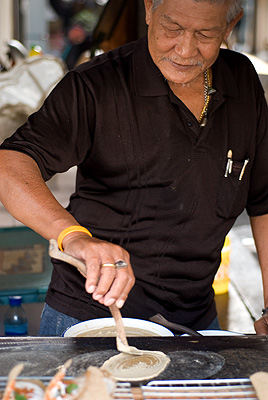
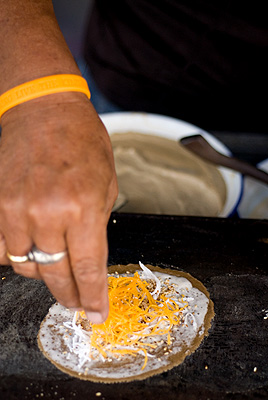
crepe-like snacks made from a light batter poured through a seive:

_DSC2512.jpg

and a huge pot of sangkhayaa, egg and coconut milk dipping sauce for paa thong ko, Chinese-style deep-fried dough:

_DSC2507.jpg

I even came across an entire stall selling an array of northern Thai dishes, all made without meat:

_DSC2517.jpg

including the famous northern curry kaeng hang lay, which was made with vegetarian pork belly!

I headed over to Wat Mangkon Kamalawat, Chinatown's most sacred temple, and a centre of activity for this festival. There were lots of people in white praying:

_DSC2565.jpg

and lighting incense:

_DSC2574.jpg

And there was even food available right at the temple. I ordered my favourite jay dish, yellow noodles fried with veggies:

_DSC2577.jpg

Which, if you'll look closely, even included some fresh greens! It was, I felt, an appropriate end to a day spent going veggie.

A few bonus pics can be seen here.

Flava

I must begin by admitting that I'm really lagging behind on this one; Chubby Hubby scooped me by visiting Flava, the brand-new Dream Hotel's funky Thai restaurant, several weeks ago. You can see his description and wonderful pics here. But I already had plans to visit the restaurant for an article I was working on, and thought it would be fun to couple this with a blog on my meal.

All meals at Flava start with a complimentary dish of khao tang na tang:

_DSC1702.jpg

This is essentially puffed rice crackers served with a dipping sauce. I normally like this dish, but when I saw the recipe that Chubby Hubby had got from Flava's chef, I was pretty skeptical. The inclusion of red curry paste makes it seem like the kind of Thai dish inspired by a recipe on the back of a box of American Pad Thai Noodles. It was better than that, although it still lacked the salty savouriness that this dish should have.

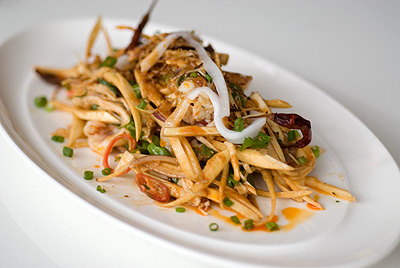
Our meal proper started with Yam chao suan, a "salad" of banana flower and young coconut with prawns and shredded chicken:

_DSC1713.jpg

This odd combination of ingredients was, well... odd, but not bad. I'm not a big fan of banana flower to begin with, so the tart, astringent taste didn't really win me over. It looks lovely though, doesn't it?

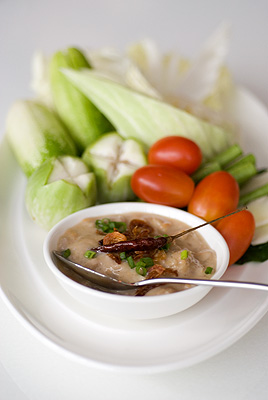
In an effort to order something slightly unusual, I chose Lon ta jiew:

_DSC1719.jpg

This dish, a savoury "dip" of fermented soybeans, coconut milk and fresh herbs, is a really Thai dish that one doesn't normally see on too many menus. Flava's version was just OK, definately nothing to write home about. The requisite saltiness of the fermented soybeans just wasn't there, and there was little hint of the lemongrass, kaffir lime leaf, galingal and other fresh herbs that should be in full force here. And the selection of veggies served along with the dish was pretty dull.

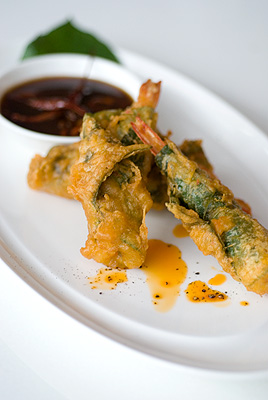
Next was Bour thot goong, shrimp wrapped in bai cha phluu, wild tea leaf, and deep-fried a la tempura:

_DSC1715.jpg

A fun, and well-prepared dish.

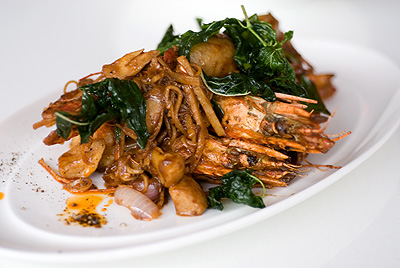
We also had Goong tom yam hang, a "dry" tom yam consisting mostly huge prawns:

_DSC1723.jpg

At this point, you might have noticed a trend: prawns. Upscale Thai restaurants tend to unmercifully unload prawns on their diners. My theory on this is that in the West, prawns, at least large, good-quality ones, are very expensive, and chefs here can easily wow foreign diners (who constitute the vast majority at upscale Thai restaurants--Thais eat elsewhere) by including them at every turn. To the restaurant's credit, the prawn dishes were all done very well, including the above, and it was probably our own fault for ordering so many dishes that included them. But like many upscale Thai restaurants, the menu seemed to be dominated by this one ingredient.

The hands-down winner of the meal was the Geang prik kraduk moo, "Pork spare ribs braised in black peppercorns and red curry":

_DSC1732.jpg

This is a variant of a southern Thai dish, and it was clear that the chef was confident about this one--not a surprise as Flava's Sous Chef is a native of Phuket. The curry was spicy, but it was the warmth of black pepper, rather than the burn of chilies. The pork was tender, and as you can see, the herbs are there in full force. I can still taste this one.

Flava's dining room is super funky, and I loved the unorthadox presentation of the dishes, especially the splashes of turmeric-laced oil and the grindings of black pepper. I'd recommend it to novice Thai diners, or to those looking for solid and tasty, but not exceptional Thai food, in an exceptional setting.

Flava
Dream Hotel
10 Sukhumvit Soi 15, Bangkok
02 254 8500
www.dreambkk.com